
Austin Hooper, NFL Tight End: Career Timeline, Stats, and the Atlanta Homecoming
From San Mateo to Stanford – Without a Scholarship
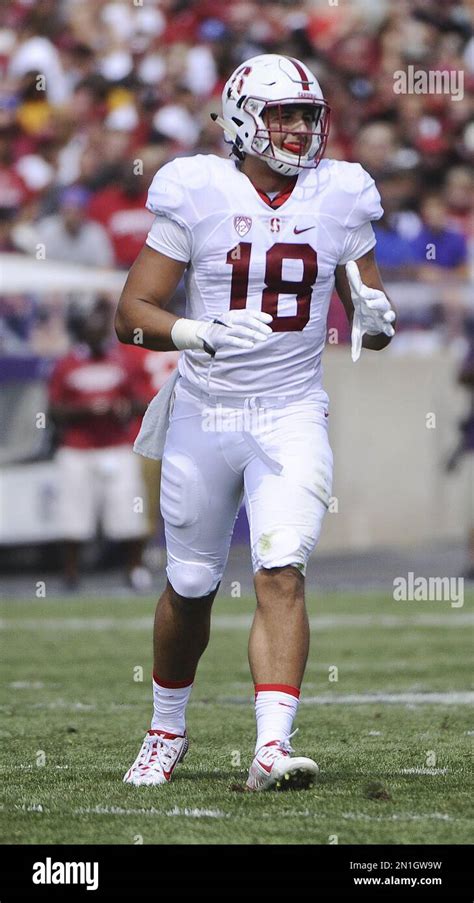
Austin Manuel Hooper walked onto Stanford’s football program in 2013 as an unrecruited freshman from De La Salle High School in Concord, California. No scholarship. De La Salle went 15-0 that year and was ranked number one nationally by both ESPN and MaxPreps the season before, so the talent around Hooper was obvious – what took longer to establish was his place in it.
By his sophomore season at Stanford in 2015, he had 34 receptions for 438 yards and six touchdowns, earned First-team All-Pac-12 honors, made the All-American third team, and was named a finalist for the John Mackey Award, which goes to the best tight end in college football. Two seasons total, 74 catches, 937 yards, eight touchdowns. Then he declared for the draft.
His combine numbers held up: 4.72 in the forty, an agility score in the 80th percentile. Not elite speed, but real athleticism. The Atlanta Falcons took him 81st overall in the third round of the 2016 NFL Draft.
His father Michael played football at San Diego State. One uncle, Greg, played fullback at Stanford from 1979 to 1982. Another uncle, Chip, played professional tennis. His brother Justin played baseball at UCLA and was drafted by the Kansas City Royals in the 14th round in 2019. The Hoopers were not producing accountants.
Atlanta, 2016 to 2019: The Years That Defined Him
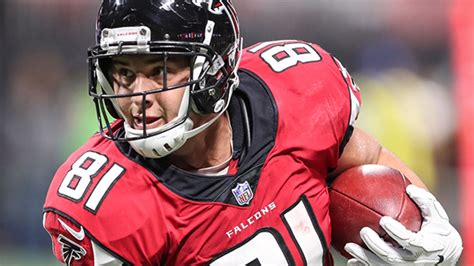
In his rookie season, Hooper caught 19 passes for 271 yards and three touchdowns in the regular season. Then the Falcons made the Super Bowl, and he started the NFC Championship game against Green Bay and caught a 19-yard touchdown from Matt Ryan in Super Bowl LI. The Falcons led 28-3 and lost. He was 22 years old.
The following September, Week 1 at Chicago, Ryan threw him an 88-yard touchdown. It remains the longest reception by a tight end in an NFL season opener in league history. Hooper finished that game with two catches for 128 yards.
What happened over the next two years was a genuine breakout. In 2018: 71 catches, 660 yards, four touchdowns, first Pro Bowl. In 2019: 75 catches, 787 yards, six touchdowns, second Pro Bowl. He finished that season inside the top five in target separation among all tight ends, a metric that reflects how cleanly a receiver gets open rather than just how many targets he sees. He also tied Tony Gonzalez’s franchise records for consecutive games with four-plus catches and consecutive games with a receiving touchdown by a tight end – four straight in both cases.
Ryan described him mid-2016 as “so California cool, it’s unbelievable.” By 2019, Ryan was calling him reliable in congested situations and crediting him for running with the ball after the catch. Four seasons, 214 catches, 2,244 yards, 16 touchdowns.
Then Hooper hit free agency as one of the better tight ends on the market, and the Cleveland Browns paid for it.
Cleveland, Tennessee, Las Vegas, New England – Four Stops in Five Years
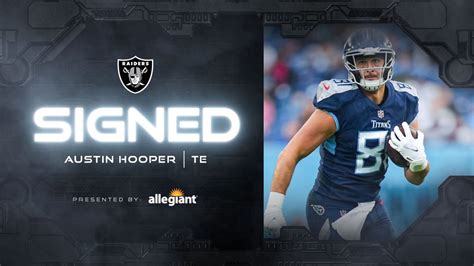
In March 2020, Hooper signed a four-year, $44 million deal with Cleveland. Head coach Kevin Stefanski said he “right away checked a lot of boxes” and cited versatility and scheme familiarity as the reasons. What followed was two productive but unspectacular seasons: 84 catches, 780 yards, seven touchdowns. The Browns ran the ball heavily under Stefanski; Hooper was part of the offense but not the center of it. He was released in March 2022.
Tennessee in 2022: 41 catches, 444 yards, two touchdowns across 17 games. Las Vegas in 2023 – a rotational year with the Raiders, his eighth season in the league. Then New England picked him up in March 2024.
With the Patriots in 2024, playing behind Hunter Henry, Hooper caught 45 passes for 476 yards and three touchdowns. The following season – 2025 – he was more of a depth piece: 21 catches, 263 yards, two touchdowns in 16 games, plus three more catches for 24 yards across four playoff games as the Patriots reached the Super Bowl and lost to Seattle. He was on the field for 46 percent of offensive snaps. That context matters for understanding what happened next.
Drake Maye connected with him on some critical downs, including a 38-yard touchdown that NFL Network highlighted as a can’t-miss play. For a player entering his 10th season, being useful to a young quarterback in a playoff run is not nothing.
What Kind of Player Is He, Actually
The honest version: Hooper at his peak was a top-five tight end who could win in traffic, create separation without elite speed, and contribute as a blocker on runs. The 2018-2019 version would have been a featured option on most NFL rosters.
The 31-year-old version returning to Atlanta in 2026 is something different. He’s a two-way tight end who can stay on the field in all three downs, catch the ball reliably in short and intermediate areas, and give a quarterback a safe option when the play breaks down. His target separation numbers from his Atlanta prime suggest the route-running was always technically sound – it’s the volume and offensive context that changed, not his hands.
What he can’t do anymore is carry a passing game when targeted 80-plus times in a season. That was a specific window, and it closed somewhere around Cleveland. At 21 catches on 26 targets in 2025 – 80.8 percent catch rate – he was efficient but limited by design. The role fit. He took it seriously. That says something about how he’s adapted.
One thing that gets overlooked: he walked on at Stanford and played 27 games for the Cardinal across two seasons without ever being given anything. The professional version of that trait – adapting to depth charts, staying ready – has let him play meaningful football well past the age when most tight ends with his injury history (he missed time in 2019) have been cut.
Back in Atlanta: The 2026 Signing
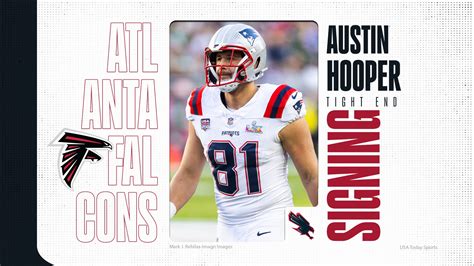
On March 9, 2026, Ian Rapoport reported Hooper was headed back to Atlanta. The deal: one year, $3.25 million. He had signed with the Patriots the previous offseason for $5 million including a $2 million signing bonus, so this is a pay cut, but not a desperate one.
The reunion makes more sense than it might look on the surface. Matt Ryan, Hooper’s quarterback during his two Pro Bowl seasons, is now Atlanta’s president of football. Kevin Stefanski, who signed Hooper in Cleveland and ran a tight-end-heavy offense there, is the Falcons’ new head coach. Tommy Rees is the offensive coordinator. The people who know Hooper best are the ones running the organization, and Stefanski specifically has a documented preference for 12 and 13 personnel – two or three tight end sets.
Kyle Pitts is the featured option at the position. Hooper slots in behind him. With Drake London, Jahan Dotson, and Olamide Zaccheaus also on the roster, Atlanta’s offense has some real pieces around whichever quarterback – Tua Tagovailoa or Michael Penix Jr. – wins the starting job. Hooper isn’t the reason they’ll score touchdowns; he’s the reason they won’t be stuck in third-and-long when the first option disappears.
When Hooper spoke at his press conference after signing, he said: “Just like when I was drafted, I am super excited to be a Falcon again. I still have my love for the game, just like I did when I was 21.” The building he walked into was different – weight room is two stories now, the locker room rebuilt – but he recognized enough of it.
He last played for the Falcons in 2019. That was the last year Atlanta made the playoffs.
The Foundation, the Family, and Everything Else

Hooper started the Austin Hooper Foundation to support children in foster care, with particular focus on young people aging out of the system at 18 – a point where institutional support typically disappears and outcomes deteriorate sharply. It’s a specific, unglamorous cause, and he’s been involved in it throughout his career with far less fanfare than athletes who attach their names to broader, higher-visibility charities.
His brother Justin, who played at UCLA, was drafted by the Kansas City Royals in 2019. His father played at San Diego State. His uncle Chip played professional tennis on the circuit. The family is not short on competitive experience, which might explain why Hooper never seemed rattled by roster changes or depth chart situations that would have rattled someone who hadn’t grown up around that kind of professional pressure.
Career Statistics, Team by Team
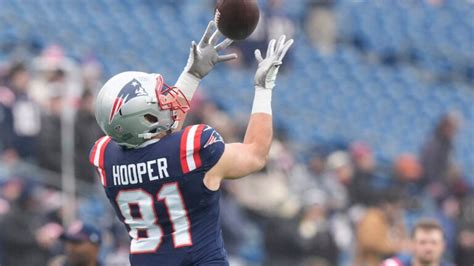
Across 155 career regular season games through 2025, Hooper has 430 receptions for 4,441 yards and 30 touchdowns. Here is the breakdown by team and season:
| Year | Team | G | REC | YDS | TD |
|---|---|---|---|---|---|
| 2016 | Atlanta Falcons | 16 | 19 | 271 | 3 |
| 2017 | Atlanta Falcons | 16 | 49 | 526 | 3 |
| 2018 | Atlanta Falcons | 16 | 71 | 660 | 4 |
| 2019 | Atlanta Falcons | 13 | 75 | 787 | 6 |
| 2020 | Cleveland Browns | 13 | 46 | 435 | 4 |
| 2021 | Cleveland Browns | 16 | 38 | 345 | 3 |
| 2022 | Tennessee Titans | 17 | 41 | 444 | 2 |
| 2023 | Las Vegas Raiders | 16 | – | – | – |
| 2024 | New England Patriots | 16 | 45 | 476 | 3 |
| 2025 | New England Patriots | 16 | 21 | 263 | 2 |
His best statistical stretch was 2018 and 2019. Those two seasons alone account for 146 catches, 1,447 yards, and 10 touchdowns – roughly a third of his career totals in two years out of ten.
Since 2016, he ranks sixth among tight ends in career receptions. That’s a number that holds up without qualification. He played in a lot of games on a lot of teams and kept catching passes reliably regardless of who was throwing them.
Comments