
Trey Amos, Washington Commanders Cornerback: From New Iberia to the NFL
Trenayvian “Trey” Amos is a cornerback for the Washington Commanders. He was born March 3, 2002 in New Iberia, Louisiana, drafted 61st overall in the second round of the 2025 NFL Draft, and became a starter for Washington before a fractured fibula ended his rookie season in Week 10. He stands 6-foot-1 and weighs 190 pounds. His jersey number is 23.
New Iberia, Louisiana: Where the Athlete Came Before the Cornerback
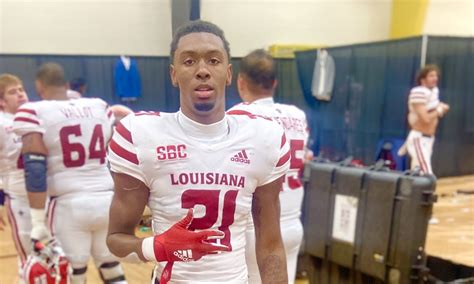
Catholic High School in New Iberia, Louisiana is a small program. They play in the Louisiana 2A division. Amos was not a cornerback-only prospect there. He played both quarterback and cornerback, ran a 11.49 in the 100-meter dash, and won the Louisiana state championship in the long jump with a jump of 22 feet, 9.75 inches. He was the state runner-up the year before at 21-11.5.
As a junior, he accounted for 1,583 rushing yards and 31 rushing touchdowns. Add 736 passing yards and nine more scores. Catholic went 14-3 that year and lost the Division III State Championship Game. They won the District Title his senior year.
Recruiting services ranked him a three-star prospect. ESPN gave him a 73 out of 100. He was the 1,448th recruit in his class according to 247Sports. Louisiana-Lafayette offered him, and so did Tennessee, LA Tech, and a few Sun Belt programs. He committed to Louisiana.
The part that gets overlooked in most draft profiles: a kid who wins a state championship in the long jump at 22-plus feet is not a coverage-first prospect being asked to run. He is a legitimate athlete who happens to play football. The Combine numbers four years later made more sense once you know that.
Three Schools, Five Years, One Destination
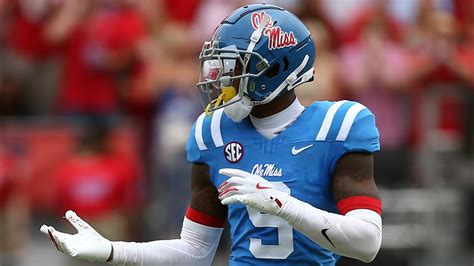
Amos spent three seasons at Louisiana-Lafayette (2020-2022). The Sun Belt is not the SEC, but it is not nothing either. He accumulated enough snaps there to enter Alabama in 2023 as a player who had seen real college football. At Alabama, he was a rotational piece. He started one game in 14. Most scouts didn’t give him much of a look.
Then he transferred to Ole Miss for 2024, and everything changed.
He started all 13 games for the Rebels. He finished the season as the SEC leader in total passes defended with 16 and in passes defended per game at 1.23. Both numbers ranked in the top five nationally. His 13 pass breakups were the most by an Ole Miss player since 2015. He tied for the team lead with three interceptions, added 3.5 tackles for loss, one forced fumble, and 50 total tackles.
PFF graded him as the 50th overall defender across all positions in the country. Not the 50th cornerback. The 50th defender. His coverage grade was 85.6, ranking eighth in the SEC. His forced incompletion rate exceeded 20 percent for three straight seasons. That last number is the one that should stick: it means that across three different programs, against three different levels of competition, he was consistently hard to complete passes against.
He earned First Team All-SEC honors. Ole Miss named him one of the centerpieces of what they called one of the best defenses in program history.
The 2025 NFL Draft: Why Washington Took Him at No. 61
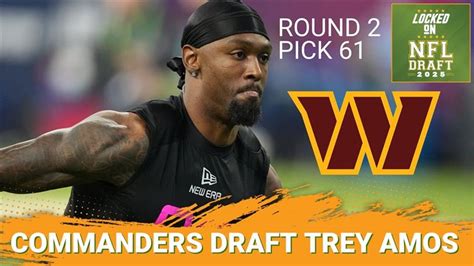
At the 2025 NFL Combine, Amos ran a 4.43 in the 40-yard dash with a 1.6-second 10-yard split. His relative athletic score came out at 8.37 out of 10, which PFF’s draft network noted was closely comparable to A.J. Terrell of the Atlanta Falcons. His 32-inch arms helped him test as a prototypical boundary cornerback on paper.
NFL.com analyst Lance Zierlein wrote that Amos “can disrupt the release and plays with good short-area movement in man coverage.” He noted the occasional issues at the top of routes and a tendency toward indecisiveness in zone, but called him a player who “uses physicality and length to shrink the 50/50 odds in his favor.”
Pro Football Network’s Ian Cummings had him ranked as a top-25 talent and projected him going to the Rams at No. 26 overall. The consensus across draft analysts placed him somewhere in the late first to early second round. Several outlets called the Washington pick a steal when it happened.
The Commanders needed cornerback help badly. Their secondary had ranked 30th in PFF’s end-of-season grades for 2024. Washington already had Mike Sainristil from the 2024 draft, but they needed a player who could hold down the opposite boundary spot in a press-heavy scheme. Amos fit that description more cleanly than anyone else available at 61.
He was also the highest-drafted Ole Miss defensive back since Senquez Golson went 56th overall to Pittsburgh in 2015, and the first Ole Miss player drafted by Washington since running back Joe Mickles in 1989.
General manager Adam Peters later said the Commanders had considered Amos in the first round. That quote surfaced after the draft. It was not the usual front-office spin: the pre-draft analysis from outside the building supported it.
What Amos Actually Does on a Football Field
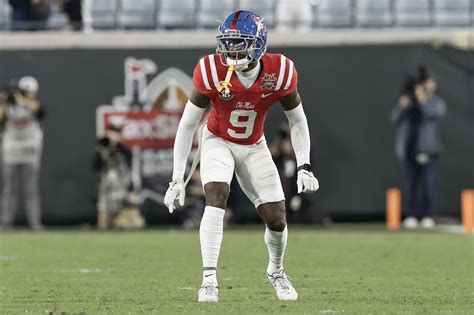
The most consistent thing in every scouting report written about Amos is the hip mobility. Big cornerbacks, the 6-foot-1 and above group, tend to be stiff. Their turns are late, their redirects mechanical. Amos is loose. He can flip his hips and run with a route without the kind of hesitation that kills coverage on double-moves. On Tap Sports Net’s detailed profile gave him a relative athletic score of 8.37, comparable specifically to Terrell, who became one of the better outside corners in the NFL once he had a few seasons of professional coaching.
In press coverage, he jams at the line and controls the release point. Receivers don’t just run free past him off the snap. He plays the hands. He gets into bodies. His 20-plus percent forced incompletion rate across three seasons reflects that: when quarterbacks do throw at him, the completion rate drops.
His 2024 allowed completion rate was 51 percent. His passer rating allowed was 54.5. Both numbers are legitimately good for a college corner, not just good relative to the Sun Belt.
The weaknesses are real, though. In zone coverage, he can lose track of route combinations. His zone instincts are solid at the surface level but break down against more complex designs. His tackling in open space is inconsistent, with a tendency to use his arms instead of his body. And his physicality at the line, a strength in college, could cost him in the NFL if he doesn’t refine the hand placement. Illegal contact calls come for corners who play that way without adjustment.
The Draft Network’s scouting report put it plainly: “The primary concern with Amos is the potential for penalties stemming from his physicality in coverage.” That’s a fair warning. Plenty of press corners have arrived in the NFL with better college grades than their first two professional seasons suggested, precisely because referees enforce contact rules more strictly at this level.
His Rookie Year With the Washington Commanders
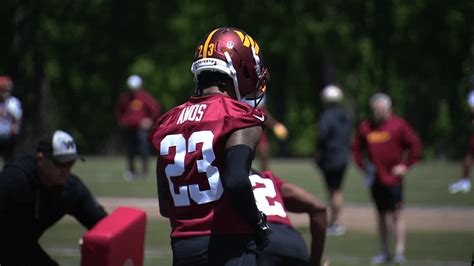
Before the season started, Nicki Jhabvala of The Athletic predicted five rookie interceptions for Amos. That is not a modest prediction. Only three Washington defensive backs had reached five picks in their first NFL season since the AFL-NFL merger: Tom Carter in 1993, Champ Bailey in 1999, and Fred Smoot in 2001. NFL.com’s Gennaro Filice named him to his pre-season All-Rookie team. Steve Wyche of NFL Network called him “the talk of camp.”
He started eight of ten games, played 511 defensive snaps, recorded 32 tackles (19 solo), six passes defensed, and one stuff. Washington’s coaching staff had him on the boundary opposite Sainristil, and he was often the better of the two when both were healthy and on the field at the same time.
His PFF overall grade for the season was 55.8, with a 58.8 coverage mark. Those are mediocre numbers. But the distribution matters more than the average: he graded 68.5 or above in coverage in five of his ten games. His lockdown rate for the season was 51.43 percent, which ranked 26th among all NFL cornerbacks. He broke up 17.6 percent of his targets. Those two numbers, particularly the lockdown rate, are not consistent with a 55.8 overall grade. The bad games pulled the number down. The good games showed something different.
In Week 10 against the Detroit Lions, he fractured his fibula trying to tackle running back Jahmyr Gibbs. He was placed on Injured Reserve shortly after. Season over. He had played 511 snaps before it happened.
The honest assessment: this was not the rookie year Washington wanted for him. The five-interception projection was not close. The PFF grade was below league average. But a 51st-percentile lockdown rate as a rookie cornerback starting on an NFL boundary, on a defense that was being rebuilt around him, is not a bad foundation. It is not a great one either. It is a starting point.
The Fibula, the Recovery, and What Comes Next
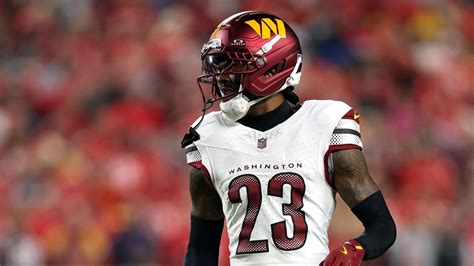
A fibula fracture is not a soft-tissue injury. It heals. The standard recovery timeline for an NFL player is four to six months, which puts a player back on the field well before a following training camp opens. Amos has a full offseason ahead, and there is no reported complication from the break.
Washington’s defensive coordinator heading into 2026 is Daronte Jones, who replaced Joe Whitt Jr. Jones built his reputation working with secondary players. He spent time at LSU and Minnesota developing corners and safeties, and his defenses have historically asked cornerbacks to do more, not less. That is either good or bad for Amos depending on whether the scheme fits. The early reporting suggests it does.
The other change is subtraction. Marshon Lattimore and Noah Igbinoghene are both gone. The starting spot across from Sainristil belongs to Amos. Washington signed Amik Robertson on a two-year deal worth $16 million and added Ahkello Witherspoon, but Robertson projects as the slot option, not the other boundary starter. Amos will get snaps as a true outside corner on a team that expects to compete in the NFC, starting in 2026.
PFF named him to their 2026 All-Breakout Team. PFF analyst Bradley Locker wrote about the gap between his season-long grade and the underlying coverage metrics: the lockdown rate, the 17.6 percent target breakup rate, the five games above 68.5 in coverage. His argument is that the number that pulls a grade down, a blown coverage that goes for 40 yards, is more correctable than the fundamentals. The fundamentals, Locker believes, are already there.
A.J. Terrell is the comparison most analysts reach for. Terrell went 26th to Atlanta in 2020, had a mixed first year, and became one of the cleanest man-coverage corners in the league by 2022. The athletic overlap between Terrell and Amos is documented. What’s harder to map is whether the mental adjustment, the coverage discipline, the penalty avoidance, follows the same path at the same speed. That part is unverifiable until he plays.
One thing worth sitting with: the best game of Amos’s rookie year, at least by PFF’s tracking, came against Kansas City in late October. Xavier Worthy had one catch for six yards when matched against Amos. Jordan Love couldn’t find Amos’s receiver in the passing game in Green Bay the week before that. Those are not random opponents. Those are the kinds of games a 55.8-grade player is not supposed to win. He won them.
Comments