
LaVar Arrington and the Washington Redskins: The Rise and Ruin of Number 56
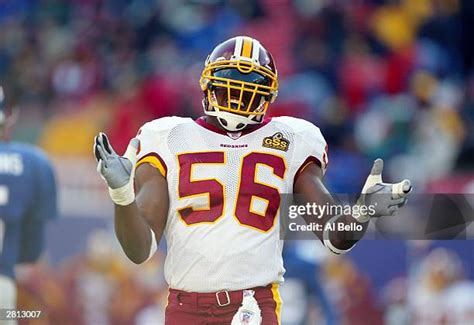
In December 2003, the Washington Redskins rushed an eight-year, $68 million contract extension across the table to LaVar Arrington. The deal was completed fast – too fast – because the team was scrambling to beat a salary cap deadline. Arrington’s agent, Carl Poston, initialed every page without reading the final draft carefully enough. A $6.5 million bonus had quietly vanished from the document. Nobody caught it until after both sides had signed.
That one transaction did more damage to Arrington’s Washington career than any injury ever could. And there were a lot of injuries.
This is not a story about a player who failed. It’s a story about a player who was genuinely great, for a few years, in a city that badly needed him – and then watched everything unravel for reasons that never had much to do with football.
From Pittsburgh to Penn State
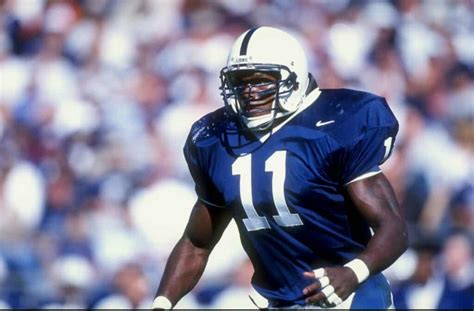
Arrington grew up in Pittsburgh, Pennsylvania, attending North Hills High School where he played both fullback and linebacker. That detail matters more than it sounds. Most elite linebacker prospects are built for one position by the time they’re 16. Arrington was legitimately dangerous at two, which told scouts something about his football IQ before they ever timed his 40.
He chose Penn State over a pile of offers and arrived in 1997 as exactly the kind of player the program needed. By 1998 he was First-Team All-Big Ten. By 1999 he swept the major defensive awards – the Chuck Bednarik Award, the Butkus Award, and the Jack Lambert Trophy, all in a single season. The unanimous All-American designation followed. Three awards in one year is not routine; it had been years since any college linebacker had pulled that off.
The “LaVar Leap” became a SportsCenter fixture during his Penn State years. He would literally vault over offensive linemen to disrupt plays, pressure quarterbacks, or just make the crowd lose its mind. It looked reckless. It worked constantly. In three seasons with the Nittany Lions he recorded 173 tackles, 39 tackles for loss, and 19 sacks. He declared after his junior year, and there was no serious debate about whether he was ready.
The 2000 NFL Draft and What Washington Expected
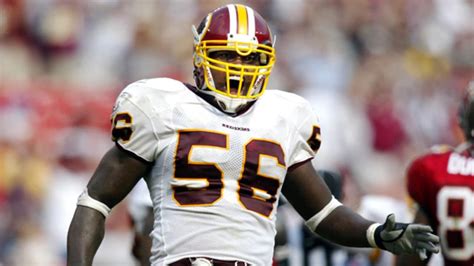
The Redskins held the second overall pick in the 2000 draft. The first pick went to Cleveland, who took Courtney Brown. Washington called Arrington’s name without hesitation.
At 6-foot-3 and 257 pounds, he was the kind of prospect that made defensive coordinators rearrange their schemes to fit the player rather than the other way around. The expectation in Washington was not modest: fans and writers talked about him in the same breath as Lawrence Taylor and Sam Huff. Huff, a Hall of Fame linebacker and longtime Redskins broadcaster, actually struck up a friendship with Arrington shortly after he arrived. That kind of connection – between a franchise icon and an incoming star – doesn’t happen by accident.
Washington’s defense had been inconsistent for years. Arrington was supposed to fix that. He was supposed to be there for the next decade.
Three Pro Bowls and What Made Him Actually Good
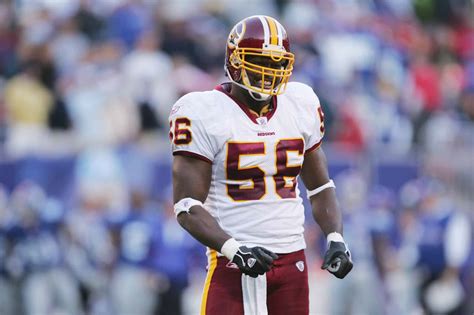
From 2001 through 2003, Arrington was one of the best linebackers in the NFL. Not one of the most hyped – one of the best, demonstrably, based on what he actually did on the field.
Three consecutive Pro Bowl selections. Two Second-Team All-Pro designations, in 2001 and 2003. He led the NFL in co-forced fumbles in 2003. Over his six seasons in Washington he recorded 23.5 sacks, which is a significant number for an outside linebacker who also spent meaningful snaps in coverage and run support. His career totals across all seven NFL seasons: 417 combined tackles, 38 pass deflections, 10 forced fumbles, 7 fumble recoveries, 3 interceptions.
What the numbers don’t fully capture is how he played. Arrington was the kind of defender who changed what an offense could attempt, not just what it could complete. Offensive coordinators spent preparation time designing ways to keep him away from the ball, which in practice meant a lot of chip blocks, motion shifts, and extra tight ends on his side. That’s influence. The 2001 Redskins defense ranked seventh in yards allowed. Arrington was its engine.
By 2004, NBC News called him the most prominent athlete in the Washington area. He was giving away his shoes and socks to fans at training camp – literally standing barefoot in the mud for 45 minutes after a long double-practice day, signing autographs and posing for photos. Washington hadn’t had a defensive player command that kind of affection since Huff’s era. Whether that comparison holds up is genuinely debatable, but the affection was real.
The Contract Dispute That Broke Everything
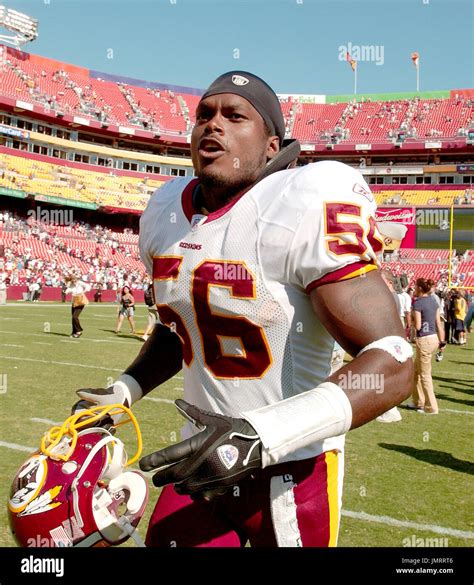
Arrington signed the extension in December 2003. By early 2004, he and Poston were claiming the Redskins had agreed to a $6.5 million bonus that didn’t appear in the final document. The Redskins denied it. Poston had initialed every page.
The NFLPA eventually suspended Poston for two years over the mishandling. Arrington, notably, did not support that punishment – a complicated position that his critics at the time didn’t fully acknowledge. He filed a formal grievance, the arbitration got postponed repeatedly, and what should have been a clean professional relationship between a franchise player and his team became 18 months of litigation and public sniping.
The settlement, finalized in August 2005, gave Arrington roughly half the disputed amount through a structure that allowed him to void the contract if he made two Pro Bowls in the next four years, at which point the Redskins could pay him a $3.25 million buyout. He never got close. The knee injuries saw to that.
What’s strange, looking back, is that the Redskins had paid Arrington well – over $33 million across his six seasons in Washington. The dispute was not about a player being underpaid by a cheap organization. It was about a transaction that got botched in the final hour by someone who didn’t read what he was signing. The whole saga had a quality of self-inflicted stupidity that made it hard to assign blame cleanly to either side, and most accounts at the time tried anyway.
Joe Gibbs, Gregg Williams, and the End of the Line
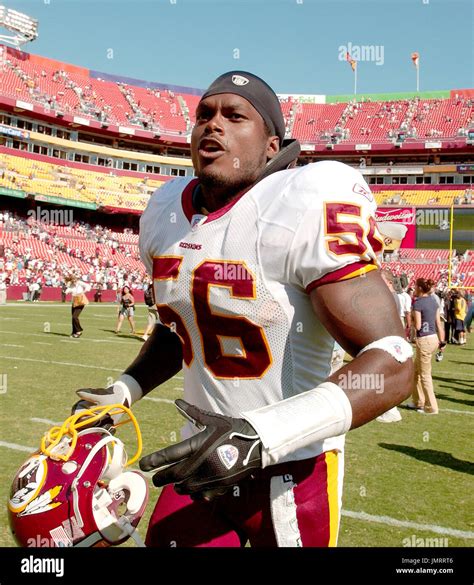
When Joe Gibbs came out of retirement to coach Washington in 2004, the narrative was obvious: Hall of Fame coach, young Pro Bowl linebacker, the Redskins were about to get very good. Gregg Williams, his defensive coordinator, ran a blitz-heavy scheme that should have been a perfect fit for Arrington’s style.
It didn’t work out that way. Arrington injured his knee in early 2004 and played only four games. In April 2005, after a second knee procedure, he publicly criticized the Redskins for not promptly disclosing news of his follow-up surgery. He then, somewhat bewilderingly, turned around the next day and criticized the media for reporting his anger. His communication with the organization had clearly broken down well past the point of repair.
He played in only six games in 2005. Gibbs released him in March 2006. Arrington paid $4.4 million out of his own pocket to buy his freedom – a final transaction that summarizes the entire relationship better than anything either party said publicly about it.
The New York Giants signed him to a seven-year, $49 million contract in April 2006. He played seven games before rupturing his Achilles tendon against Dallas in week 7. The Giants released him in February 2007. A few months later, in June 2007, his motorcycle crashed on a highway ramp in Maryland. He broke a bone in his arm and three bones in his leg. He was wearing a helmet. He was 28 years old.
What His Career Was Actually Worth
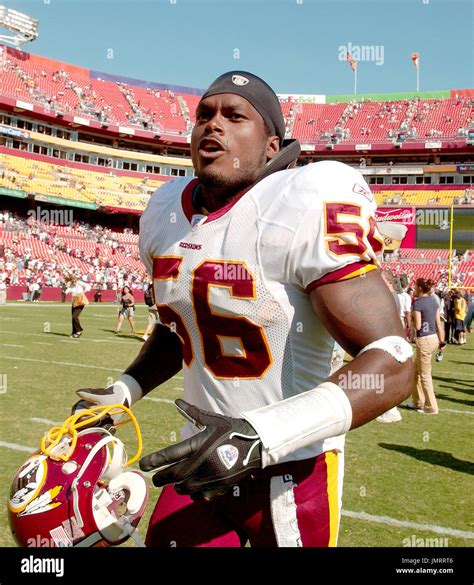
The Washington Commanders included Arrington on their 90 Greatest list, the franchise’s own retrospective ranking of its best players across all eras. That’s not a consolation prize. The list is competitive – there are decades of Redskins history and a lot of legitimate candidates – and Arrington made it despite playing fewer than 90 games total.
His Pro Football Hall of Fame case is weaker. The honest version of that argument goes like this: his peak was three seasons, he played 85 games in seven years, and the standard for Canton requires sustained production over time. He doesn’t have it on paper. The College Football Hall of Fame inducted him, which reflects what he actually accomplished at Penn State.
The comparison that keeps coming up, usually from people who watched him play in 2001 and 2002, is to Patrick Willis – another outside linebacker who was widely considered the best in the game until injuries cut him short. Willis retired at 30 rather than keep playing damaged. Arrington didn’t get that choice. The knee didn’t give him the option to decide.
Here’s what I find genuinely hard to resolve about his Redskins tenure: the franchise got roughly three excellent seasons from the second overall pick in the 2000 draft, paid him $33 million, and then spent years publicly disputing whether they owed him another $6.5 million. The $6.5 million, in context, was real money but not franchise-breaking money for an organization that Dan Snyder was running at significant expense throughout that period. The decision to fight the dispute rather than settle it quickly cost both sides – in legal fees, in goodwill, in Arrington’s focus, and in whatever the 2004 and 2005 Redskins might have gotten from him had the relationship stayed intact. Whether the missing bonus was a deliberate omission or an honest administrative error under deadline pressure was never definitively established in public record, and the parties disagreed to the end.
After Football
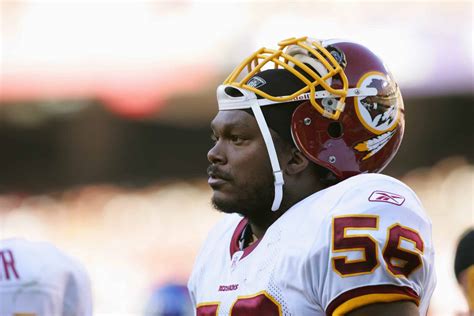
Arrington moved into broadcasting without much of a transition period. In 2009 he became co-host of Redskins Nation on Comcast SportsNet, the franchise’s flagship pre- and post-game show. That same year he launched The LaVar Arrington Show with Chad Dukes on 106.7 The Fan (WJFK-FM) in Washington, an afternoon drive program that ran until 2012 and drew strong ratings during its run. In 2014 he joined NFL Network as an analyst, contributing to NFL AM and NFL Total Access.
His on-air persona during the radio years was, by his own design, critical of the Redskins organization and of Dan Snyder specifically. A 2018 Bleacher Report piece called him Washington’s biggest critic. That framing wasn’t unfair for the period it described, though it also oversimplified what was clearly genuine frustration from someone who felt the organization had handled his situation poorly – which, regardless of legal fault, it had.
In November 2024, the Washington Commanders named Arrington the Week 11 “Legend of the Game.” It was the first time he had been formally welcomed back by the organization in any meaningful capacity since his departure in 2006. He told reporters he felt an energy at the stadium within three hours that he had never experienced even as a player. Whether that reads as reconciliation or just as the passage of time softening old disputes probably depends on how much weight you put on institutional gestures versus what actually happened between 2003 and 2006.
Either way, 85 games wasn’t what anyone in Washington had signed up for in April 2000. Arrington included.
Comments