
Steve Largent and the Seattle Seahawks: How a Castoff from Houston Became the Franchise’s First Legend
The Houston Oilers traded Steve Largent to the Seattle Seahawks in August 1976 for an eighth-round draft pick. Not a third. Not a second. An eighth. The Oilers thought he was too slow and too small to survive in the NFL, and they made that call after four preseason games. By the time Largent retired 14 seasons later, he held six major NFL receiving records and was the first player in league history to catch 100 touchdown passes.
That trade is still one of the most lopsided in NFL history, on either side of the ledger.
From Tulsa to the Bottom of a Draft Board
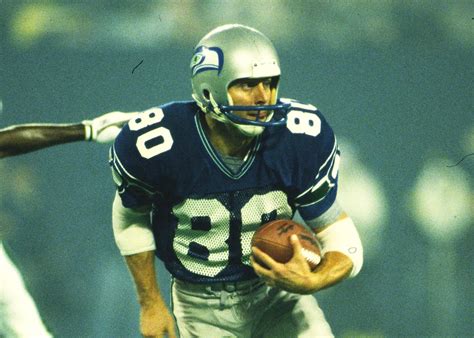
Largent grew up in Tulsa, Oklahoma, born September 28, 1954. His childhood wasn’t stable – he’s talked openly about a broken home and coaches filling the role his father didn’t. What he had, early and consistently, was a knack for catching a football in traffic. He was a standout at Putnam City High School but not the kind of recruit that big programs fight over.
He ended up at the University of Tulsa, which at the time was one of the few schools in that region still building its offense around throwing the ball. That wasn’t an accident on Largent’s part. He led the nation in touchdown catches in both 1974 and 1975. By the time he graduated with a biology degree in 1976, he held records all over the Tulsa program’s history.
The NFL saw a 5-foot-11, 187-pound receiver who ran a below-average 40-yard dash. Houston took him in the fourth round, 117th overall, which at least meant someone saw something. Then training camp happened, and the Oilers saw enough – or not enough – and shipped him north to an expansion team that didn’t even have a full season under its belt.
What Largent Actually Was as a Football Player
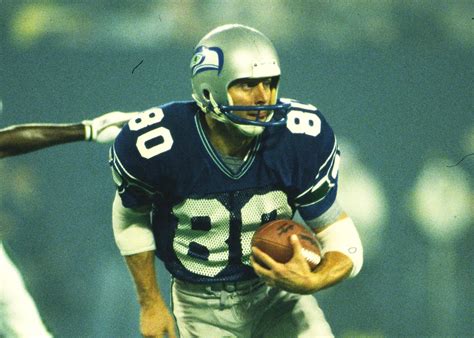
The standard explanation for Largent’s career is that he “overcame” his physical limitations. That framing is a little too tidy. He wasn’t slow in any way that mattered on a football field. He was slow in a straight line, in a controlled environment, running alone. In a route, against a cornerback who had to mirror him through cuts and double-moves, he was rarely beatable.
On the NFL Films documentary about his career, he put it plainly: “A lot of receivers run a 4.3 40, but they can’t run routes, and they can’t come out of routes. I could get into a route and out of a route without losing any speed. I was quicker than a lot of guys that had a lot faster straight-ahead speed.”
That’s not modesty. It’s an accurate technical description of what separated him. His cuts were sharp enough that defensive backs who had a step on him at the snap often found themselves grasping at air by the time the ball arrived. Dave Krieg, who threw to Largent for most of the 1980s, said the routes were so precise that he could throw to a spot before Largent broke on the ball – and Largent would be there.
His hands were exceptional. In 200 career games he dropped almost nothing. He ran every route on the tree at a high level, which made him impossible to shade in one direction. And he studied opponents the way a chess player studies openings – there are accounts from teammates of Largent spending hours reviewing film on defensive backs he hadn’t faced yet, mapping their tendencies before the week’s practice even started.
Jerry Rice, who would eventually break every record Largent held, told NFL Films: “What I learned from Steve Largent is how precise he ran his routes.” That’s Rice. Saying that. About someone other than himself.
The Career Numbers, With Context
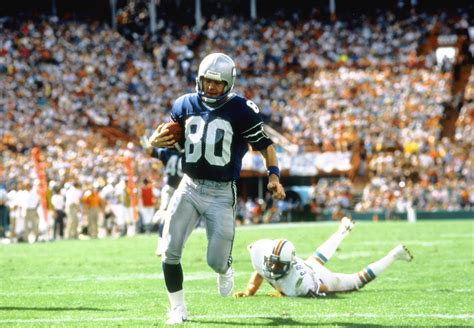
Largent caught 54 passes in his rookie season, third-best in the NFC. In 1978 he led the AFC with 71 receptions and made his first Pro Bowl. His first 1,000-yard season came that year – 1,168 yards – missing the league lead by one yard.
In eight of the nine seasons from 1978 through 1986, he went over 1,000 yards. That run includes two NFL receiving titles: 1,237 yards in 1979 and 1,287 in 1985. He caught 70 or more passes six times. Ten times he caught at least 50, which stood as an NFL record. He caught at least one pass in 177 consecutive regular-season games – a streak that lasted until 1994, five years after he retired.
When he walked away after the 1989 season, the records he held were: most career receptions (819), most career receiving yards (13,089), most touchdown receptions (100), most consecutive games with a reception (177), most seasons with 50 or more catches (10), and most seasons with 1,000 or more yards (8). Six records. All major. All broken eventually by Jerry Rice, but not all of them quickly.
One thing those numbers don’t fully convey: Largent played in an era when NFL teams ran the ball far more than they throw now. His 819 catches came across 14 seasons of offenses that weren’t designed around volume passing. The comparison to today’s receivers is genuinely complicated, and anyone who waves it away by just saying “Rice was better” is skipping a real analytical question.
Seven Pro Bowls, spanning 1978 to 1987. First-Team All-Pro in 1979, 1983, 1985, and 1987. NFL Man of the Year in 1988 – the award now called the Walter Payton Award – for his charity work and community involvement. The man had range.
The 1988 Game Against Denver That Seahawks Fans Still Talk About
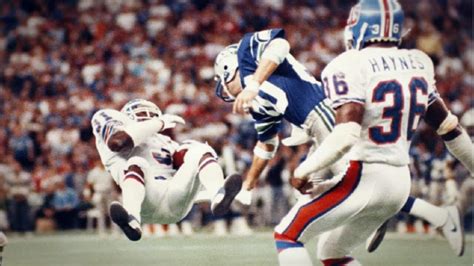
In Week 1 of the 1988 season, Largent caught a pass and Denver safety Mike Harden drove a forearm into his facemask on the way down. Illegal hit, called on the field, but Largent was unconscious before he landed. He missed the following week.
He said nothing publicly. He came back, played out the season, and waited.
Week 15. Seattle vs. Denver again. Dave Krieg threw an interception, and Harden picked it off and started returning it up the field. Largent, who was not involved in the play, ran him down from behind and delivered a block that de-cleated the safety, caused a fumble, and left Largent recovering the ball on the turf. He was 34 years old.
It’s the kind of story that gets retold because it fits what people sensed about him – quiet, professional, slow to react, but with something underneath that didn’t forget. Whether you read that as competitive or calculated depends on your own sensibility. Either way, it happened exactly like that.
Records, Rings, and Retirement
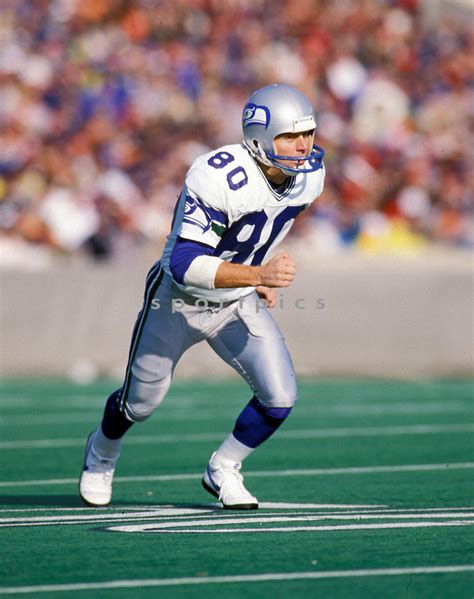
The Seahawks inducted Largent into their Ring of Honor in 1989, the same year he retired. They were the first franchise to do that – honor someone before the Hall of Fame process even opened. His number 80 was retired the same year.
In December of that final season, in a game against Cincinnati, Krieg found Largent in the back of the end zone for his 100th career touchdown reception. Don Hutson had held the record at 99 since 1945. Largent had now broken it, in his last significant statistical act as a professional football player.
The Pro Football Hall of Fame inducted him in 1995, his first year of eligibility. He was the 23rd player ever elected in their first eligible year. He was also, at that point, the first Seahawk to make it to Canton. At the Super Bowl that same year, Super Bowl XXIX, Largent flipped the coin – another first for any Seahawks player.
In 2019 the NFL put together its 100th Anniversary All-Time Team, a panel of coaches, executives, former players, and media selecting the best players at each position across the league’s entire history. Largent made the team. Kenny Easley and Cortez Kennedy were finalists and didn’t. Walter Jones did. Seattle put two players on a list of the hundred best to ever play the game, and Largent was one of them.
After Football: Congress, Oklahoma, and What He Chose to Do With the Platform

Largent spent a couple of years doing marketing consulting for Sara Lee after retiring. In 1994 he ran for Congress in Oklahoma’s 1st Congressional District as a Republican and won. He was re-elected three times. In 2002 he gave up his seat to run for governor of Oklahoma and lost. He returned to private life.
The political career gets mentioned in every profile, usually briefly. What’s less discussed is what he actually did with that time in office – he was vocal on issues tied to his personal faith and was considered a consistent conservative voice through the late 1990s during the Clinton impeachment period. He was not a passive presence in Congress.
What he’s talked about more candidly in interviews is his personal background – growing up in a house that wasn’t stable, the coaches who stepped in, the process of learning to trust people and eventually extend forgiveness in situations where it didn’t come naturally. In a 2017 interview with Brock Huard on the podcast Above and Beyond, he went into specifics about that part of his life in a way he hadn’t before. The football career runs clean in every narrative. The personal story is messier, which is probably why it’s more interesting.
What He Left Behind in Seattle
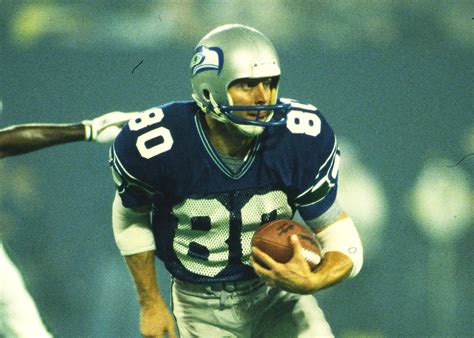
The Steve Largent Award has been given annually by the Seahawks since 1989 to the player or coach who best exemplifies spirit, dedication, and integrity. Largent himself was the first recipient, in the year he retired. It’s now one of the team’s most respected internal honors.
His yards-per-game record for a single season – set in 1979 – stood untouched for more than 40 years, until Jaxon Smith-Njigba was averaging 106.8 yards per game through part of the 2025 season and appeared to have a chance to finally break it. The fact that a record from 1979 was still on the books in 2025 tells you something specific about how good Largent was in that era, even accounting for the differences in how the game was played.
His number 80 has not been unretired. No Seahawk has worn it since 1989. For a franchise that has now won a Super Bowl, had Hall of Fame players at multiple positions, and gone deep into January football multiple times – Largent still sits at the beginning of every honest conversation about who built that organization’s identity.
He was 34 years old when he retired. He caught 28 passes that final year in 10 games, clearly not the same receiver he had been. But he had 100 touchdowns by then, a record that stood until Jerry Rice passed it in 1992, three years later. Rice took everything eventually – that’s what Rice did. But Largent got there first, from Tulsa, on an eighth-round pick’s worth of trust from a team that nobody had heard of yet.
Comments