
Kenny Stabler and the Oakland Raiders: The Snake, the Super Bowl, and a Legacy That Still Stands
The Kid from Foley and the Nickname That Followed Him Forever
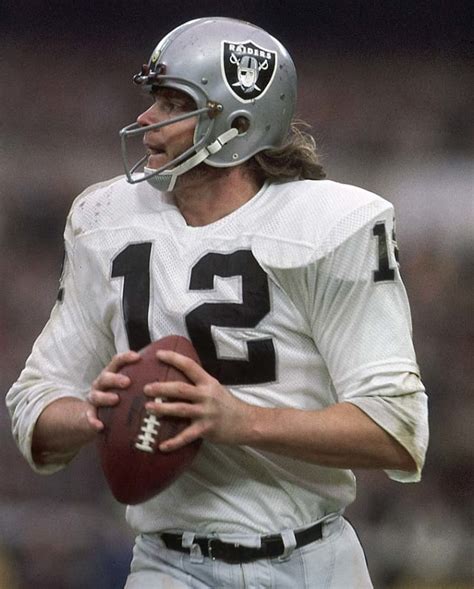
Ken Stabler was born on Christmas Day, 1945, in Foley, Alabama – a small Gulf Coast town where his father Leroy worked as a mechanic. He led Foley High School’s football team to a 29-1 record over three years, including three state titles, which is the kind of thing that gets you recruited by Bear Bryant. It also got him drafted by the New York Yankees in the 10th round of the 1966 MLB draft, then the Mets in January 1967, and then the Houston Astros after that. He turned all three down for football.
The nickname came from a junior high punt return. His coach, Denzil Hollis, watched him cut back and forth across the field – estimates put it at roughly 200 yards of actual ground covered to score from 20 out – and said something. Exactly what he said is mildly disputed. Stabler claimed Hollis shouted “Damn, that boy runs like a snake.” Hollis’s widow remembered it more simply: the boy came off the field and Hollis just said, “Good job, Snake.” Either way, the name stuck harder than any tackle anyone ever put on him.
At Alabama, he backed up Steve Sloan in 1965 on a national championship team, then won the starting job himself, earning All-America honors in 1967. He played in the same program as Joe Namath and Bart Starr – one of the stranger lineages in football history – before the Raiders took him in the second round of the 1968 AFL-NFL Draft, 52nd overall.
Waiting, Then Winning: The Oakland Years
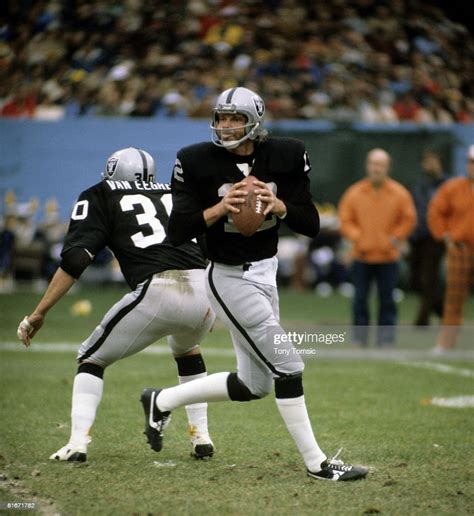
He sat. Two full seasons on the inactive list while Daryle Lamonica ran the Oakland offense. Stabler appeared in some games after 1970, got a little more work each year, and finally took over as the starter midway through 1973 after the Raiders dropped two of their first three games. That year he took them to the AFC Championship – a 27-10 loss to Miami – but it was the first of five consecutive trips to that game. They lost the next two as well. Against Pittsburgh in 1974. Against Pittsburgh again in 1975.
1974 was his best statistical season individually. He led the NFL with 26 touchdown passes, posted a 72.1 passer rating adjusted upward by the era’s standards, and was named the league’s Most Valuable Player by the Associated Press. He made four Pro Bowls during his Oakland tenure and was All-Pro twice. When he retired after the third game of the 1984 season, his career completion percentage of 59.85 was second only to Joe Montana – who had played just six seasons at that point.
In 1976 they finally broke through. Stabler finished the regular season with a 103.4 passer rating, led the AFC in passing, and then beat the Minnesota Vikings 32-14 in Super Bowl XI, completing 12 of 19 for 180 yards. It was not particularly close. The Raiders were dominant that day in a way the previous three AFC Championship losses had made seem almost impossible.
His final Oakland numbers: 19,078 passing yards, 150 touchdown passes, a 69-26-1 record in his starts. All three are still franchise records. Rich Gannon eventually broke his completion percentage mark, but Gannon was operating in a completely different passing era – more rules protecting receivers, more illegal contact calls, softer coverage schemes. Stabler threw into the teeth of 1970s defenses.
The Plays With Names
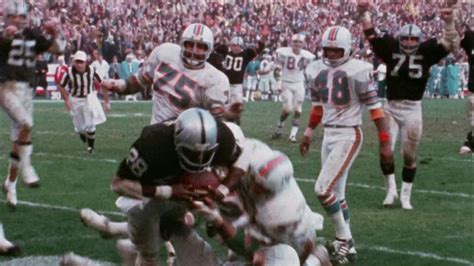
Four games from Stabler’s career became the kind of thing that gets its own proper noun in NFL history.
The Sea of Hands. December 21, 1974. Oakland hosting Miami in the AFC Divisional round, the Dolphins chasing their third straight Super Bowl. With 26 seconds left and the Raiders trailing, Stabler found running back Clarence Davis in the end zone for an 8-yard touchdown. Three Miami defenders grabbed at the ball simultaneously. Davis kept it. Raiders 28, Dolphins 26.
Ghost to the Post. December 24, 1977. Oakland versus Baltimore in the AFC Divisional round. Dave Casper running a deep crossing route, Stabler finding him for 42 yards late in the fourth quarter to set up the field goal that sent it to overtime. Then Stabler hit Casper again – in the second overtime – for the winning score.
The Holy Roller. September 10, 1978. Raiders trailing the San Diego Chargers 20-14 with ten seconds left. Stabler, about to be sacked and out of options, intentionally fumbled the ball forward. Pete Banaszak batted it. Dave Casper fell on it in the end zone. Touchdown. Oakland wins 21-20. The NFL changed the rules after that season – you can’t advance a fumble in the final two minutes unless you’re the fumbler. It was the kind of thing only the Raiders would do, and the kind of thing only Stabler would think to do.
He was also on the field for the setup to the Immaculate Reception. In the 1972 AFC Divisional game against Pittsburgh, Stabler scrambled 30 yards for a go-ahead touchdown in the fourth quarter, putting Oakland ahead with minutes to go. Then Franco Harris caught Terry Bradshaw’s deflected pass off the turf – or off Frenchy Fuqua’s shoulder pad, depending on who you believe – and the Steelers won. Stabler wasn’t responsible for the outcome, but he was there. He was always there when games turned into something people remembered for decades.
What Made Him Different as a Quarterback
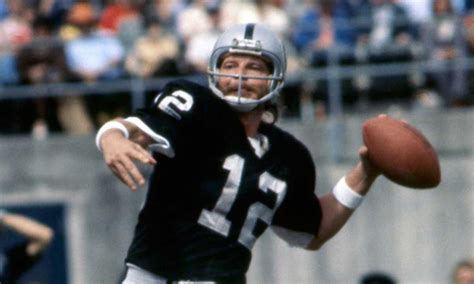
He was left-handed, which is genuinely rare at the position. The spiral came out the other way, the footwork mirrored, receivers had to adjust. But Stabler’s specific skill was accuracy under pressure that had nothing to do with athletic escape. His knees started failing him relatively early. By his late Oakland years, he wasn’t running anywhere. He was reading defenses, making decisions faster than almost anyone, and throwing to spots rather than receivers.
Pete Banaszak put it plainly in a quote that’s been repeated enough times now that it reads like mythology but isn’t: “If you wanted the ball between the four and the zero on the jersey, he’d put it there. If you wanted it in the ear hole, Kenny could put it there.” Banaszak played next to him for years. He wasn’t doing PR.
John Madden’s version was simpler. “If I had one drive to win a game to this day, and I had a quarterback to pick, I would pick Kenny.” Madden won exactly one Super Bowl as a head coach. It was with Stabler.
The Elias Sports Bureau tracked this specifically: the Madden-Stabler combination had the fourth-best winning percentage of any head coach-quarterback pairing in NFL history with a minimum of 75 games together, at .756. Behind only Belichick-Brady (.773), Lombardi-Starr (.770), and Dungy-Manning (.759). That’s the actual peer group.
He also held the NFL record for consecutive postseason games with a touchdown pass: 10 straight. That record stood for years after he retired.
Everything After Oakland
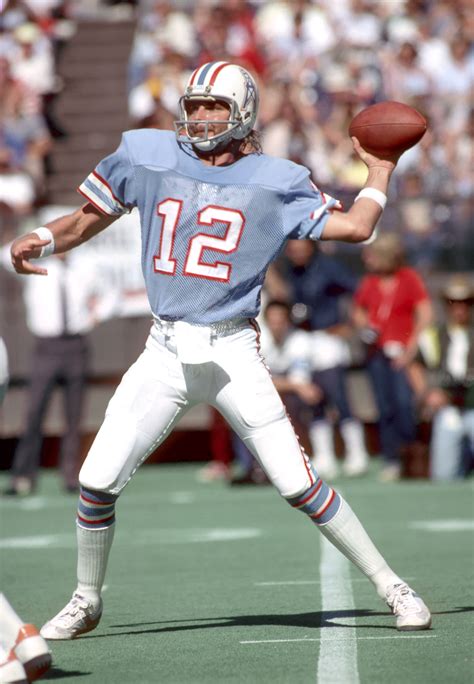
The trade to Houston in 1980 was Al Davis’s doing, and Stabler didn’t want it. The two men had been building toward a rupture for years – personality conflicts, contract disagreements, Stabler’s lifestyle increasingly at odds with what Davis thought an Oakland Raider should represent off the field, which is saying something given how much latitude the Raiders gave their players in that era. They finally reconciled in Davis’s office in 2009, six years before Stabler died.
In Houston, Stabler threw for 3,202 yards his first season – the second time in his career he’d topped 3,000. He played two years with the Oilers, then two more with the New Orleans Saints before retiring three games into the 1984 season. His knees were done. He was 38.
After football he did radio work, broadcasting Alabama games for years, a job he reportedly loved in part because it kept him close to the state where he’d started everything. He fished, rode horses on his Alabama ranch, lived without particular urgency or apology.
The Hall of Fame Problem
He died July 8, 2015, from complications of Stage 4 colon cancer, at 69. His family released a statement saying he passed surrounded by his three daughters and his longtime partner, Kim Bush, with Lynyrd Skynyrd’s “Sweet Home Alabama” and Van Morrison playing in the background. He had not yet been inducted into the Pro Football Hall of Fame.
The Hall inducted him posthumously in August 2016. John Madden presented him by video. His twin grandsons, Jack and Justin – 17 at the time – accepted the bust alongside his Raiders teammate Fred Biletnikoff.
The delay was a real failure, and the football community knew it. Stabler was the only quarterback who both started and won a Super Bowl during the 1970s who wasn’t already in Canton while he was alive. Of the five quarterbacks who threw the most touchdown passes that decade, the other four were already enshrined. His 150 touchdown passes in the 1970s alone rank third all-time for that decade, and his two runners-up in that stat were Hall of Famers before he was.
The whisper explanation was always that voters held his lifestyle against him. He drank. He stayed out. He famously claimed to have studied game plans by jukebox light in honky-tonk bars the night before games – and then went out and completed 60 percent of his passes anyway. Whether that bothered voters in ways they didn’t articulate openly is impossible to confirm, but the pattern is hard to dismiss entirely.
What’s certain is that he was better than his induction timeline suggested. The completion percentage alone should have been enough – second only to Montana when he retired, in a far more physical era. In 2022, the Raiders worked with the Hall of Fame to change the rules around posthumous inductees receiving the Ring of Excellence, a right previously available only to those alive at enshrinement. The Stabler family received his ring that September.
CTE and What Came After His Death
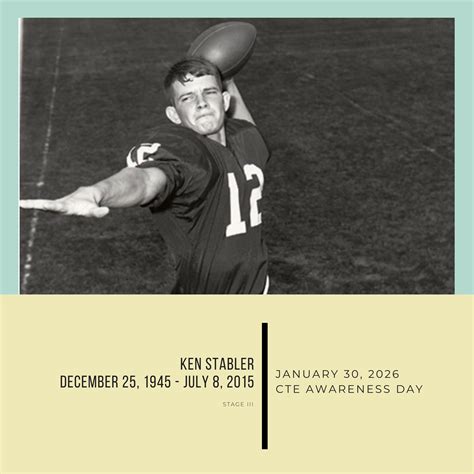
The posthumous CTE diagnosis arrived after researchers at Boston University examined Stabler’s brain. He was found to have had the disease. He became the first Super Bowl-winning quarterback confirmed to have suffered from chronic traumatic encephalopathy.
Kim Bush told reporters at the time: “I think Kenny’s best play was donating his brain. It’s bigger than the Super Bowl. Bigger than anything out there.” That’s a sentence that’s harder to sit with the longer you think about it – a man whose greatest gift to the world may have been the thing inside his helmet rather than everything he did with what was around it.
The colon cancer, not the CTE, was what killed him. Whether the CTE affected his final years in ways that went unrecognized is an open question. His family has not detailed that publicly.
The Numbers, Plainly
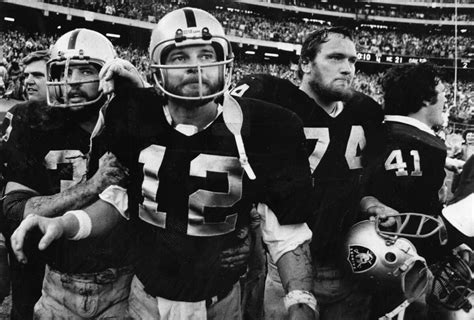
Fifteen NFL seasons. 184 games, 146 starts. 27,938 passing yards. 194 touchdown passes, 222 interceptions. Career record as a starter: 96-49-1. In the postseason: 13 games, 12 starts, 2,641 yards, 19 touchdowns, 13 interceptions, 7-5 as a starter including one Super Bowl win.
Oakland-only: 19,078 yards, 150 touchdowns, still the franchise records after four-plus decades. His completion percentage in Oakland – 59.9 percent – was an almost unheard-of number for the era, later edged out by Rich Gannon in 2002, a full generation later and under very different rules.
Awards: 1974 NFL MVP, 1974 and 1976 AFC Player of the Year, four Pro Bowl selections, two first-team All-Pro designations, the NFL’s 1970s All-Decade Team, and the Pro Football Hall of Fame class of 2016.
Against his 1970s contemporaries: Terry Bradshaw won four Super Bowls to Stabler’s one and made the Hall of Fame in 1989. Roger Staubach had a better postseason record. Bob Griese won two championships. But Stabler’s single-season peak in 1976 – the 103.4 passer rating, the AFC passing title, the Super Bowl – holds up against any of them. And his career completion percentage, adjusted for when he played, may be his most underappreciated credential.
The Raiders were 69-26-1 in his starts. That’s the number Madden was talking about when he said he’d still take Stabler for one drive.
Comments