
Vinny Testaverde and the New York Jets: Career, Stats, and What He Actually Meant to the Franchise
Vinny Testaverde grew up on Long Island rooting for the New York Jets. He eventually became their best quarterback in 30 years. That detail gets skipped over a lot, probably because the football conversation always circles back to the 1999 Achilles injury or the interception numbers – and those things are real – but the full picture of what Testaverde did in green and white is more complicated and, in some stretches, genuinely impressive.
He played for the Jets across parts of seven seasons, went 36-29 as a starter, led them to the AFC Championship Game, and threw five touchdown passes in a single quarter against Miami. Not many quarterbacks in franchise history can say anything close to that.
Before New York
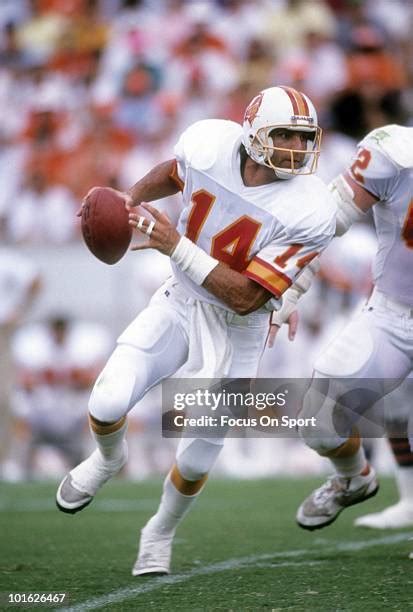
The 1987 NFL Draft had Testaverde going first overall to Tampa Bay – ahead of Rod Woodson, who went 10th to Pittsburgh and ended up in the Hall of Fame. Testaverde had won the Heisman Trophy at Miami in 1986, threw 26 touchdowns that season (the most in major college football that year), and was considered a generational arm. The Buccaneers got six years of mostly disappointment. They averaged five wins per season during his time there.
Cleveland was similar. Then Baltimore, where things started to click. He made his first Pro Bowl after the 1996 season with the Ravens, completing 57.3% of his passes for 4,177 yards. He was 33 years old and had never been to an AFC Championship Game.
Bill Parcells signed him in June 1998. The Ravens released him, the Jets claimed him, and Parcells installed him as the backup to Glenn Foley. That arrangement lasted about two weeks of actual game time.
The 1998 Season
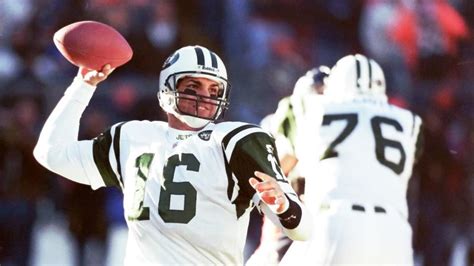
Foley started the first two games. He went down injured in Week 2 against Baltimore, and Testaverde stepped in. From that point, starting 13 games, he went 12-1. The Jets finished 12-4, won the AFC East title (their first division crown since the AFL-NFL merger), earned a first-round bye, beat Jacksonville 34-24 in the divisional round, and lost to Denver 23-10 in the AFC Championship.
His numbers that season: 3,256 yards, 29 touchdowns, 7 interceptions, 61.5 completion percentage. The TD-to-INT ratio was something Jets fans hadn’t seen from the quarterback position in years. For context, his career interception rate entering that season sat around 4.5%. In 1998 it was 1.7%.
Curtis Martin rushed for 1,287 yards. Keyshawn Johnson caught 10 touchdowns. Aaron Glenn was the shutdown corner on defense with Bill Belichick running the unit. Parcells had built something real, and Testaverde was the piece that made the offense go.
What I find genuinely hard to explain is how the narrative about Testaverde as an interception-prone quarterback survived 1998. He threw 29 touchdowns and 7 picks – across 421 pass attempts. That’s not a fluke stat line. That’s a quarterback operating within a system that suited him, staying disciplined in a way he hadn’t managed to consistently before.
He was selected to his second Pro Bowl. The first had come with Baltimore in 1996. Both times, he was 33 or older.
The Phantom Touchdown
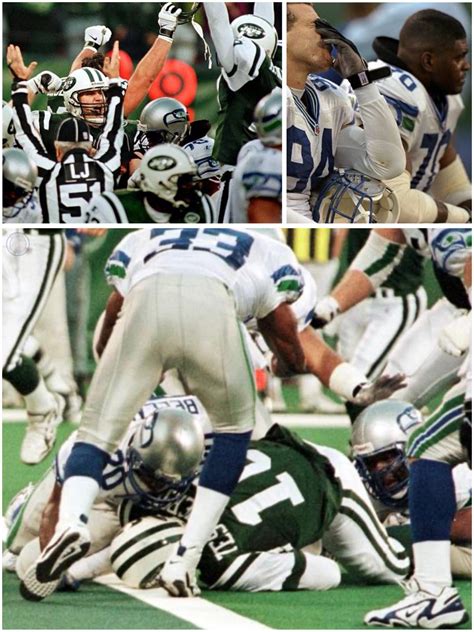
December 1998, Giants Stadium, Jets hosting Seattle. Testaverde dove for the pylon on a quarterback sneak and the officials ruled it a touchdown. Replays showed his body crossed the goal line but the ball didn’t. No instant replay system was in place at the time to overturn it. The Jets won the game. Seattle was furious, and reasonably so.
The NFL reinstated instant replay for the 1999 season. That play is the direct reason. So Testaverde’s helmet dive in a regular-season game against the Seahawks changed the way the league handles officiating. That’s an odd legacy to carry around, but he carries it.
The 1999 Achilles and What the Jets Lost
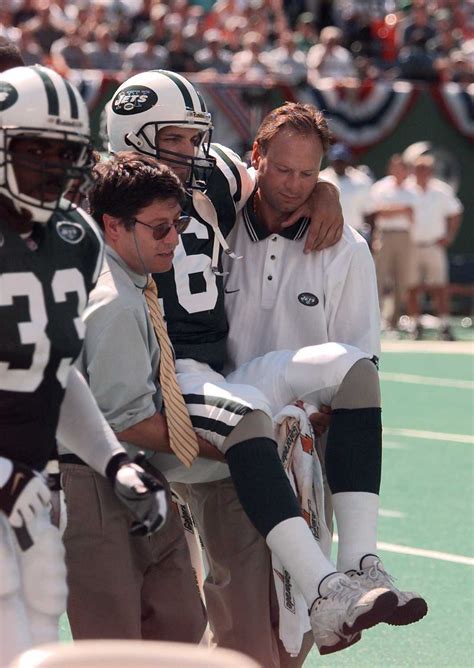
September 12, 1999. First game of the season, at home against New England. On what looked like a routine scramble, Testaverde’s left Achilles tendon ruptured. Season over. Career possibly over, given his age – he was 35.
The Jets had been picked by many analysts to reach the Super Bowl. They went 8-8 and missed the playoffs. The difference between the 1998 team and the 1999 team was almost entirely Testaverde’s presence. Rick Mirer and Ray Lucas combined for 24 touchdowns and 23 interceptions filling in.
There’s a counterfactual that Jets fans don’t always want to sit with: if Testaverde had started all 16 games in 1998 instead of 13, the Jets might have had the top seed in the AFC and hosted the Championship Game rather than traveling to Denver, where the Broncos were 10-0 at home that season. The three losses with Foley cost them home-field. Denver won that Championship Game 23-10. Mile High in January against Elway’s offense was a different animal than anything the Jets faced at Giants Stadium.
The Monday Night Miracle
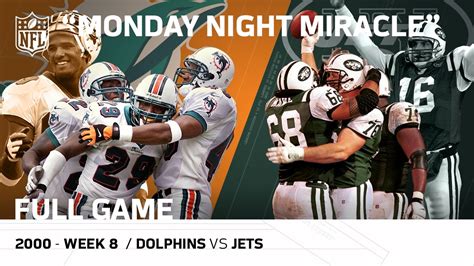
October 23, 2000. Testaverde came back from the Achilles tear, which was already remarkable for a 36-year-old quarterback. The Jets trailed Miami 30-7 heading into the fourth quarter at Giants Stadium. Nobody left. The comeback that followed was voted by fans as the greatest game in Monday Night Football history.
In the fourth quarter alone, Testaverde threw five touchdown passes. Laveranues Coles caught one. Jermaine Wiggins caught one. Then, improbably, offensive lineman Jumbo Elliott – 6-foot-7, 305 pounds – hauled in a touchdown from Testaverde in the back of the end zone. The Jets tied it 30-30 and eventually won 40-37 in overtime.
Testaverde finished with 378 yards. The game went to overtime after the Jets scored 33 straight points in the fourth quarter, which is still one of the most astonishing single-quarter performances in NFL history by a quarterback who, 13 months earlier, had been on crutches.
The Jets honored that team at a 10-year reunion in 2010. Testaverde recalled the touchdowns from memory at halftime – named each one, each receiver, each situation – which tells you something about how clearly that night is still sitting in his head.
Year-by-Year Stats With the Jets
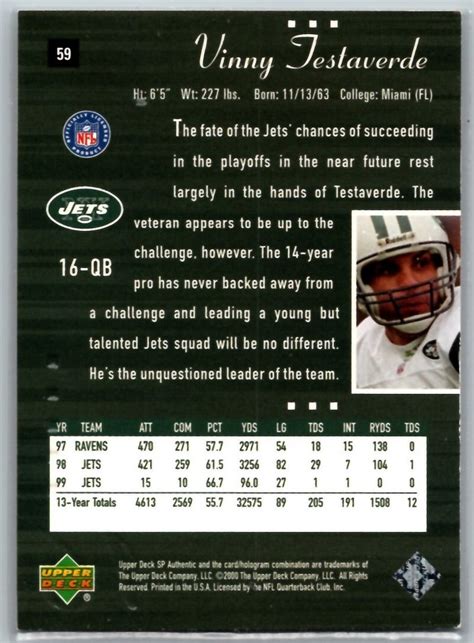
| Season | GS | Comp% | Yards | TD | INT | Rating | Result |
|---|---|---|---|---|---|---|---|
| 1998 | 13 | 61.5% | 3,256 | 29 | 7 | 101.6 | Lost AFC Championship |
| 1999 | 1 | – | – | – | – | – | IR (Achilles) |
| 2000 | 16 | 57.4% | 3,732 | 21 | 25 | 71.4 | Missed playoffs |
| 2001 | 16 | 57.7% | 2,752 | 15 | 14 | 74.9 | Lost Wild Card (Oakland) |
| 2002 | 10 | 56.0% | 1,697 | 8 | 8 | 73.4 | Missed playoffs |
| 2003 | 5 | 51.0% | 627 | 4 | 5 | 65.5 | Missed playoffs |
| 2005 | 5 | 54.9% | 561 | 4 | 3 | 75.2 | Missed playoffs |
The 2000 season is the awkward one in that table. The Monday Night Miracle lives in Jets folklore, but his interception total that year (25) was the highest of his Jets career, and the team missed the playoffs at 9-7. The 1998 numbers are the outlier in both directions – better than anything he managed before or after, and the one season where the mechanics and the supporting cast and the coaching all landed at once.
Three Head Coaches, One Quarterback
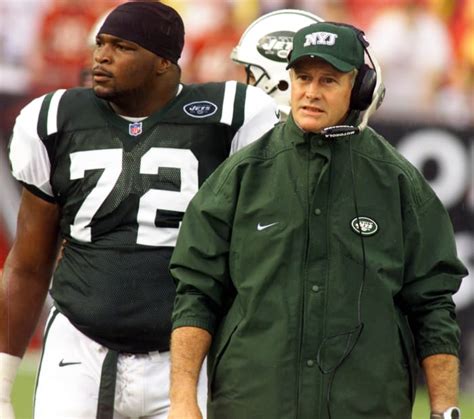
Parcells left after the 2000 season. Al Groh came in and lasted one year before heading to Virginia. Herm Edwards took over in 2001 and coached Testaverde through the 2003 season. Through all three, Testaverde was the starter – or near it – and the Jets averaged just under nine wins per year from 1998 through 2003. For a franchise that had made the playoffs five times in the previous 15 seasons, that run represented something.
Parcells then went to Dallas and brought Testaverde with him in 2004. At 41, Testaverde threw for 3,532 yards and 17 touchdowns with the Cowboys, which is the part of his career that tends to get underplayed. The Cowboys went 6-10 anyway.
He came back to the Jets in 2005 for five starts, then signed with New England in 2006 as a backup to Tom Brady, and finished with Carolina in 2007 at age 43. Twenty-one seasons total. The NFL record for throwing a touchdown pass in 21 consecutive seasons belongs to him. He also holds the record for throwing TD passes to 70 different receivers, which is an odd kind of record but reflects how long he lasted and how many rosters turned over around him.
Where He Stands in Jets History
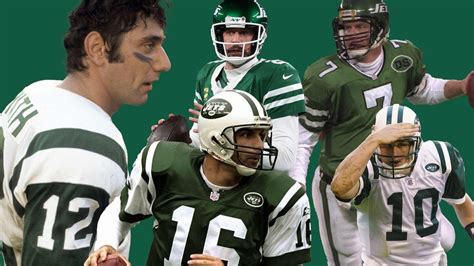
The argument for Testaverde as the second-best quarterback in Jets history rests mostly on the 1998 season and the cumulative win-loss record. Joe Namath’s ceiling is higher – one Super Bowl, one iconic guarantee, one defining moment the franchise still trades on. But Namath played in an era of weaker competition and had a career that deteriorated badly in the early 1970s. In terms of sustained success over multiple seasons, Testaverde’s Jets run compares reasonably well.
Ken O’Brien had a solid stretch in the late 1980s, Chad Pennington was quietly effective before injuries caught up with him, but neither led a team as far as Testaverde did in 1998. Bleacher Report placed him among the 25 greatest players in Jets history, which is appropriate without being a stretch.
The Hall of Fame question is a separate matter. His career numbers – 46,233 yards (sixth all-time at retirement), 275 touchdowns, 21 seasons – look like Hall-of-Fame territory on the surface. The complications are also real: 267 career interceptions, a career winning percentage of 42.3% as a starter, and the fact that he never had a sustained run as a top-five quarterback in the league. He is not in Canton and probably won’t be, which is defensible even if the career was longer and more productive than most people remember.
Bill Parcells threw 77 touchdowns and 58 interceptions out of him during the Jets years – meaning Parcells found a way to minimize the tendency that had plagued Testaverde since Tampa Bay. Outside of that specific coaching relationship, the numbers reverted. That’s not nothing. It says something about Testaverde as a player, but it also says something about what Parcells built around him in 1998 and how rarely that kind of environment came together again.
The 1998 Jets won 12 games, came within one game of the Super Bowl, and played in what most analysts considered the second-best team in the NFL that season by Simple Rating System. They had to play that title game on the road because of three early losses when Foley was starting. Testaverde went 12-1 in his 13 starts that year. The math on that is not ambiguous.
Comments