
Dyami Brown – NFL Wide Receiver Profile, Career Stats, and What 2026 Holds
The Basics
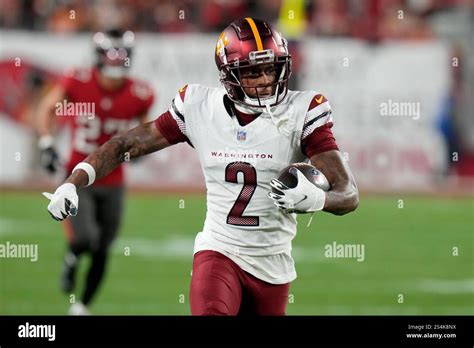
Dyami Brown is a wide receiver for the Washington Commanders. Born November 1, 1999, in Charlotte, North Carolina – pronounced dee-AH-mee, which almost nobody gets right on first try – he signed back with Washington in March 2026 on a one-year, $3 million deal after a rough year in Jacksonville. He’s 6-foot-0, 195 pounds, and was drafted by Washington in the third round of the 2021 NFL Draft, 82nd overall. Career totals through 2025: 79 receptions, 1,011 yards, five touchdowns across 77 games.
His younger brother Khafre played wide receiver alongside him at North Carolina. That’s not a footnote – two brothers running routes in the same college offense at the same time is genuinely unusual, and both were legitimate prospects.
College Career at UNC
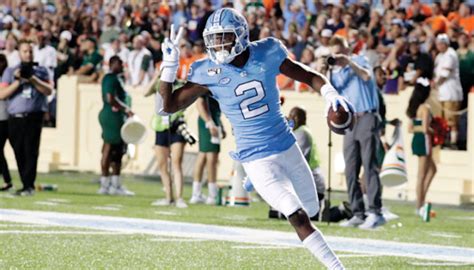
Brown played three seasons for the Tar Heels from 2018 to 2020. His freshman year was quiet: 17 catches, 173 yards, one touchdown in nine games. That changed fast.
In 2019, with Sam Howell running the offense, Brown caught 51 passes for 1,034 yards and 12 touchdowns, averaging 20.3 yards per reception. That average ranked ninth nationally. The following year he posted 55 catches, 1,099 yards, eight touchdowns – 20.0 yards per catch again – and earned first-team All-ACC honors and third-team AP All-American recognition.
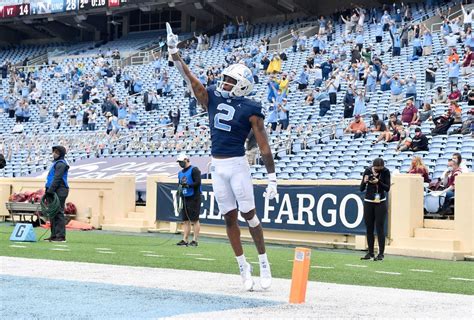
He became the first player in UNC history with two 1,000-yard receiving seasons, and the first FBS player since 2000 to average at least 20 yards per catch in back-to-back years. That second fact is the one that gets overlooked. Averaging 20 yards per reception once is unusual. Doing it in consecutive seasons means you’re consistently winning downfield, not catching a handful of fluky deep balls.
He skipped the 2021 Orange Bowl to prepare for the draft. He was also named a Biletnikoff Award semifinalist in 2020. His six-catch, 202-yard, three-touchdown game against Virginia got him ACC Receiver of the Week. So did a 150-yard performance against NC State.
2021 NFL Draft Scouting Profile
NFL Network analyst Lance Zierlein compared him to Paul Richardson and called him a player with “excellent ball-tracking talent with the ability to follow the flight over his shoulder and bring it in for the score.” NFL Network’s Bucky Brooks went further, calling him the best pure deep threat in the entire 2021 draft class.
The strengths were real and consistent across every scouting report: straight-line speed that tests around 4.45 in the 40, outstanding ball tracking on deep routes, over-the-shoulder catch ability, reliable hands downfield, and a willingness to play physical despite not being a big receiver. He drives defensive backs off the line of scrimmage by threatening vertically, which creates the cushion he needs to snap off routes underneath.
The weaknesses were equally consistent. Limited short-area quickness. No true second gear once he gets moving. His route tree at UNC leaned almost entirely on vertical routes and simple stems – coverage that could jam him at the line had a real chance to disrupt his timing. His agility and explosiveness scores at the combine tested slightly below average. One scouting report from CheeseheadTV noted that Syracuse defensive back Ifeatu Melifonwu specifically gave him problems in 2020, which isn’t a random observation – Melifonwu went in the third round himself that year.
The consensus projection: third-round pick, ceiling of a No. 2 receiver, immediate contributor as a deep threat. Washington took him exactly where scouts said they would.
Washington Commanders: 2021–2024
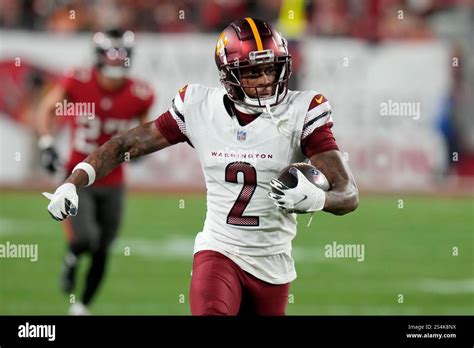
His first three NFL seasons were defined by inconsistency and limited opportunity. In 2021, 15 games, 12 catches, 165 yards, no touchdowns. In 2022, things briefly clicked – against the Tennessee Titans in Week 5, he caught two passes for 105 yards and his first two career touchdowns. He finished that season with five catches for 143 yards and two scores in 15 games. Not a breakout. A glimpse.
2023 was forgettable. Twelve receptions, 168 yards, one touchdown in 17 games.
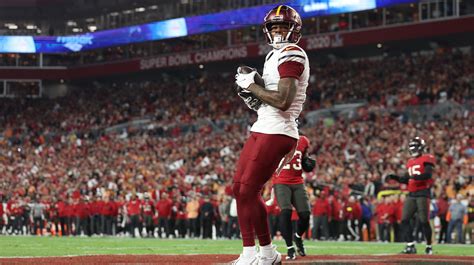
Then 2024 happened, and Jayden Daniels happened with it. Brown set career highs across the board: 30 receptions on 40 targets, 308 yards, one regular-season touchdown in 16 games. In Week 5 against Cleveland, he hauled in a 41-yard touchdown before halftime as part of a 34-13 Washington win. His 10.3 yards-per-reception average that season was lower than his college numbers – a sign he was running more intermediate routes in Daniels’ scheme rather than just going deep every snap.
Then the playoffs. Five receptions for 89 yards and a touchdown against Tampa Bay in the Wild Card. Six catches for 98 yards against Detroit in the Divisional Round, both team highs that day. Three playoff games total: 14 catches on 18 targets, 229 yards, one score. That ranked second in the entire NFL in postseason receiving yards. He tied Terry McLaurin for the most receptions on the team across those three games.
What strikes me about that playoff run is how sudden it looked from the outside – but the target share tells a different story. Washington ran him on 18 routes over three games, and he caught 14. That’s not luck. That’s a receiver operating at a level he’d never been asked to reach before, in games where the coverage schemes were designed for him.
Career Statistics by Season
| Season | Team | G | Targets | Rec | Yards | Avg | TD |
|---|---|---|---|---|---|---|---|
| 2021 | WAS | 15 | 14 | 12 | 165 | 13.8 | 0 |
| 2022 | WAS | 15 | 14 | 5 | 143 | 28.6 | 2 |
| 2023 | WAS | 17 | 23 | 12 | 168 | 14.0 | 1 |
| 2024 | WAS | 16 | 40 | 30 | 308 | 10.3 | 1 |
| 2025 | JAX | 14 | 37 | 20 | 227 | 11.4 | 1 |
| Playoffs 2024 | WAS | 3 | 18 | 14 | 229 | 16.4 | 1 |
The Jacksonville Year
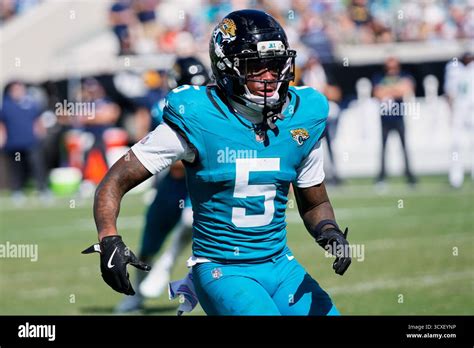
The $10 million contract with Jacksonville in March 2025 was built entirely on those three playoff games. That’s fine – that’s how NFL free agency works. The problem is the Jaguars were expecting a version of Brown that had only shown up in a three-game stretch, against defenses adjusting on the fly to Washington’s offense.
He caught 20 passes for 227 yards and one touchdown in 14 regular-season games. He suffered a concussion in Week 9 against the Raiders. His drop rate for the season was 13.5%, second worst in the NFL behind Atlanta’s David Sills at 13.9%. He was a healthy inactive for Jacksonville’s Wild Card game against Buffalo. The team chose Tim Patrick from the practice squad over Brown for that roster spot.
The Jaguars had Brian Thomas Jr., Travis Hunter (a rookie first-round pick), and then added Jakobi Meyers at the trade deadline. Brown was never going to find consistent targets in that room. That’s context, not excuse. A more reliable receiver makes something happen with 37 targets over 14 games.
Brown’s own framing when he returned to Washington: he said he “had to see himself grow in a different way.” That’s a measured, self-aware thing to say about a season that didn’t go as planned. Whether the growth was real shows up in 2026.
What Kind of Receiver He Is
The Cover1 scouting summary from February 2025 put it cleanly: Brown wins on straight-line speed and stride separation, with active hands and decisive execution on screens and fly sweeps. He’s not a receiver who creates separation with footwork or sharp cuts at the break point. He creates it by threatening vertically until the corner gives him room, then exploiting that room.
His ball tracking downfield is genuinely above average. The over-the-shoulder catch in traffic – where most receivers lose the ball in their peripheral vision – is one of his cleaner skills. His 28.6-yard average in 2022 on five catches isn’t a fluke of small samples; it’s what happens when you give him single coverage on deep routes.
The short-area stuff is where it gets complicated. He doesn’t win with cuts at 10 yards. Tight man coverage on short and intermediate routes can slow him significantly, which is why his 2024 numbers – 10.3 yards per catch with Daniels – looked so different from his college average. He was running more variety. That growth was real, even if the sample was one season.
He’s also a surprisingly willing blocker for a receiver his size, partly because the UNC offense asked him to block for Javonte Williams and Michael Carter regularly. That carries real value on a roster.
2026: Back in Washington
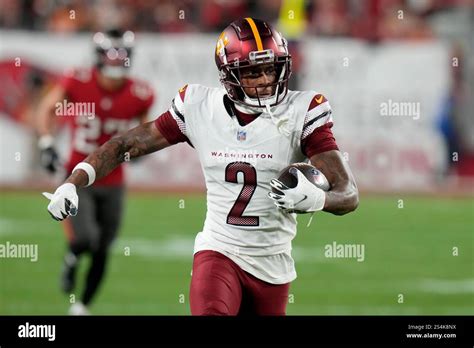
The one-year deal Brown signed in March 2026 is reportedly worth $3 million – significantly less than the $10 million Jacksonville paid, and roughly in line with where his market value sat before the 2024 playoffs. That pricing tells you what teams actually think of him outside the playoff sample.
Washington’s receiver room behind Terry McLaurin is genuinely open. Deebo Samuel Sr., Noah Brown, and Chris Moore all hit free agency. The Commanders drafted Clemson’s Antonio Williams in the third round of the 2026 draft. Brown, Williams, and Van Jefferson – another veteran signed the same week – are competing for real snaps as the No. 2 and No. 3 options behind McLaurin.
Heavy.com’s Ryan McCafferty predicted Brown will face a real battle just making the 53-man roster, which is a harsh read but not a dishonest one. His 2025 drop rate, his age (26), and the presence of a new third-round pick all complicate his path. At the same time, McCafferty acknowledged the Commanders are thin enough at receiver that Brown probably makes the team regardless.
The case for him in 2026 is straightforward: Jayden Daniels is one of the best quarterbacks in the NFL at throwing deep, and Brown is one of the better deep receivers available to Washington. If the offense gets Brown on the move – fly sweeps, designed targets on vertical routes – he can produce. The case against him is that his role in 2024 came late in the season after Jahan Dotson was traded, and that specific version of opportunity may not repeat.
Fantasy Football Value for 2026
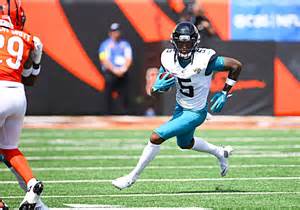
In 12-team redraft leagues, Brown is a waiver-wire name heading into August, not someone worth a draft pick. His realistic floor is 25 to 35 catches for 300 to 400 yards with maybe two touchdowns, which scores at a low-end WR4 pace. That’s a flex option in a pinch, not a starter.
The upside scenario requires McLaurin missing games and Washington not signing another wide receiver between now and September. Both things could happen. Neither is something to draft around in good conscience.
Dynasty: minimal long-term value. He turns 27 in November and is on a one-year deal. If he has a strong 2026, he might earn another short-term contract somewhere – but he’s not a dynasty hold at any meaningful cost.
Best ball is the format where Brown makes the most sense, purely because his occasional 80-yard game gets locked in at ceiling value. His 2022 Week 5 game against Tennessee – two catches, 105 yards, two touchdowns – is the template. Those games happen. They just don’t happen on a schedule.
Comments