
Chase Daniel Football Career: High School Star, College Record-Breaker, 14-Year NFL Backup
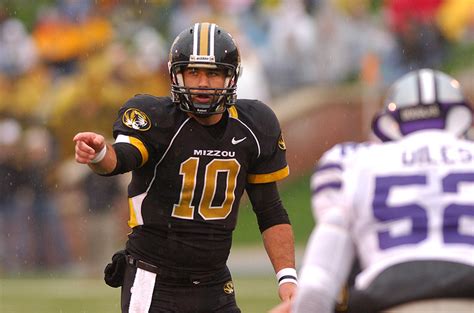
Chase Daniel went undrafted in 2009. Fourteen years later, he retired with a Super Bowl ring, career stops at seven NFL franchises, and a broadcasting gig at ESPN. That gap between what scouts thought of him and what actually happened is the whole story.
Born October 7, 1986, in Irving, Texas, Daniel played his high school ball at Southlake Carroll – a program that was already something of a factory for elite quarterbacks before he arrived. Under head coach Todd Dodge, he moved from wide receiver as a sophomore to starting quarterback, and the Dragons went 31-1 over his two seasons running the offense. They won the 5A Division II state title in 2004. He was named Class 5A State Offensive Player of the Year twice.
Seventy-five scholarship offers came in from programs across the country. His father, by Daniel’s own account, wanted no distractions heading into senior year – and Missouri, which had offered first, became the pick.
What He Built at Missouri
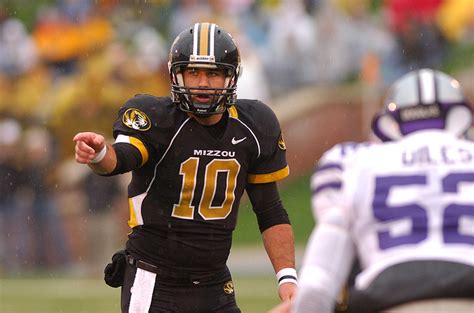
Daniel arrived at Mizzou in 2005 as a backup behind Brad Smith and played in 10 games that season, completing 38 of 66 passes for 247 yards. By 2006, he had the starting job and threw for 3,527 yards with 28 touchdowns at a 63.5 percent completion rate, earning a Brut Sun Bowl berth for the program. That was the warmup.
The 2007 season is what people remember. Missouri finished that year 12-1, reached the No. 1 ranking in the AP Poll in November, and won the Big 12 North Division title – the first in program history. Daniel threw for 4,306 yards and 33 touchdowns with a 68.2 percent completion rate. He finished fourth in Heisman Trophy voting behind Tim Tebow, Darren McFadden, and Colt Brennan, earned second-team All-American honors, and was named Big 12 Offensive Player of the Year. Missouri was one half away from the national championship game before losing to Oklahoma in the Big 12 title game.
The 2008 Cotton Bowl against Arkansas – a 38-7 Missouri win – was the exclamation point. Daniel finished his college career with 12,515 passing yards, 101 touchdown passes, and a 68 percent completion rate across 13,485 yards of total offense. Every major passing and total offense record in Missouri history belonged to him when he left.
What doesn’t fully add up is this: a quarterback who ran a 68 percent completion rate in a major conference, finished top four in the Heisman, and transformed a program from middle-of-the-Big-12 irrelevance to a No. 1 ranking should have been drafted. The fact that he wasn’t says something specific about how NFL scouts evaluated quarterbacks in that era – arm strength, measurables, prototype size. Daniel checked most boxes but not all of them, and in 2009, that still mattered more than efficiency numbers.
The 2009 Draft and What Followed
256 picks. His name wasn’t called.
Washington signed him as an undrafted free agent and released him before the season. The New Orleans Saints picked him up for their practice squad late in 2009 – just in time to ride out the greatest season in Saints history. Drew Brees threw for 4,388 yards that year. The Saints beat the Indianapolis Colts 31-17 in Super Bowl XLIV. Daniel didn’t take a snap in the game, but he was on the active roster, and the ring is real.
He backed up Brees in New Orleans from 2009 through 2012, learning from arguably the most accurate passer in NFL history during a stretch when the Saints offense was consistently one of the best in football. Whatever concerns scouts had about Daniel in the draft, the Saints clearly weren’t worried about his football IQ or his ability to run a complex offense.
Seven Teams, One Common Thread
Kansas City signed him in 2013. Andy Reid’s system suited Daniel well – Reid was already building something in Kansas City around Patrick Mahomes, though Mahomes wouldn’t arrive until 2017. Daniel made his first two career NFL starts as a Chief, going 16-of-26 for 200 yards in a spot start against the Jets in 2014. Matt Nagy was the quarterbacks coach for those Kansas City teams, a detail that would matter later.
Philadelphia in 2016 is where the what-if lives. Daniel signed a three-year, $21 million deal – not backup money, or at least not purely backup money. The Eagles signed him expecting to give him a real look. Six weeks later, they traded up to select Carson Wentz with the second overall pick in the draft. Daniel never started a game in green. He asked for his release after one season and went back to New Orleans.
The Bears signed him in March 2018, in part because Matt Nagy had just been hired as Chicago’s head coach. Daniel reunited with a coordinator he’d played under in Kansas City and became Mitchell Trubisky’s primary backup. He made three starts for Chicago in 2019 – his most in any single season – and went 38-of-55 for 419 yards with three touchdowns and two interceptions across those games.
Detroit took him in 2020, the Chargers in 2021. With the Chargers, he backed up Justin Herbert and appeared in four games in 2022, throwing one touchdown. He declared free agency in March 2023 and never signed with another team.
74 games. 5 starts. 186 completions on 273 attempts, 68.1 percent, 1,746 yards, 9 touchdowns, 7 interceptions. Passer rating of 85.8. For a player who rarely played, those efficiency numbers are not bad – they’re actually quite good. But nobody evaluates backup quarterbacks on per-attempt efficiency, which is part of why backup quarterbacks remain both essential and almost entirely invisible.
Broadcasting: NFL Network to ESPN
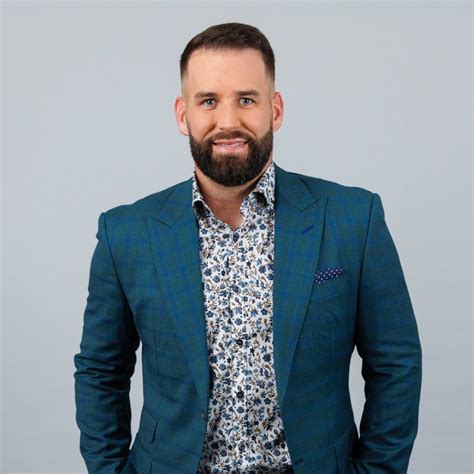
Daniel started doing media while he was still playing. He appeared on NFL Network’s NFL Gameday Final immediately after playing in a Monday Night Football game – making him, by most accounts, the first active player to do that. He built from there: Facebook Live streams, co-hosting The Athletic’s Scoop City podcast with Dianna Russini and James Palmer, then FS1’s The Facility alongside former players. The Facility was canceled in summer 2025.
ESPN announced his hiring in August 2025. He joined as a college football color commentator and NFL studio analyst, partnering with play-by-play voice Clay Matvick. His first assignment was Duquesne at Pittsburgh on August 30. He told Kirk Herbstreit about his early mock game at ESPN – called half of Georgia-Missouri in Charlotte – and said he was, in his own words, “about as bad as you could possibly be.” Herbstreit helped him work through the transition from player to analyst.
ESPN’s producers reportedly believed early that Daniel could become a high-level analyst. Whether that plays out depends less on football knowledge, which he clearly has, and more on whether he develops the broadcasting instincts that are genuinely a separate skill from understanding the game.
Missouri Hall of Fame, 2024
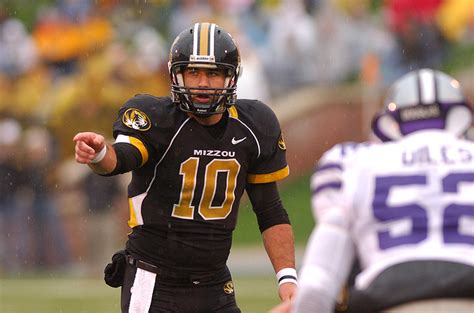
The Missouri Sports Hall of Fame inducted him with the Class of 2024. In his remarks, Daniel noted that Missouri’s offer came first – before the 74 others – and that his father’s straightforward approach to recruiting meant they didn’t overthink it. He signed with Mizzou. The Tigers went 30-11 in his three seasons as a starter, won back-to-back Big 12 North titles in 2007 and 2008, and played in three bowl games.
He’s also in the Carroll ISD Athletics Hall of Honor and the University of Missouri Athletics Hall of Fame, inducted in 2014, six years after leaving Columbia.
What’s genuinely worth noting about the Missouri legacy is the timeline: Daniel left after 2008, and Missouri joined the SEC in 2012. His teams were Big 12 teams. The argument that his tenure raised the program’s national profile enough to make that move possible is not provable, but it’s not crazy either. The Tigers were a footnote in college football before 2007 and a legitimate brand after it.
The Backup Quarterback Problem
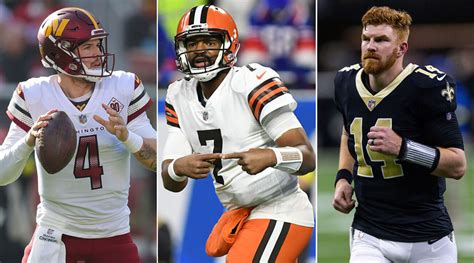
Seven franchises paid Daniel over 14 seasons. That doesn’t happen by accident. Teams kept signing him because he arrived at every facility knowing the offense better than most starters, prepared every week as if he were going to play, and never created locker room problems when he didn’t. Those qualities are worth real money – his career earnings are estimated at well over $30 million across his contracts.
The Eagles deal alone was $21 million over three years, though he collected just one year before requesting his release. The Bears contract in 2018 was reportedly around $10 million guaranteed. For a player who started five games in 14 years, those numbers reflect how seriously franchises take the backup position when they’re not sure if their starter will hold up.
His own post on social media in 2023, timed to the NFL Draft, said it plainly: “I thought I’d get drafted and was heartbroken when I didn’t. 14 seasons later – undrafted and a Super Bowl ring. Don’t let anyone tell you what you can or can’t do.” The message is earnest and probably useful for players in that moment. It’s also just accurate. He did the thing.
Comments