
Charles Haley: The Only Man With Five Super Bowl Rings
From Gladys, Virginia to Canton, Ohio
Nobody recruited Charles Haley. Not really. He played linebacker and tight end at William Campbell High School in Naruna, Virginia, won a district championship, earned defensive player of the year honors for Region III, and still ended up with exactly one Division I scholarship offer. James Madison University. That was it.
He took it.
At JMU, which was running a Division I-AA program at the time and had never once produced an NFL Draft pick, Haley became the school’s first First Team All-American and finished his career with 506 tackles – still the program record. He had 17 sacks over four seasons and led the team in tackles as a sophomore and a junior. In 1985, against Georgia Southern (the eventual national champion that year), he blocked a punt, forced a fumble, recorded a sack, and deflected three passes. In a single game.
The San Francisco 49ers selected him in the fourth round of the 1986 draft, 96th overall. Ninety-five players went before him. He became the first player in JMU history ever drafted into the NFL, and the school’s defensive MVP award now carries his name.
San Francisco: Six Seasons, Two Rings, One Trade Nobody Saw Coming
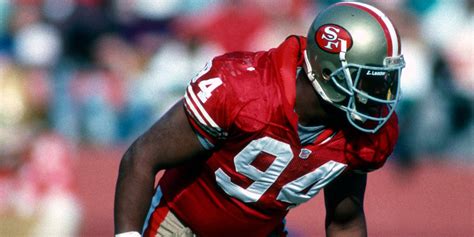
He arrived in San Francisco as an outside linebacker in Bill Walsh’s 3-4 scheme and immediately led the team in sacks. As a rookie. With one start all season. He had 12 sacks in 1986, which ranked second in the entire NFL, and was named to the All-Rookie team by both United Press International and Pro Football Weekly.
The next five years looked roughly the same: Haley led the 49ers in sacks every single season from 1986 through 1991. His best year came in 1990, when he posted 16 sacks – a career high, and the best mark in the NFC – and won NFC Defensive Player of the Year. He went to three Pro Bowls during his time in San Francisco (1988, 1990, 1991) and won two Super Bowl rings, after the 1988 and 1989 seasons.
Then the 49ers traded him to Dallas.
The reasons have been discussed at length. Haley was difficult. Teammates complained. Coaches complained. He clashed with players including Steve Young, which he has discussed publicly more than once without much remorse. What’s interesting, though, is that by the time he left, San Francisco had won back-to-back championships with him as a cornerstone of the defense. The 49ers decided the friction wasn’t worth it. The Cowboys decided it absolutely was.
Dallas Cowboys: Three More Rings and a Dynasty That Made No Sense Without Him
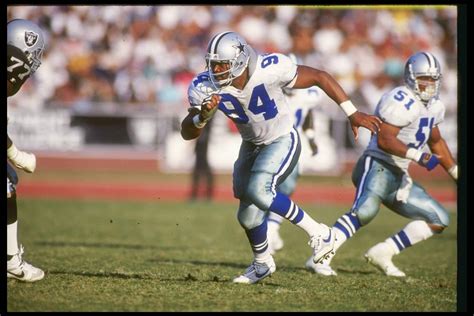
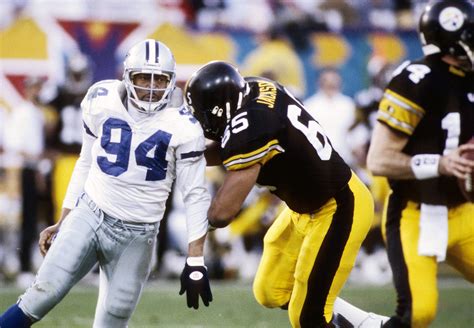
When Haley arrived in Dallas in 1992, the Cowboys moved him to defensive end in their 4-3 scheme. He was 28 years old and coming from a system that had used him differently for six years. He adapted immediately.
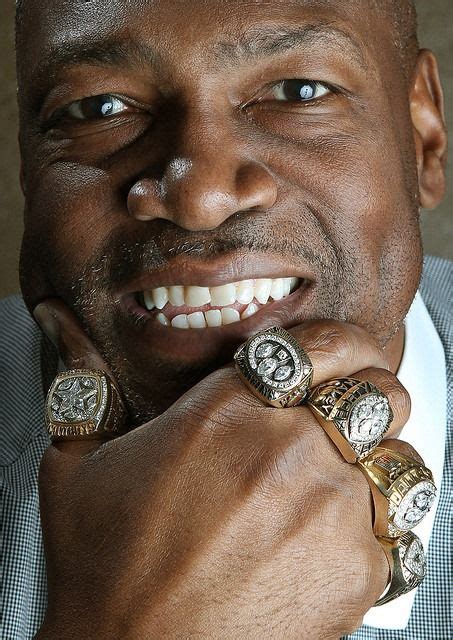
Dallas won the Super Bowl after the 1992 season. And after 1993. And after 1995. Three rings in four years, giving Haley five total, which remains the most by any player in NFL history. No one else has won five. Bill Belichick, as a coach, has six. As a player, five is the ceiling, and it belongs to one person.
His individual numbers held up in Dallas too. He posted double-digit sacks in 1994 (12.5) and 1995 (10.5), earned two more Pro Bowl selections, and won his second NFC Defensive Player of the Year award in 1994 – the only player in league history to win that award with two different teams. The Cowboys’ offense gets most of the attention from that era, and reasonably so: Troy Aikman, Emmitt Smith, Michael Irvin, and Deion Sanders were all household names. But that defense – and specifically Haley’s ability to wreck a quarterback’s day before the play even developed – is what separated Dallas from every other team in the NFC.
A serious back injury in 1996 limited him to five games. He had surgery and retired. Two years later, the 49ers brought him back for two playoff games in January 1999. He played one more full season that year, added three sacks, and walked away for good with 100.5 career sacks across 169 games.
Career Statistics
The numbers below cover his full professional career across both teams and both stints with San Francisco.
| Season | Team | Games | Sacks | Honors |
|---|---|---|---|---|
| 1986 | SF 49ers | 16 | 12.0 | All-Rookie |
| 1987 | SF 49ers | 12 | 6.5 | – |
| 1988 | SF 49ers | 16 | 11.5 | Pro Bowl, SB XXIII |
| 1989 | SF 49ers | 16 | 10.5 | SB XXIV |
| 1990 | SF 49ers | 16 | 16.0 | Pro Bowl, All-Pro, NFC DPOY |
| 1991 | SF 49ers | 16 | 7.0 | Pro Bowl |
| 1992 | Dallas Cowboys | 15 | 6.0 | SB XXVII |
| 1993 | Dallas Cowboys | 15 | 8.5 | SB XXVIII |
| 1994 | Dallas Cowboys | 15 | 12.5 | Pro Bowl, All-Pro, NFC DPOY |
| 1995 | Dallas Cowboys | 16 | 10.5 | Pro Bowl, SB XXX |
| 1996 | Dallas Cowboys | 5 | 1.5 | – |
| 1998–99 | SF 49ers | 11 | 3.0 | – |
| Career Total | 169 | 100.5 | 5 Pro Bowls, 2× All-Pro | |
He also recorded 26 forced fumbles during his career, which ranks 30th all-time in NFL history, and added 11 more sacks in the postseason. He was named All-Pro twice: once as an outside linebacker and once as a defensive end, which is a genuinely unusual distinction – most players who switch positions that significantly see their effectiveness drop.
The Hall of Fame Question Nobody Wanted to Answer
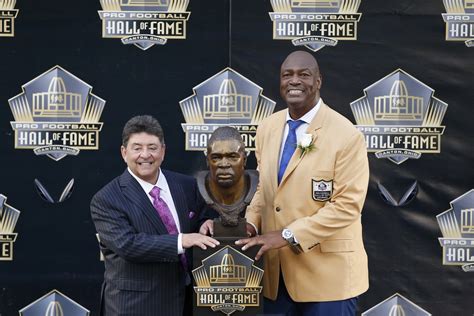
Haley retired after the 1999 season. He was not inducted into the Pro Football Hall of Fame until 2015. That’s a 15-year gap for the only player in league history to win five championships.
The standard explanation is his reputation – the volatility, the locker room incidents, the relationships he torched in San Francisco before Dallas picked up the pieces. Voters didn’t say that explicitly, but the timing is hard to read any other way. Bill Walsh, before he died in 2007, made clear he considered Haley one of the most important players he ever coached. Joe Montana said Haley “was one of the biggest impact players on the 49ers defense.” Neither of those endorsements moved the timeline much.
He was inducted into the Virginia Sports Hall of Fame in 2006, the College Football Hall of Fame in 2011, and the Texas Black Sports Hall of Fame and the Dallas Cowboys Ring of Honor both in 2012. Canton came three years after that, with former 49ers owner Eddie DeBartolo Jr. presenting him. Haley said it was “the best moment of my life” and that he never thought he was good enough to reach the NFL at all, which – given the recruiting process that left him with one college offer – is more understandable than it sounds.
The Personality, the Diagnosis, and What Actually Explains the Behavior
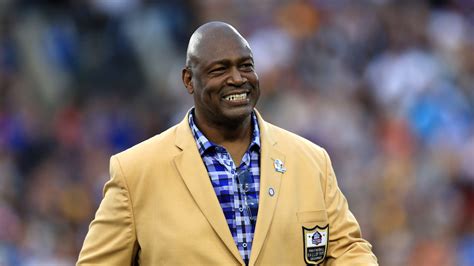
In 2002, three years after his final season, Haley was diagnosed with bipolar disorder. He has since been candid about what that diagnosis explained – and what it doesn’t excuse.
He once destroyed a training room because someone threw away his dominoes. He made life difficult enough for the 49ers organization that they traded away one of their most productive defensive players during an active dynasty run. These are real events and he doesn’t dispute them. What he’s said publicly, including in interviews promoting his 2012 memoir “All the Rage: The Life of an NFL Renegade” and his 2016 follow-up “Fear No Evil: Tackling Quarterbacks and Demons on My Way to the Hall of Fame,” is that he was experiencing something he didn’t have words for and wasn’t willing to admit needed help.
“Football masked my mental illness,” he told a reporter in Athens, Texas, where he was speaking at a NAMI event. “Everybody told me, ‘A man doesn’t cry.’ I didn’t have any friends. I was scared to let people get near me.”
He has also shared that during high school he attempted suicide. That’s not a detail most profiles include, and it reframes every story about his temper. He wasn’t simply difficult. He was carrying something serious for decades before anyone gave it a name.
What I find genuinely surprising about Haley’s story is that the NFL had him for 13 seasons – during which his behavior was frequently documented and discussed – and the system around him produced no diagnosis, no real intervention, and no framework for understanding what was happening. His 1994 season, the year he posted 12.5 sacks and won NFC Defensive Player of the Year for the second time, came while he was still undiagnosed. He was performing at an elite level and struggling privately in ways nobody around him seemed equipped to address.
He stopped taking medication once and hit a dinner table hard enough that the people at nearby tables stood up and left. His kids were scared. “From that moment,” he said, “I said I’m going to get some help.” He’s been an advocate for mental health awareness since his diagnosis, speaking at schools, working with NAMI chapters, and running the Haley Family Foundation, which supports youth mentorship and community development programs.
After Football: Coaching, Memoirs, and What Comes Next
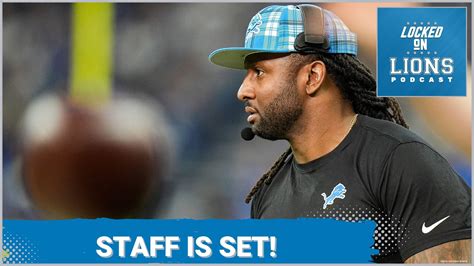
He spent two seasons as a defensive assistant with the Detroit Lions in 2001 and 2002, then stepped away from coaching. The Lions went 2-14 in 2001 and 3-13 in 2002, so the environment wasn’t exactly one that kept coaches around long.
His two memoirs cover different periods of self-understanding. “All the Rage” came out in 2012, before his Hall of Fame induction, and reads as an account of his career and its collateral damage – including his divorce and the relationships that didn’t survive his playing years. “Fear No Evil” came after Canton and deals more directly with the bipolar diagnosis and his years of public advocacy since. He’s been a visible presence at Dallas Cowboys events and continues to speak publicly about mental health, particularly to young people and athletes who might recognize themselves in his pre-diagnosis behavior.
The Cowboys retired his jersey number during his Ring of Honor induction. JMU named their defensive MVP award after him in 1999. He’s received the Ronald E. Carrier Distinguished Alumni Achievement Award from his alma mater. These are the institutional markers of a career well-regarded by the institutions that shaped it, which is a different thing – and sometimes a more meaningful one – than a Hall of Fame vote.
Where He Stands Among NFL Defensive History
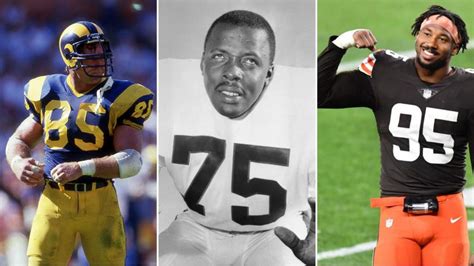
100.5 career sacks places Haley inside the NFL’s 100-sack club, a group with roughly 30 members as of 2025. His postseason sacks (11) are not included in that figure. Reggie White finished with 198. Bruce Smith ended at 200. Lawrence Taylor, who played a different style of game, had 132.5. Haley’s raw sack total is not in the same range as those three, and framing him as their equal would be wrong.
What’s harder to quantify is the franchise context. White and Smith played on very good teams; neither played on five championship teams. Taylor won two Super Bowls. Haley won five, across two separate organizational dynasties, contributing to each as a starter and primary defensive disruptor. The argument for placing Haley in elite company isn’t his total sack count – it’s the combination of individual production and team impact at the highest possible level, maintained across different coaches, different schemes, and a position change at 28 years old.
There’s also the forced fumble record to consider. Twenty-six forced fumbles ranks 30th all-time. Six seasons with 10 or more sacks, which puts him among 22 players in NFL history who managed that. And the two-team All-Pro distinction – linebacker in 1990, defensive end in 1994 – has no real parallel.
His delayed Hall of Fame induction, combined with the long-running debates about his personality, probably cost him some standing in the historical conversation. Players who are hard to root for are harder to remember fondly. But the record of five Super Bowl rings isn’t a matter of debate. Nobody has matched it. Forty years of NFL seasons since his first championship and the number still sits at one: Charles Haley.
Comments