
Andre Rison Football: The Career, the Controversies, and Why He Still Doesn’t Have a Gold Jacket
Andre Rison finished his NFL career with 743 receptions, 10,205 receiving yards, 84 touchdowns, and five Pro Bowl appearances. He won a Super Bowl with Green Bay and a Grey Cup with Toronto, making him one of a very small group of players to hold professional football championships from two different countries. He holds an NFL record that still stands – most teams scored a touchdown for, at seven. And he’s not in the Pro Football Hall of Fame.
From Flint to First Round
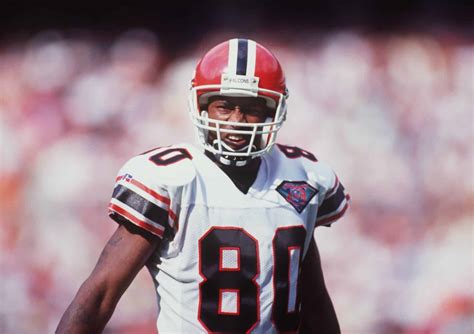
Rison grew up in Flint, Michigan, which in the mid-1980s was already deep into the economic collapse that would define it for the next four decades. He went to Flint Northwestern High School, where he was a three-sport athlete – football, basketball, track – and the kind of talent that small cities produce once a generation and then watch leave.
At Michigan State he played under George Perles and finished his Spartans career with 146 receptions, 2,992 receiving yards, and 11 games over 100 yards receiving. He was a key contributor on the 1987 Michigan State squad that won the Rose Bowl on January 1, 1988, beating USC 20–17. In 2015, Michigan State inducted him into the athletics hall of fame.
The 1989 NFL Draft is one of the most stacked in league history. Troy Aikman went first. Then Tony Mandarich, which is a story unto itself. Barry Sanders third. Derrick Thomas fourth. Deion Sanders fifth. Rison went 22nd to Indianapolis, the second receiver off the board behind Hart Lee Dykes, who went to New England at 16 and never played a full season in the league.
Rison caught 52 passes for 820 yards and four touchdowns in his rookie year, started 13 of 16 games, and earned PFWA All-Rookie honors. Indianapolis went 8-8. Then the Colts traded him to Atlanta.
Five Seasons in Atlanta – and the Numbers That Should Be Enough
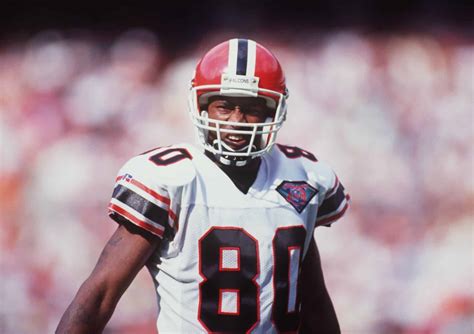
The trade happened April 20, 1990. The Colts sent Rison, Chris Hinton, a fifth-round pick, and their 1991 first-round pick to the Falcons – all so Indianapolis could move up to select Jeff George first overall. Atlanta got the better of it by a distance.
Over the next five seasons, Rison put up numbers that sit comfortably alongside any receiver of the era. Two First-team All-Pro selections, in 1990 and 1991. Four consecutive Pro Bowls, 1990 through 1993. In 1993 he led the entire NFL with 15 receiving touchdowns and was only the fifth receiver in league history to score 60 touchdowns in his first six seasons. He led all NFL receivers in receptions across his first four seasons combined, and his first five.
Chris Berman at ESPN gave him the nickname “Bad Moon” – a reference to the Creedence Clearwater Revival song “Bad Moon Rising” – and it stuck because it fit. Rison was unpredictable. He ran routes with a looseness that drove defensive backs into coverage breakdowns, and he had the hands and body control to make catches that receivers with better pure speed couldn’t replicate.
The 1991 Falcons finished 10-6, went to the playoffs, and Rison was a genuine first-option receiver on a team that actually competed. That doesn’t get mentioned enough when people talk about his peak.
After 1994, he signed with Cleveland.
The Cleveland Year, the Jacksonville Year, and Then Something Unlikely
The Browns gave him five years and $17 million, which at the time was the richest contract ever signed by a wide receiver. Art Modell had to take a loan to cover the signing bonus. What followed was the worst statistical season of Rison’s career: 47 catches, 701 yards, three touchdowns. He was booed at home. The team was in chaos over Modell’s plan to relocate to Baltimore. After a home loss to Green Bay, Rison unloaded on the Cleveland crowd in terms that ended his tenure there before the relocation did.
He was released. Baltimore didn’t want him – the Ravens used that roster spot on Ray Lewis and Jonathan Ogden, their first-round picks in 1996. Rison landed in Jacksonville, where things also went sideways: he had a miscommunication with Mark Brunell during a Week 12 loss to Pittsburgh, got into it with the coaching staff, and was released again.
The Green Bay Packers claimed him off waivers on November 20, 1996.
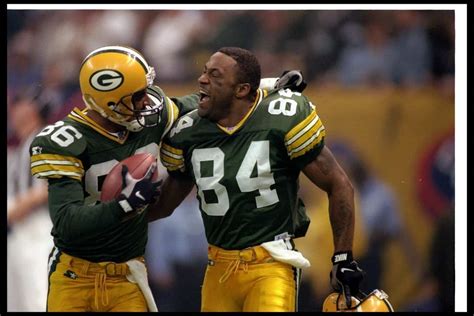
He played five games down the stretch, caught 13 passes. Then the Packers went on a playoff run. Rison caught seven passes for 143 yards and two touchdowns across three postseason games. And on January 26, 1997, in Super Bowl XXXI at the Louisiana Superdome, Brett Favre hit him on the first scoring drive of the game – a 54-yard touchdown, the first points on the board in a 35-21 win over New England.
Favre had been his teammate in Atlanta during the 1991 season, which is one of those details the league’s connective tissue loves to produce. Rison went from being cut twice in the same year to catching a Super Bowl touchdown. You can’t manufacture that arc.
Andre Rison and Lisa “Left Eye” Lopes

In March 1993, Rison began dating Lisa “Left Eye” Lopes, the rapper from TLC. They moved into his house in the Country Club of the South subdivision near Alpharetta, Georgia. The relationship was volatile. Lopes filed an assault charge against Rison in September 1993, which was later dropped.
On the night of June 9, 1994, after another argument, Lopes set fire to a pair of Rison’s sneakers in an upstairs bathtub. The fiberglass tub melted. The structural frame caught. By the time Rison returned from a teammate’s house where he’d spent the night, the $1.3 million mansion was gone.
Lopes turned herself in the following morning. She was charged with felony arson, released on $75,000 bail, went through rehab for alcohol abuse, and received five years probation and a $10,000 fine. At her sentencing, Rison sat next to her and held her hand. He said publicly that he forgave her.
They stayed together. In June 2001, Rison announced on Atlanta hip-hop station WHTA-FM that they planned to marry on July 5 at the Atlanta Botanical Garden. On April 25, 2002, Lopes was killed in a car crash while on a spiritual retreat in Honduras. She was 30.
What strikes me about this story, having read accounts of it from multiple angles, is how thoroughly it swallowed Rison’s athletic identity in the public memory. Ask most people what they know about Andre Rison and the fire comes up before the Pro Bowls do. That’s not a fair trade for what he produced on the field, but it’s the one he got.
Kansas City, Oakland, and Toronto
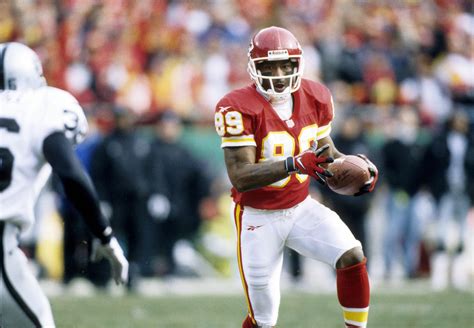
Rison signed with the Kansas City Chiefs before the 1997 season, picked up the nickname “Spider-Man” somewhere along the way, and had a genuine bounce-back year: 72 receptions, which was his most since his Atlanta peak, and a fifth Pro Bowl selection. He was 30 years old and still a legitimate starter. The Chiefs went 13-3 that season, though they lost to Denver in the divisional round.
He played two more years in Kansas City, then one final season with the Oakland Raiders in 2000. That closed out his NFL run: 186 games, 743 catches, 10,205 yards, 84 touchdowns. The seven-teams touchdown record – Colts, Falcons, Browns, Jaguars, Packers, Chiefs, Raiders – is the kind of stat that reflects a career that moved around more than it should have.
In 2004 he joined the Toronto Argonauts of the CFL. The Argonauts won the Grey Cup that year, which meant Rison added a Canadian championship to go with his Super Bowl ring. He was released during the 2005 season.
The Hall of Fame Argument – and Why It’s Messier Than Either Side Admits
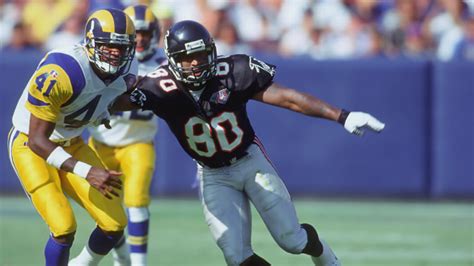
Rison has not been elected to the Pro Football Hall of Fame. He’s been eligible, he’s been discussed, and the debate comes up in cycles without resolution.
The statistical case is real. His 84 receiving touchdowns rank 20th all-time. His 10,205 receiving yards put him 46th all-time in a career that ended in 2000. He made five Pro Bowls and was First-team All-Pro twice, both in an era – 1990, 1991 – when the competition at the position included Jerry Rice, Sterling Sharpe, and Michael Irvin. Irvin, for reference, made four Pro Bowls and is in Canton.
Tim Brown made nine Pro Bowls and is in Canton. Andre Reed made seven and is in Canton. Cris Carter, whose numbers in the 1990s ran alongside Rison’s through the early part of the decade, made eight Pro Bowls and is in Canton. Rison’s receptions total of 743 is lower than all of them – but his peak, specifically the stretch from 1990 through 1993, is as good as any of those players ran in a four-year window.
The complication is the off-field record: the house fire, child-support arrests, a gun incident outside a Kroger in Alpharetta. The Hall of Fame selectors have never published a clean rubric for how personal conduct factors into voting, which means it operates as an invisible weight on some careers and gets overlooked entirely in others. Rison himself, in interviews going back to 2009 and forward through recent years, has been consistent: he believes he belongs, he’s waiting, and he’s aware that waiting may be all he gets to do.
What complicates the “off-field issues” argument is that it gets applied inconsistently. There are players in Canton whose personal histories include serious legal and conduct issues. The Hall has always been selective about which controversies it holds against a player and which ones it quietly sets aside. Rison’s specific controversies had one quality the others mostly didn’t: they involved a famous woman, happened in a pre-social-media era that was somehow still national news, and became permanently attached to his name in a way that most receivers’ personal struggles never did.
After Football – Coaching and What He’s Said About It
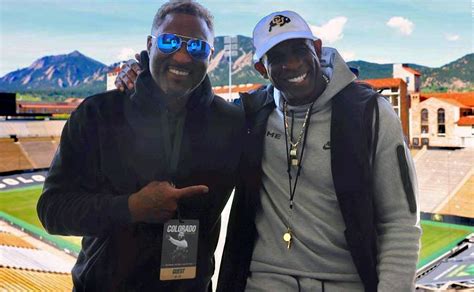
Rison has spent years working with Football University, a camp featuring former NFL players, and coached at the high school level in Flint. He’s spoken in interviews about getting into coaching the same way he got into the game – through relationships and showing up. Deion Sanders, his former Falcons teammate, is a significant thread here: Rison has credited Sanders with getting him started in that world, and in early 2023 told TMZ Sports he’d like to be a candidate for the Las Vegas Raiders’ head coaching position. He also mentioned interest in the Michigan State opening around the same period.
Neither happened. He’s continued working with youth players and has been candid in interviews about using his own missteps as part of what he teaches. “I tell them they can’t make mistakes they can’t come back from,” he said in an AJC interview from 2009 that holds up remarkably well. “Because I overcame adversity. I had some problems I caused, some I didn’t. But I overcame it.”
He was inducted into the Michigan Sports Hall of Fame and the Greater Flint Area Sports Hall of Fame. The Pro Football Hall of Fame door has not opened. He’s 59 now, and the window that feels relevant – the one where voters are still thinking of him as a contemporary rather than a historical figure – is getting narrower every cycle.
743 receptions. 84 touchdowns. One Super Bowl ring. Still no call from Canton.
Comments