
Laremy Tunsil: From the Gas Mask Video to the NFL’s First $30M Offensive Tackle
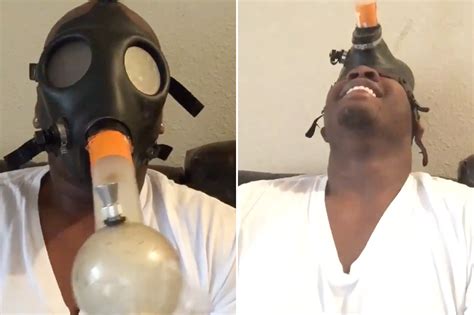
Laremy Alexander Tunsil was projected as a potential No. 1 overall pick in the 2016 NFL Draft. Mel Kiper had him first on his final big board. The Ravens were reportedly ready to take him sixth. Then, at 7:47 PM on draft night, a video appeared on his Twitter account showing him wearing a black gas mask and smoking marijuana – and everything changed in about thirty seconds.
He fell to the Miami Dolphins at No. 13. The slide cost him something in the range of $10 million in signing bonus money. And for the next decade, he spent his career systematically proving everyone who hesitated wrong.
He is now the Washington Commanders’ left tackle, five-time Pro Bowler, and as of March 2026, the first offensive lineman in NFL history to earn $30 million per year. He also represents himself in contract negotiations – no agent – which is unusual enough that it’s worth noting on its own.
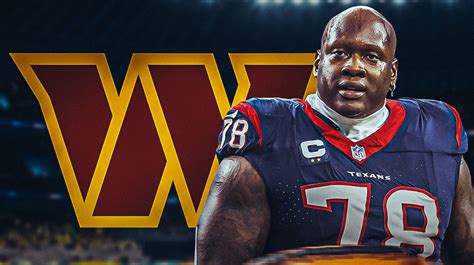
Early Life and College Career
Tunsil grew up in Lake City, Florida, where he attended Columbia High School and was named a Class 6A All-State tackle. He enrolled at Ole Miss in 2013, earned second-team All-SEC honors as a freshman – the second player in school history to do that – and never really stopped getting better.
By his junior year in 2015, he was the consensus top offensive tackle in the country. The numbers from that season tell the story more cleanly than any scouting report could: in the six games Tunsil played, Ole Miss averaged 201.7 rushing yards and 514 total yards per game and allowed one sack. Without him, those averages dropped to 104 rushing yards and 411 total yards, with three sacks per game. One player. That kind of gap.
There was a seven-game suspension in 2015 for accepting impermissible benefits – he missed most of the season’s first half. He came back for the Texas A&M game, helped the Rebels rack up 230 rushing yards and kept Myles Garrett (the SEC’s sacks leader that year) without a sack. He earned first-team All-SEC and second-team All-America honors that season anyway, playing in only six games.
Kiper’s ranking wasn’t a surprise. The question heading into draft night was whether anyone would take him ahead of the quarterbacks. Nobody traded up for a quarterback at pick one that year – the Rams traded up to No. 1, but that was for Jared Goff. The expectation was Tunsil was going top five. Then his phone buzzed.
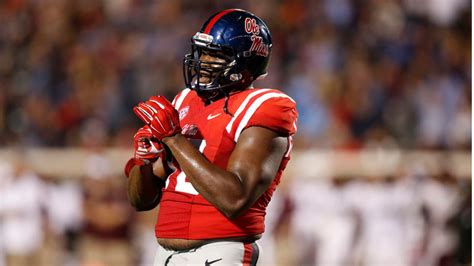
Draft Night, the Gas Mask Video, and the Fall to No. 13
He was in the green room at the Auditorium Theatre in Chicago. His agent at the time, Jimmy Sexton, got word first and notified Tunsil’s party. By the time Tunsil looked at his phone, his account’s password had already been changed – whoever hacked it had locked him out. He couldn’t delete the post. The video had already gone viral.
“I was panicking a little bit,” he told ESPN years later. “I’m just like, ‘Don’t let my mom and my auntie see this.'”
Baltimore was at No. 6 and had reportedly been ready to take him. They took Ronnie Stanley instead. Tennessee passed. Jacksonville passed. By the time Miami called at No. 13, Tunsil said he genuinely thought he might be heading to the second round.
The financial damage was real. The difference in signing bonus between a top-five pick and No. 13 in 2016 was roughly $10 to $12 million. Someone – Tunsil later pointed to a family dispute involving his stepfather – engineered this, on the most important night of his professional life, for reasons that were never entirely resolved in public.
At his post-draft press conference, a reporter asked point blank whether the video was real. He paused, said yes. Then, when pressed about text messages that also leaked that night – showing exchanges about payments from an Ole Miss coach – he answered yes to that too, which briefly created a separate NCAA compliance story. That press conference became its own event.
What’s strange, and I think genuinely underappreciated, is that the thing that cost him millions of dollars on draft night ended up fueling something in him that might be worth more than the money he lost. He’s said repeatedly that the slide gave him a chip on his shoulder. “To this day, I still have that chip just to prove everybody wrong.” Six consecutive Pro Bowls suggest it worked.
In 2022, he minted the gas mask video as a 1-of-1 NFT and donated a portion of the proceeds to the Last Prisoner Project, which supports people incarcerated for cannabis offenses. That’s either a smart rebranding move or a genuinely thoughtful gesture, probably both.
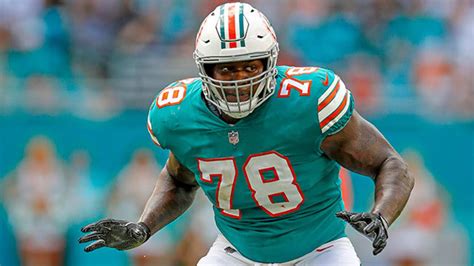
Miami Dolphins (2016–2018)
He made the PFWA All-Rookie Team in 2016. That was about as smooth an NFL debut as a first-round pick can have, particularly given the noise surrounding his arrival.
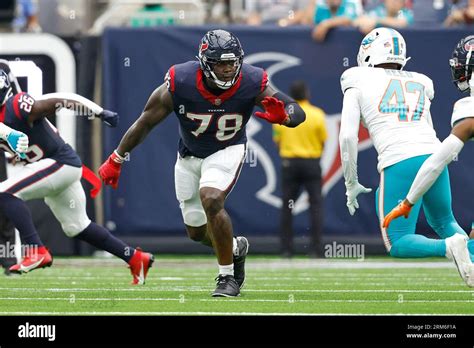
Miami kept him for three seasons. He developed steadily, his pass protection grades improved each year, and by 2018 it was becoming obvious that the Dolphins had a player worth more than they were likely able to keep. The Texans had been watching. In August 2019, Houston made one of the most aggressive trades for a non-quarterback in recent memory: they sent two first-round picks and a second-round pick to Miami for Tunsil and wide receiver Kenny Stills.
CBS Sports later called it “one of the most crippling trades on a franchise” in recent history, from Houston’s perspective. The picks the Dolphins got back eventually helped them rebuild into a playoff team. The jury on whether Houston overpaid is complicated – Tunsil was excellent there for six years – but the pick cost was severe.
Houston Texans (2019–2024): Three Contract Records in Five Years
The Texans didn’t hesitate. Within months of the trade, they signed him to a three-year, $66 million extension – $22 million per year, making him the highest-paid offensive tackle in NFL history at the time. He negotiated it himself.
He made the Pro Bowl that first season. Then again in 2020. Missed 2021 due to injury, then made it in 2022, 2023, and 2024. Six Pro Bowls total in six Texans seasons where he was healthy and active. His PFF pass-blocking grades through that stretch were consistently in the high 80s and low 90s – in 2024, he posted an 89.1 grade, which ranked among the best at his position.
In 2021, Houston signed him to a new extension worth $75 million over three years with $60 million guaranteed. First tackle to earn $25 million per year. He’d already been the first at $20 million per year. Each contract reset the market for his position, and each time, he negotiated the deal himself – unusual enough in the NFL that it routinely gets mentioned in coverage of any new extension.
From 2022 through 2024, his cumulative pass-blocking grade from PFF was 91.7, second among all offensive tackles in that span. His pressure rate allowed was 3.1%, third best at the position. Those aren’t flashy numbers in the way a quarterback rating is, but for an offensive tackle, they’re about as good as it gets.
By late 2024, the Texans were managing a tight salary cap situation. Tunsil wanted another market-setting extension. Houston didn’t see a path to making the numbers work. In March 2025, they traded him to Washington.
Washington Commanders Trade (2025) and His Best PFF Grade Since Being Drafted
The trade terms: Washington sent a 2025 third-round pick (No. 79 overall), a 2025 seventh-rounder (No. 236), a 2026 second-rounder (No. 38), and a 2026 fourth-rounder (No. 106) to Houston. The Commanders also got a 2025 fourth-round pick back. It’s a real price – four picks, including a second-rounder – for a 30-year-old tackle on an expiring deal.
The context was Jayden Daniels. He’d won Offensive Rookie of the Year in 2024, but the Commanders’ 2025 season fell apart partly because he missed 10 games with injuries. Protecting him became the front office’s top priority. Adam Peters, Washington’s general manager, made it clear before the trade that he wanted to get Tunsil’s extension done faster than the Terry McLaurin holdout situation that dragged through 2024. He was right to worry about that.
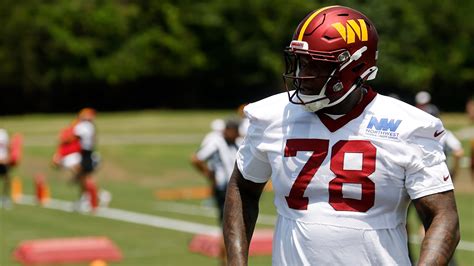
In 2025, Tunsil started 14 games for the Commanders. He allowed 15 total pressures across 802 snaps – a 1.9% pressure rate – and 2 sacks. His PFF pass-blocking grade was 88.9, second among all offensive linemen who played at least 554 snaps. His overall grade of 84.7 was his highest since being drafted in 2016, per PFF, ranking sixth among 89 qualified offensive tackles. Washington’s run game also benefited: the team averaged 4.9 yards per carry, seventh-best in the league.
He did have eight penalties, which is a real number. He didn’t make the Pro Bowl, first time since 2021 he’d been snubbed. But in a season where the Commanders went 5-12, he was arguably the most consistent player on the entire offense. Fred Smoot on the team’s official podcast put it plainly: “If we would have given up a first-round pick, it still would have been enough.”
The March 2026 Contract Extension: NFL’s First $30M Per Year Offensive Lineman
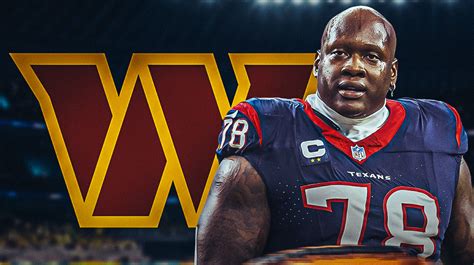
On the first day of 2026 free agency, March 9, Washington signed Tunsil to a two-year, $60.2 million extension. The deal includes $61.5 million in guarantees and a $32.5 million signing bonus – the largest signing bonus ever for an offensive lineman.
It made him, per ESPN’s Adam Schefter, “the NFL’s first $30 million-per-year offensive lineman.” He was already the first at $20 million per year. Then $25 million. Now $30 million. Three times in seven years, he’s reset the market for his position. No other offensive tackle has done that once.
The cap structure is worth understanding because it’s genuinely clever. His 2026 cap hit is just $11.9 million – well below what anyone expected. It rises to $17.2 million in 2027, then jumps to $42.2 million in 2028. There’s an out clause in 2028 that would make it effectively a two-year, $53.4 million deal, though cutting him then would carry $38.7 million in dead cap (spreadable over two years). The Commanders still carry the second-most salary cap space in the NFL despite signing Tunsil and pass rusher Odafe Oweh in the same offseason. Peters structured both contracts to give Washington flexibility without sacrificing the present.
Tunsil told reporters it was the fastest extension negotiation of his career.
Career Statistics and PFF Grades at a Glance
Through the 2025 season, Tunsil has started all 139 games he’s appeared in. Zero games started, zero games inactive – 139 straight. For a position that demands sustained physical punishment, that kind of durability matters almost as much as the grades.
His five Pro Bowl selections came in 2019, 2020, 2022, 2023, and 2024. He missed 2021 with injury and 2025 despite PFF grades that arguably deserved the nod. His PFF pass-blocking grades since 2019: 90.7, 91.3 (approximate range from public reporting), followed by consistent grades in the high 80s and low 90s, with 2025’s 88.9 ranking second in the entire league at his position.
Since 2022 specifically, his cumulative pass-blocking grade is 91.7 – second among all offensive tackles. His pressure rate allowed during that stretch is 3.1%, third-best at the position. In 2025, he allowed 15 pressures in 444 pass-blocking opportunities, which works out to just under a 3.4% rate on the season. Two of those pressures became sacks. In 802 total offensive snaps, he was flagged eight times, which is the part of the 2025 numbers that draws fair criticism.
What the Hall of Fame Conversation Actually Looks Like
He’s said he wants the gold jacket. “I want to be known as one of the best ever.” Given where he is at 31, that’s not an unrealistic thing to want.
Five Pro Bowls is the threshold most analysts point to for serious Hall of Fame consideration at offensive tackle. He has that. Sustained elite PFF grades over a decade? Check. Three market-setting contracts that confirm peer recognition of his ability? Check. 139 consecutive starts? That’s the kind of durability number that voters notice.
What he doesn’t have is a Super Bowl appearance, and Hall of Fame voters for offensive linemen tend to weight team success more than they probably should. Anthony Muñoz is the gold standard; he had three Super Bowl appearances. Orlando Pace made it in 2009 largely on the back of “The Greatest Show on Turf” era with the Rams. Tunsil has protected good quarterbacks – Deshaun Watson, briefly, and more recently CJ Stroud and Jayden Daniels – but hasn’t been on a team that made a deep playoff run.
A few more seasons at this level, especially if the Commanders can convert that offensive line investment into postseason results, and the conversation gets serious. Right now it’s a legitimate maybe, which is further along than most left tackles get.
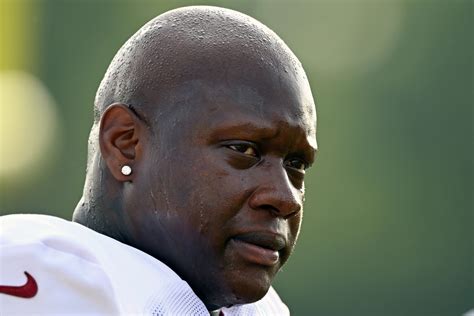
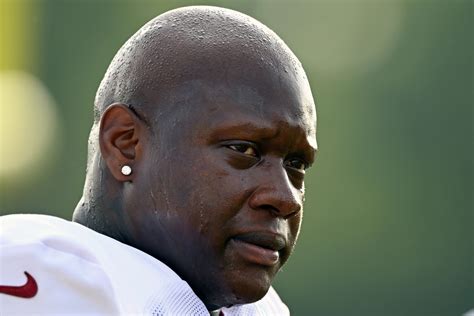
The gas mask video still follows him – he’s acknowledged that people recognize his name and think of it immediately. “When they see a picture of me, they think ‘gas mask,’ and that’s the part that really bothers me, because I’m more than that.” He’s right that he is. But the story is also part of what makes his career worth tracking: whatever happened on April 28, 2016, the player who came out the other side has spent a decade making a very clear argument that the teams who hesitated were wrong.
He cost himself nothing in the long run. The person who hacked his phone gave him a chip he’s been spending ever since.
Comments