
Michael Bennett and the Seattle Seahawks: What He Did, What He Said, and Why It Still Matters
Michael Bennett recorded 39 sacks in five seasons with Seattle. Three Pro Bowls. One Super Bowl ring. And according to Bill Belichick’s own research staff, he was the single biggest concern heading into Super Bowl XLIX – bigger than Richard Sherman, bigger than Earl Thomas, bigger than Kam Chancellor. That last part tends to get lost.
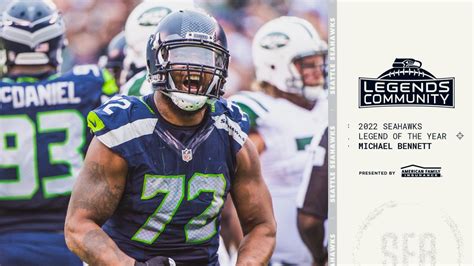
From Undrafted to the Legion of Boom
Bennett went undrafted out of Texas A&M in 2009. Seattle signed him, cut him before the season ended, and Tampa Bay claimed him off waivers in October of that year. He spent four seasons with the Buccaneers, started all 16 games in 2012, and posted nine sacks – a career high at the time. That performance was what brought him back to Seattle.
The Seahawks signed him in March 2013 on a one-year, $5 million deal. What they got was a player who had figured something out in Tampa that most defensive linemen never do: how to win with leverage and angle instead of just raw athleticism. By the end of that first season back, he led the team in sacks (8.5), tackles for loss (9), and quarterback hits (26).
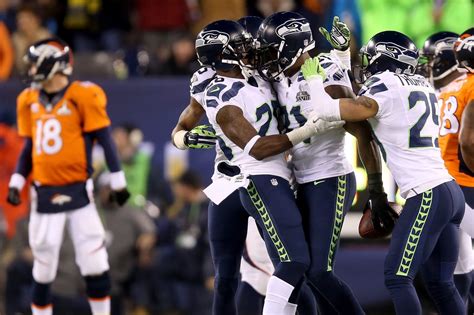
The 2013 defense – the one that held Peyton Manning’s record-setting Broncos to 8 points in Super Bowl XLVIII – is remembered mostly through its secondary. Sherman’s tip in the NFC Championship. Chancellor’s hit on Marshawn Lynch. But up front, Bennett was the reason the pocket collapsed before those moments could even develop. Joe Staley, a six-time Pro Bowl offensive tackle for the 49ers, said Bennett was probably the best defensive end in the NFL during those years. Staley was not prone to flattering the competition.
The Numbers, and What They Don’t Capture
Over five seasons in Seattle: 39 sacks, 69 tackles for loss, 118 quarterback hits. Three consecutive Pro Bowl selections from 2015 through 2017, including Pro Bowl Defensive MVP honors. Those are the headline numbers. They’re accurate and they’re impressive, and they still don’t tell you what it was actually like to gameplan against him.
Ernie Adams, Bill Belichick’s long-time director of football research and arguably the most analytically rigorous mind in the sport during that era, said before Super Bowl XLIX that blocking Bennett was the Patriots’ primary offensive concern. Not covering Doug Baldwin. Not stopping Lynch. Bennett. A team that had just spent a season building one of the most efficient offenses in the league looked at Seattle’s entire defense and identified a 275-pound defensive end who had been cut by his original team five years earlier as the thing they were most worried about.
He wore number 72 in Seattle. One of those players who seems too light for his position and then spends Sundays making tackles for loss in the backfield.
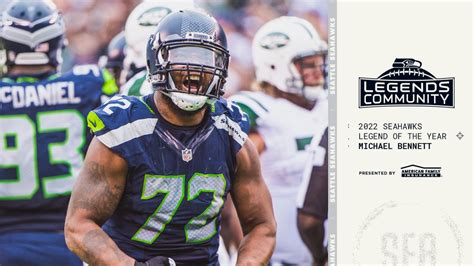
The Sack Dances, the Quotes, the Persona
Bennett was genuinely funny. Not NFL-player-doing-a-media-obligation funny. Actually funny. After sacking Eli Manning in 2013, he did a full impersonation of defensive tackle Brandon Mebane’s sack dance – complete with the signature moves – while Mebane stood nearby watching. After sacking Colin Kaepernick, he kissed his own bicep. He seemed to enjoy himself in a way that most defensive linemen, who are often asked to project menace at all times, don’t allow themselves to.
His quotes hold up better than most athletes’ do. In the summer of 2017, between his second and third consecutive Pro Bowl seasons, he said: “Your longevity in sports is so short, but your legacy is forever. You never know when you’re going to get hurt, you never know when you’re going to get cut. Your legacy has to be what you do in the community.” He was 31 years old at the time, still in his prime, and talking about what would happen when it ended.
He co-wrote a book in 2018 with sports journalist Dave Zirin called Things That Make White People Uncomfortable. It covered football, race, activism, and what it costs an athlete to speak publicly about anything outside the sport. It was not a ghostwritten memoir padded with training camp stories. It had a point of view and it argued it.
August 27, 2017: The Las Vegas Incident
Bennett was in Las Vegas for the Mayweather-McGregor fight. After the event, a noise that sounded like gunshots scattered the crowd outside the Cromwell Casino on Las Vegas Boulevard around 1:30 a.m. Bennett ran. Las Vegas Metropolitan Police were responding to a report of an active shooter. What happened next is where the two accounts diverge and never fully reconcile.
In a statement posted to Twitter on September 6, 2017, Bennett wrote that officers singled him out, ordered him to the ground at gunpoint, held a gun near his head with a threat to shoot him, and had a second officer press a knee into his back hard enough to make breathing difficult. He was held in a police car until they identified who he was. He retained Oakland civil rights attorney John Burris and described the experience as traumatic.
Las Vegas Metropolitan Police Undersheriff Kevin McMahill held a news conference the same day. His account: officers saw Bennett crouching behind a gaming machine and then running out of the building, jumping a wall into traffic on Flamingo Road. McMahill said race was not a factor and that officers acted appropriately given the circumstances. A subsequent internal investigation cleared the officers of wrongdoing.
TMZ obtained video of part of the incident. It begins after the moments Bennett described as most severe, so it neither confirms nor contradicts the specifics of what he wrote. That gap matters – and it’s the part that kept the story unresolved in a way that a lot of coverage glossed over.
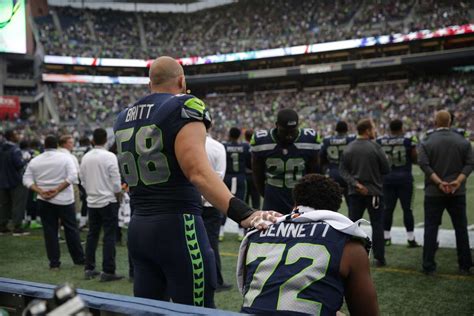
NFL Commissioner Roger Goodell released a statement supporting Bennett. The Las Vegas police union called for the league to investigate Bennett instead. Goodell declined. At the Seahawks’ home opener against San Francisco two weeks later, Bennett took his usual seat on the bench during the anthem. Center Justin Britt and running back Thomas Rawls stood beside him, each with a hand on his shoulder. Cliff Avril and Frank Clark sat with him near the end.
Activism, the Anthem, and the Coalition
Bennett had been sitting during the national anthem since the 2017 preseason, joining a protest movement Colin Kaepernick had started the previous year. He was not the only Seahawk doing it – Seattle was one of the more politically engaged locker rooms in the league during that period – but he was among the most visible and the most willing to explain his reasons in detail.
In September 2017, Bennett co-authored a ten-page letter to NFL Commissioner Roger Goodell with players Anquan Boldin, Torrey Smith, and Malcolm Jenkins. The letter represented a coalition of more than 40 active players focused on criminal justice reform, police-community relations, mass incarceration, and funding for community programs. The letter explicitly asked Goodell for support. It was a formal document, not a press release.
He was named the Seahawks’ nominee for the Walter Payton NFL Man of the Year Award in 2017. After retiring, he joined Cliff Avril and Doug Baldwin to form Champions of Change, a foundation focused on social justice and community development. Those three players – all from the same Seahawks defensive era – have stayed connected to the work in ways that outlasted their playing careers.
After Seattle
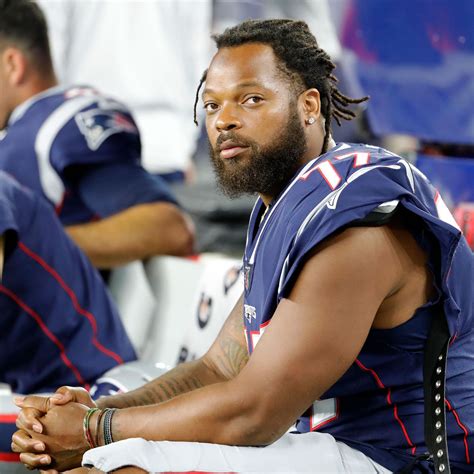
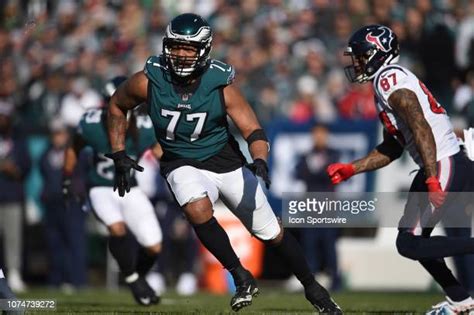
The Seahawks traded Bennett to the Philadelphia Eagles in February 2018, along with a seventh-round draft pick, for a fifth-round pick and wide receiver Marcus Johnson. He was 32 and coming off his third consecutive Pro Bowl season. Philadelphia won Super Bowl LII that year, though Bennett’s contribution was limited by a shoulder injury.
He went to New England in 2019, was suspended one game by the Patriots for a conduct issue, and was traded to Dallas later that season. He announced his retirement after the 2019 campaign. Career totals: 156 games, 69.5 sacks, 10 forced fumbles.
A 2018 criminal charge out of Houston – stemming from an alleged shove at Super Bowl LI in February 2017, when he was trying to reach his brother Martellus on the field after the Patriots won – was eventually dismissed in 2020 after prosecutors determined there was insufficient evidence. That charge, filed a year after the alleged incident and announced the week Bennett went public about the Las Vegas incident, drew significant suspicion from his supporters about the timing. It was never resolved in a way that satisfied either side.
The Seahawks Top 50 List (2025)
In 2025, Seattle celebrated its 50th season as a franchise. As part of that, the organization asked fans, former players, front office staff, and Seattle media to vote on the top 50 players in franchise history. Bennett made the list.
The full roster includes Steve Largent, Walter Jones, Marshawn Lynch, Russell Wilson, Richard Sherman, Earl Thomas, Kam Chancellor, Bobby Wagner, and Cortez Kennedy – players who defined entire eras of Seahawks football. Bennett is in that company, which tells you something about how the franchise and its fans remember those five years.
The ceremony was held at Lumen Field during a halftime show in 2025, with honorees receiving a commemorative jacket. Bennett, who lives in Honolulu with his family in retirement, was part of it. What I find interesting is that a player who spent five years in Seattle – not ten, not a career – made a list that includes people who spent their entire NFL careers there. Five seasons, one ring, and three Pro Bowls was apparently enough. Based on what those five seasons actually produced, it’s hard to argue with.
Where He Stands in Seattle’s Defensive History
The Seahawks have had good defensive ends across their history. Jacob Green played 12 seasons in Seattle and retired with 97.5 sacks, the franchise record. Chris Clemons had 11.5 in 2012 alone. Cliff Avril, who played alongside Bennett from 2013 through 2017, was the other half of one of the better two-man edge-rush combinations in the league during that run.
Bennett’s 39 sacks in five seasons don’t top Green’s overall total. But sack totals are a narrow way to evaluate a defensive lineman, and by the broader measures – tackles for loss, quarterback hits, impact on opposing game plans – Bennett during the 2013-2017 period was playing at a level that put him in a different category than most players who wore that uniform.
The Belichick detail keeps coming back. You can find plenty of reasons to rank a player based on statistics or awards. But when the most analytically prepared coaching staff in the sport spends the week before the Super Bowl telling their offense that Bennett is their biggest problem, that’s a data point statistics don’t generate on their own.
Comments