
Who Was Gale Sayers? The Running Back Who Did More in 68 Games Than Most Do in 200
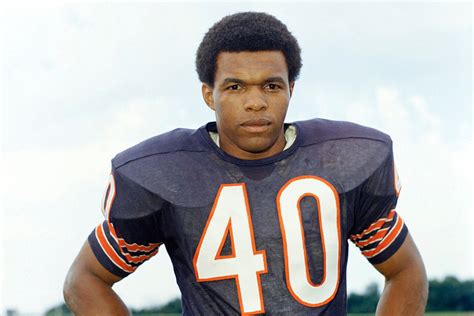
Gale Sayers played seven seasons for the Chicago Bears, but injuries reduced that to roughly five of real football. He finished with 4,956 rushing yards – a number that wouldn’t crack the top 50 all-time. And in 1977, at age 34, he walked into Canton as the youngest player ever inducted into the Pro Football Hall of Fame. Nobody has been younger since.
Early Life: Wichita to Omaha to Lawrence
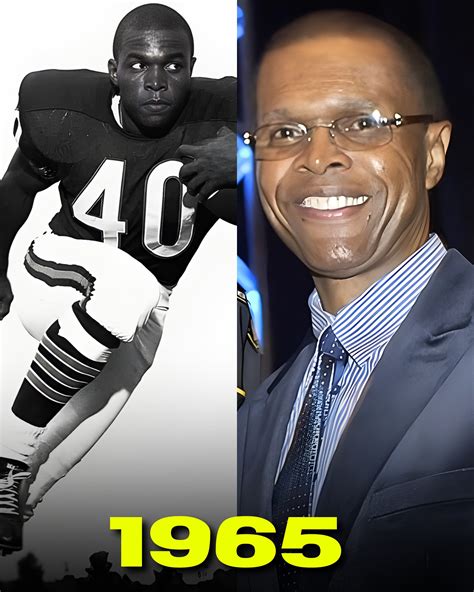
He was born May 30, 1943, in Wichita, Kansas, the second son of Roger and Bernice Sayers. The family moved to Omaha, Nebraska, where Gale attended Omaha Central High School and started drawing attention as a running back and track athlete. Speed was obvious early. What wasn’t obvious – until he got to college – was what he could do with a football in open space.
At the University of Kansas he played three seasons for the Jayhawks, finishing with 2,675 rushing yards and 3,917 all-purpose yards. Those are good numbers. The number that people actually remember is 99. In 1963, Sayers broke loose against Nebraska in Lincoln for a 99-yard run, the first in NCAA Division I history. His senior year he returned a kickoff 96 yards to upset Oklahoma 15-14. He was a consensus All-American twice.
Both the Chicago Bears and the Kansas City Chiefs drafted him in the first round in 1965 – Chicago fourth overall in the NFL draft, Kansas City fifth in the AFL draft. He chose Chicago. That decision is the whole story.
The 1965 Rookie Season: Six Touchdowns in One Game
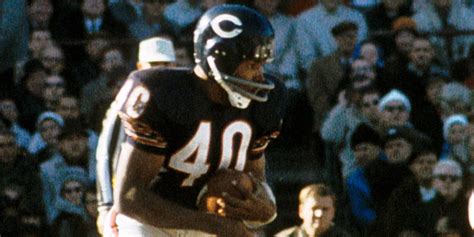
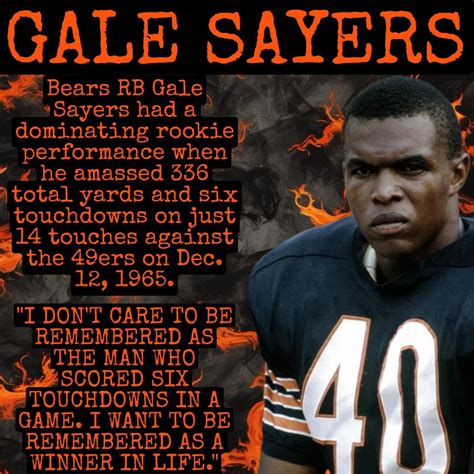
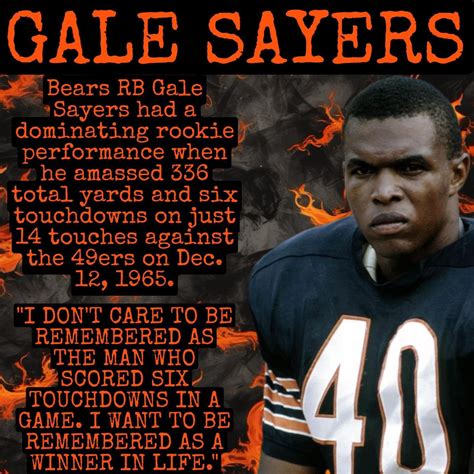
On December 12, 1965, at Wrigley Field in Chicago, the Bears played the San Francisco 49ers on a field that had turned to mud. Most backs would have lost half a step in those conditions. Sayers scored six touchdowns – an 80-yard pass-run play, a 50-yard rush, a 65-yard punt return, and three shorter scores – tying the all-time single-game NFL record. George Halas, who had been coaching pro football since 1920, called it the greatest performance he had ever seen from a ball carrier.
That game was the exclamation point on a season that had already been extraordinary. Sayers finished 1965 with 22 rushing touchdowns and 132 points, both rookie records at the time. He gained 2,272 all-purpose yards. He made the Pro Bowl in his first year and was the unanimous choice for NFL Rookie of the Year.
What made him hard to stop wasn’t just speed – plenty of backs were fast. It was the cutback. Sayers could change direction at nearly full speed, which almost nobody else could do at his size. Defenders who had an angle on him would suddenly find he’d already gone the other way. He described his own running style as “lurchy, herky-jerky” – keeping people off-balance so that even when contact came, the defender was already wrong-footed.
Career Stats and Records
His 1966 season produced 1,231 yards on the ground, which led the NFL. He won the rushing title again in 1969. Five consecutive first-team All-Pro selections from 1965 through 1969. Four Pro Bowls, with MVP honors in three of them. His career kickoff return average of 30.6 yards per return is the highest in NFL history – it has never been broken.
Across his full career: 4,956 rushing yards, 112 receptions for 1,307 yards, 2,781 kickoff return yards. Combined net yards of 9,435. He set 23 franchise records for the Bears and seven NFL marks. He played 68 games total.
For context, a running back in today’s NFL typically plays 16 to 17 games per season. Sayers’ 68-game career is about four full modern seasons. The Hall of Fame voters looked at those 68 games and said it was enough – first ballot, no debate.
The Knee Injuries That Ended Everything
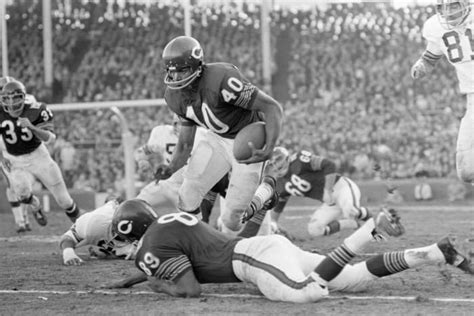
November 10, 1968. Bears versus 49ers. Sayers cut left on a run and his right knee gave out – a torn medial collateral ligament and damaged anterior cruciate. Surgery followed immediately. The rehabilitation was brutal and uncertain; the medical tools available in 1968 for this kind of repair were far cruder than anything used today.
He came back in 1969 and led the NFL in rushing with 1,032 yards. That comeback is, by most accounts, one of the most remarkable in pro football history. Bear in mind: he had missed almost all of 1968, returned the following year, and still won the rushing title. His teammates voted him the George S. Halas Award for courage.
Then in 1970, the left knee went. He played parts of the 1970 and 1971 seasons but was clearly diminished – 26 carries in 1971. He retired before training camp in 1972. He was 28 years old.
What would the numbers have looked like healthy? Nobody can say with confidence, but Walter Payton – who played 13 seasons and set what was then the all-time rushing record at 16,726 yards – spent his entire Bears career in Sayers’ shadow in terms of pure running ability, at least as far as his teammates and coaches were concerned. That comparison is not a knock on Payton. It says something about how people who watched Sayers actually felt.
Brian Piccolo, Brian’s Song, and What the Story Actually Was
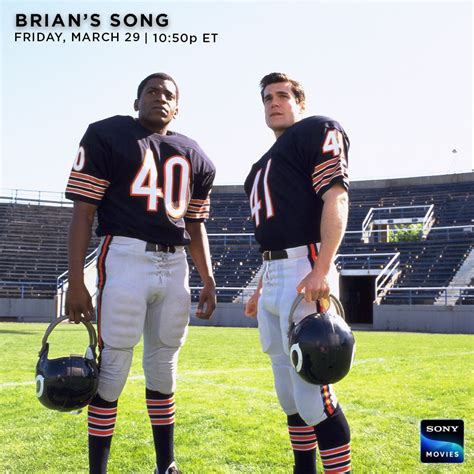
In 1967, the Bears stopped assigning hotel rooms by race. Sayers, who was Black and already the best player on the team, was paired with Brian Piccolo, a white running back who had come up from the practice squad. By most accounts they didn’t immediately bond. Piccolo’s biographer Jeannie Morris quoted him calling Sayers “an arrogant son of a bitch” when they first met. That’s the real starting point of the friendship, not the one the movie shows.
They became close over time, partly through competing for carries and partly because Piccolo helped push Sayers through the 1968 knee rehabilitation. When Sayers came back in 1969 and won the rushing title, he accepted the Halas Award at the annual dinner and told the room he wanted them to love Brian Piccolo – that Piccolo was the man of courage, not him. Piccolo had been diagnosed with embryonal cell carcinoma and would die at 26 in June 1970.
The 1971 TV film Brian’s Song, based on a chapter from Sayers’ autobiography I Am Third, aired on ABC on November 30, 1971, and drew one of the largest audiences in made-for-TV movie history at that point. It exaggerated the closeness of the friendship – Morris herself said the film “exaggerated” it while not abusing the story. But the emotional core was real: two men from different racial backgrounds, competing for the same job, who ended up genuinely caring for each other at a moment when that kind of friendship across racial lines was not common or easy.
Millions of people who have no idea what Sayers’ kickoff return average was know his name because of that movie. That’s an odd kind of immortality – being remembered more for a friendship than for a career that was by any measure extraordinary on its own.
After Football: Athletic Administration, Business, Philanthropy
He went back to school. After retiring in 1971, Sayers returned to the University of Kansas, completed his undergraduate degree, then earned a master’s in educational administration. He became assistant athletics director at Kansas from 1972 to 1976, then took the full athletic director role at Southern Illinois University, where he served until 1981.
Back in Chicago, he co-founded Sayers and Sayers Enterprises, a sports marketing and public relations firm. Later he founded Sayers 40 Inc., a technology solutions company that grew into a significant operation – not a hobby business. He also supported underserved schools and adoption programs through philanthropic work.
The National Association of Collegiate Directors of Athletics inducted him into the John McLendon Minority Athletics Administrators Hall of Fame in June 2009. He had been building that second career quietly for nearly four decades, and it doesn’t get nearly enough attention.
Dementia, Death, and the Question His Wife Raised
In March 2017, Sayers’ wife Ardythe told reporters publicly that he had been diagnosed with dementia and that she partly blamed his football career. He had been declining for years by that point. He died September 23, 2020, at his home in Wakarusa, Indiana. He was 77.
The Pro Football Hall of Fame flew its flag at half-staff. NFL commissioner Roger Goodell called him one of the finest men in the league’s history. Hall of Fame president David Baker noted that Sayers had played only 68 games and still made the Hall on the first ballot – a fact Baker described as “clear-cut.”
Ardythe’s comment in 2017 came three years before his death, when the conversation about CTE and long-term brain damage in NFL players had already been building for years. His case doesn’t prove a direct link between football and his dementia – medicine doesn’t work that cleanly. But it sits in that conversation, and it’s worth acknowledging that his wife was direct about it at a time when the league was still largely resistant to the connection.
Where Sayers Fits Among the All-Time Greats
The standard objection to ranking Sayers among the best running backs ever is sample size. Sixty-eight games. You can’t know what he would have become. That’s a fair point. It’s also true that what he produced in those 68 games was statistically extraordinary on a per-game basis, and that everyone who played against him – coaches, linebackers, defensive backs – consistently rated him as the most difficult runner they had ever faced.
Dick Butkus, his teammate and one of the best linebackers in history, said Sayers “ran circles around everybody” in practice. Butkus was not given to flattering his peers. George Allen, who coached against Sayers repeatedly, placed him above Jim Brown as a pure open-field runner. That’s a minority opinion, but it wasn’t a careless one.
The NFL named him to both the 75th and 100th Anniversary All-Time Teams. His jersey number 40 is retired by the Bears. His number 48 is retired by the University of Kansas. The youngest Hall of Famer in history, still, after nearly 50 years.
What I find genuinely strange about his legacy is that the injuries feel like the point of the story, rather than a detour from it. Most athletes are remembered for what they built. Sayers is remembered partly for what got taken away – and yet what remains, the actual record, is enough that the taking-away almost doesn’t matter. The 1965 season alone would justify a serious Hall of Fame conversation. The rest is extra.
Comments