
John Riggins and the Washington Redskins: Riggo, the Diesel, and a Legacy Built on Fourth Down
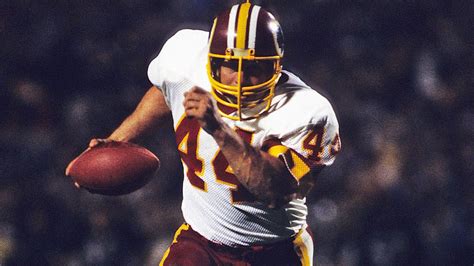
Fourth-and-one, Miami 43-yard line, 10 minutes left in Super Bowl XVII. Joe Theismann called “I-Left, Tight Wing, 70 Chip” in the huddle. John Riggins took the handoff, hit the hole Joe Jacoby and Russ Grimm opened on the left side, absorbed a hit from cornerback Don McNeal at the line of scrimmage – McNeal was 5-11 and 185 pounds, Riggins was 6-2 and 240 – and shook him off like someone brushing lint off a coat. Then he ran 43 yards untouched into the end zone. Washington led 20-17. They won 27-17. Riggins finished with 166 yards on 38 carries, both Super Bowl records at the time.
What makes the story strange is what came before it. Riggins had spent the entire 1980 season on his farm in Kansas, refusing to play because the Redskins wouldn’t renegotiate his contract. He was 31. Most teams would have moved on. Most players who walk out at 31 don’t come back as Super Bowl MVPs.
Before Washington
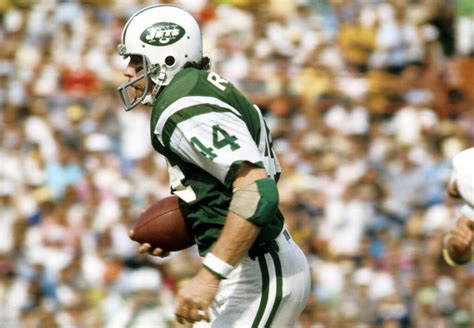
Riggins grew up in Centralia, Kansas – population under 500 – and played college ball at the University of Kansas, where he broke Gale Sayers’ school rushing records. The New York Jets took him sixth overall in the 1971 draft. He spent five years there, put up solid numbers, and wore a Mohawk to training camp, which for 1971 was the kind of thing that got written about.
His Jets career topped out at 1,005 rushing yards in 1975. Good, not great. The franchise wasn’t built around him, and he knew it. When his contract expired, four teams called: Minnesota, Houston, Washington, and the LA Rams. He signed with the Redskins in 1976 for five years at $1.5 million total – compared to the $63,000 he’d made in his final Jets season. He said later he picked Washington because of their winning record. Maybe. The $1.44 million raise probably helped clarify his thinking.
The First Run in Washington
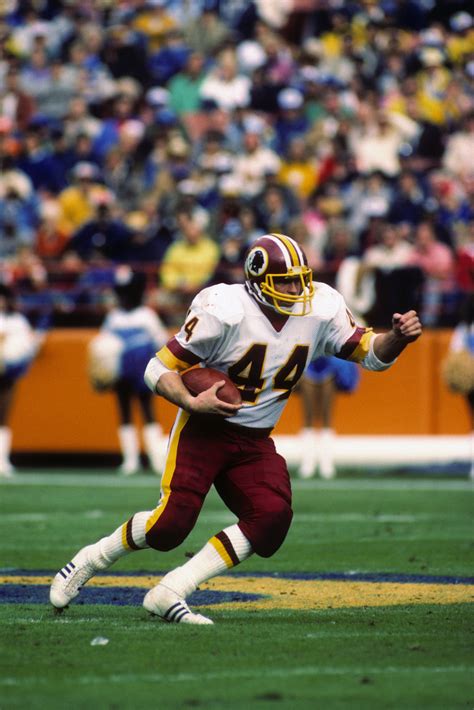
George Allen was still coaching Washington when Riggins arrived, running a committee backfield that included Calvin Hill and Mike Thomas. Riggins carried it 162 times for 572 yards in 1976. Fine, nothing more. He hurt his knee in 1977 and missed most of the season.
Allen left after 1977, Jack Pardee came in, and suddenly Riggins was the lead back. He ran for 1,014 yards in 1978 – his first 1,000-yard season – and repeated it in 1979 with 1,153 yards. Washington went 10-6 and 10-6 those two years, both times making the playoffs. Then, on the last day of the 1979 regular season, they lost to Dallas 35-34. Riggins said afterward: “I played as well that day as I ever played and we still lost.” Before training camp in July 1980, he asked the Redskins to renegotiate his $300,000-per-year deal. They said no. He left.
The Farm, the Return, and Joe Gibbs Making a House Call
The 1980 season happened without him. Washington went 6-10. Riggins sat in Lawrence, Kansas, hunting and farming. The NFL put him on the “left camp-retired” list, which meant he couldn’t sign anywhere else even if he wanted to.
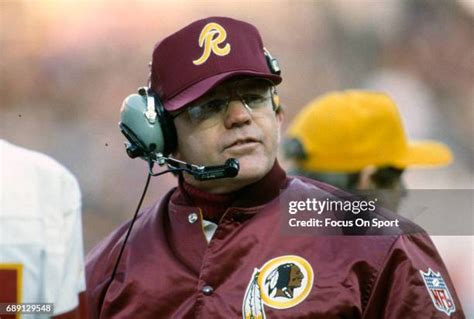
In the spring of 1981, new head coach Joe Gibbs drove out to Kansas to make his case in person. Riggins was out hunting when Gibbs arrived, so the coach sat in the living room and talked to Riggins’ wife. When Riggins got back, they had a conversation Gibbs described as unlike anything else in his coaching career. Shortly after, Riggins returned to Washington with a line that has outlived every press conference quote from that era: “I’m bored, I’m broke, and I’m back.”
He ran for 714 yards in 1981. Not the 1978-79 version of himself, not yet. Gibbs was installing his one-back offense and building the offensive line that would become the Hogs. Riggins was the designated engine of that system, but the engine needed a season to warm up.
1982: Nine Games, Four Playoff Wins, One Run That Mattered
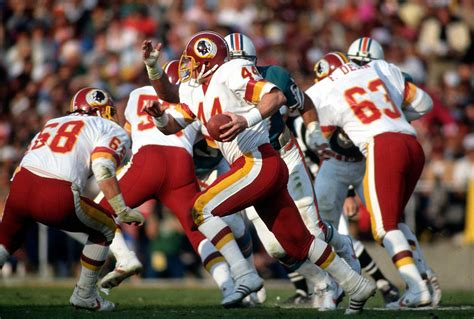
The 1982 season was shortened to nine games by a players’ strike. Riggins ran for 553 yards in the regular season, which looks modest until you understand he was 33 years old and averaging 4.3 yards per carry behind a line that had, in Joe Bugel’s phrase, fully become the Hogs. Jacoby at left tackle, Russ Grimm at left guard, Jeff Bostic at center, Mark May at right guard, George Starke at right tackle. They were enormous, mean, and precisely coached.
Washington’s playoff format that year put 16 teams in, so they played four games before the Super Bowl. Riggins ran for more than 100 yards in all four. His total for the postseason: 610 yards on 136 carries. That was a record then and held for years. By the time Super Bowl XVII kicked off at the Rose Bowl in Pasadena on January 30, 1983, he had already had four of the best games of his career. What he did in the fifth one anyway is what people remember.
The 43-yard run came on a play called “I-Right 70 Chip.” Theismann handed it to Riggins going left. Jacoby, who weighed 300 pounds, and Grimm, who weighed 275, cleared the way. McNeal was the last man and lost the footrace. After the game, at a party in Washington, Riggins reportedly leaned over to Supreme Court Justice Sandra Day O’Connor and told her to “lighten up, Sandy.” She was seated next to him at dinner. O’Connor, to her credit, later said she didn’t mind. That detail – real, unprovable-looking, not the kind of thing anyone invents – is pretty much John Riggins in a sentence.
1983: The Season That Doesn’t Get Enough Credit
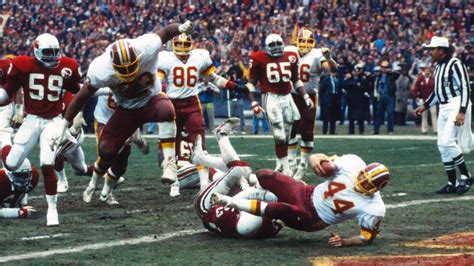
The Super Bowl is what most people know. The 1983 season is what actually separates Riggins from almost every other running back in NFL history.
He was 34 years old. He rushed for a career-high 1,347 yards and scored 24 touchdowns – all rushing, none receiving. The 24 TDs were an NFL record. He reached the end zone in 13 consecutive games, tying another record. He fumbled three times across 468 touches, regular season and playoffs combined. The Bert Bell Award that year went to him as the NFL’s best player, and he earned his only First-Team All-Pro selection.
That touchdown record stood for 12 seasons. Emmitt Smith broke it in 1995. Before Smith, every year from 1983 to 1994, the NFL record for rushing touchdowns in a single season belonged to a 34-year-old workhorse back who’d spent a year on a Kansas farm. Washington went 14-2 that regular season, lost to the Raiders 38-9 in Super Bowl XVIII, and Riggins finished with 1,239 rushing yards the following year at age 35 – his fifth and final 1,000-yard season. No player has rushed for more yards at ages 34 and 35 than Riggins. That’s not a trivia point; it’s genuinely hard to explain.
What the Numbers Actually Say
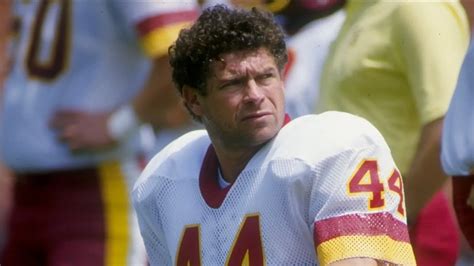
2,916 career carries. 11,352 rushing yards. 104 rushing touchdowns. 250 receptions for 2,090 yards and 12 more scores. Total touchdowns: 116.
He played 175 games over 14 seasons across two franchises. His yards-per-carry average – 3.9 – doesn’t read as flashy, and that’s probably the one honest argument against putting him in the conversation of greatest backs ever. Barry Sanders averaged 5.0. Jim Brown averaged 5.2. Riggins was a between-the-tackles grinder, not a cutter. What that 3.9 reflects is 2,916 carries, many of them in short-yardage situations where he was being handed the ball because nobody else on the roster could be trusted with it. He didn’t run around people. He ran through them, and did it for 14 years.
His postseason line tells the real story: 251 carries, 996 yards, 12 touchdowns in nine playoff games. The 1982 postseason alone (610 yards, 4 games) is one of the best playoff runs any back has ever had, regardless of era.
The Hogs and the System That Made It Work
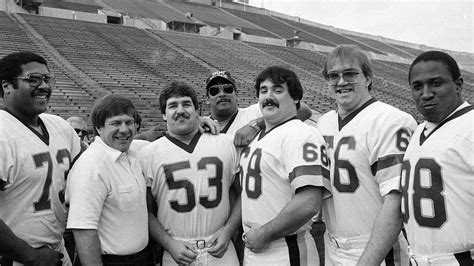
Riggins didn’t run in a vacuum. Joe Gibbs’ one-back offense in the early 1980s was designed specifically around a physical back who could handle 30-plus carries a game, and Gibbs built the offensive line to match. Joe Bugel, the line coach, called them the Hogs partly as an inside joke and partly because it fit. Jacoby and Grimm both ended up in the Hall of Fame. Jeff Bostic played center for a decade and never missed a start he was healthy for.
The scheme mattered. Gibbs’ offense asked Riggins to read one gap, hit it hard, and trust the blocking. It wasn’t complicated. What was complicated was executing it at the level Washington did for three straight seasons, particularly the 1982-83 stretch. Theismann managed the passing game well enough to keep defenses honest, but everyone knew what was coming. They ran Riggins anyway. He averaged 4.3 yards in the 1982 playoffs running into defenses that were specifically trying to stop him.
Hall of Fame, Ring of Fame, and What Came After
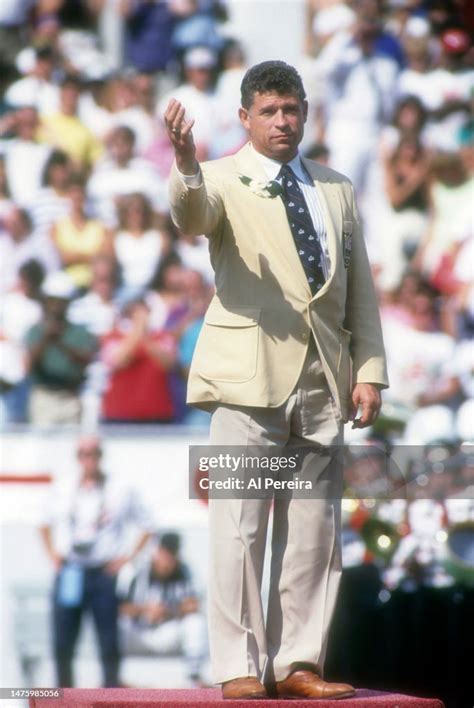
Riggins retired after the 1985 season at 36. The Redskins put him in their Ring of Fame at RFK Stadium in 1990. The Pro Football Hall of Fame inducted him in 1992 in Canton, Ohio – Class of ’92, alongside Lem Barney, Al Davis, John Mackey, John Hannah, and Ron Mix.
He didn’t disappear. He did television and radio work in the Washington market. He hosted a hunting, fishing, and cooking show on the Discovery Channel called “Riggo on the Range.” He launched a sausage brand and a beer called John Riggins 4th & 1 Pilsner. He did voicework, some acting, and stayed visible enough in the DC area that when the team rebranded from Redskins to Commanders in 2020, he was still one of the names people brought up when explaining what the old franchise meant to its fans.
He turned 76 in August 2025. The Kansas Ring of Honor inducted him in 2007, four decades after he played his last game for the Jayhawks.
Where Riggins Sits in Washington Football History
The Redskins Ring of Fame includes Sammy Baugh, Sonny Jurgensen, Bobby Mitchell, Darrell Green, Art Monk, Joe Theismann, Dave Butz, Chris Hanburger, and others. It’s not a weak list. Riggins belongs at or near the top of it, and not just because of Super Bowl XVII, though that alone would make a case.
What sets him apart is the combination: the career volume, the postseason production, the 1983 season, and the fact that his best football happened after he came back from walking out on the team entirely. Most franchise legends are continuous stories – drafted here, grew here, retired here. Riggins left. He sat out a year. He came back at 32 and had the four best seasons of his career. That particular shape of a career doesn’t happen often.
No Washington running back has come close to his postseason numbers. Clinton Portis ran for over 1,000 yards in 2005 and 2008 and was very good. Portis never played in a Super Bowl. Alfred Morris ran for 1,613 yards in 2012, which is more than Riggins ever managed in a single regular season, and he was also very good. Morris appeared in one NFC Championship game. The postseason is where Riggins separated himself from everyone who followed him, and it’s the part of his record that doesn’t age.
One thing I keep coming back to: the 1982 postseason record of 610 rushing yards was set in four games. Not six, not eight. Four. The NFL that year, because of the strike, used a 16-team playoff bracket that required four wins to reach the Super Bowl. Riggins ran for more than 100 yards in every single one of those games, then ran for 166 more in the Super Bowl itself. That’s 776 yards across five postseason games in the same year. At 33.
Comments