
Rich Gannon and the Oakland Raiders: A Journeyman’s Late-Career Peak
Eleven Years Before Oakland
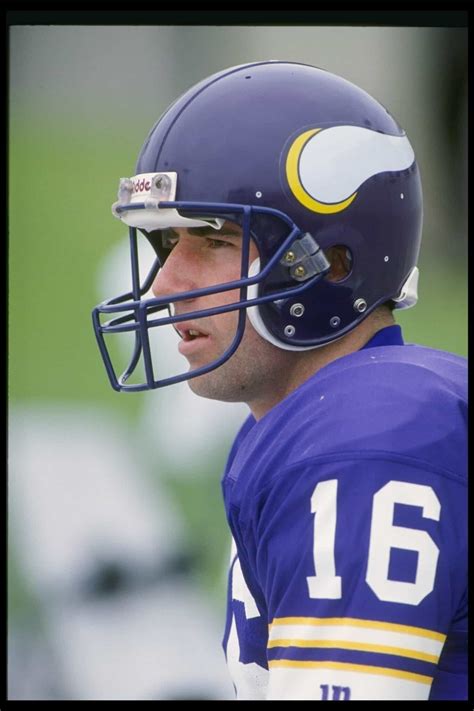
The New England Patriots drafted Rich Gannon in the fourth round of the 1987 NFL Draft with a plan he wanted no part of. They wanted to move him to wide receiver, or tight end, or defensive back – anything but quarterback. He refused, and they traded him to Minnesota. That detail matters because it tells you something about who Gannon was before the Raiders ever got involved: someone who had spent his entire career insisting he could play, while the league mostly disagreed.
He spent six seasons in Minnesota, then one in Washington in 1993, then four with Kansas City from 1995 to 1998. Good years, some of them. He threw for over 2,500 yards in 1997 with the Chiefs. But he was never the unquestioned starter, never the guy a franchise built around. When he signed with Oakland in February 1999, he was 33 years old and had made zero Pro Bowls.
In his own words to the Associated Press: “In 1999, I was really a journeyman quarterback. I had played in the league 11 or 12 years and never really felt I was given an opportunity or chance to be an everyday player.”
Jon Gruden, Al Davis, and the West Coast Fit
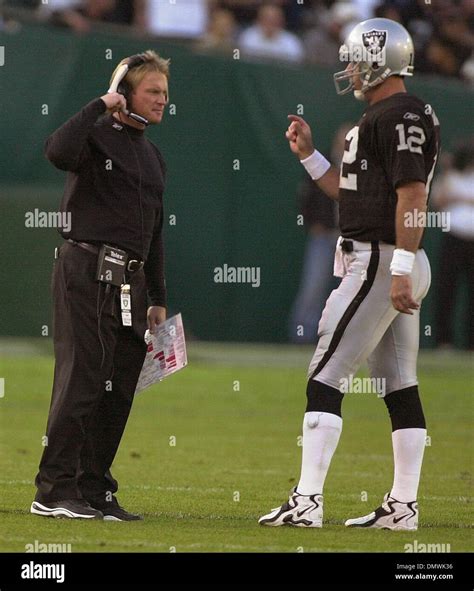
Jon Gruden ran a West Coast offense built on accuracy, quick reads, and timing routes. Gannon was precise, football-smart, and had a quick enough release to make it work. Al Davis signed off. That was the whole equation.
What’s easy to miss is how much of Gannon’s success in Oakland came down to mutual desperation – in the best sense. Gruden was a young head coach, 35 years old when the 1999 season started, trying to prove he belonged. Gannon said in 2018 that he believed the two connected because they were wired the same way: “Jon feels like he has to prove something every day of his life. I think it’s what drives him and motivates him. I think it’s why he and I had such great symmetry because I think I’m wired the same way.”
Gruden’s read of Gannon was similarly blunt. He credited Gannon’s ability to see blitzes and make audibles at the line as something he hadn’t coached before at that level.
The 1999 Raiders went 8-8. Not a great record, but Gannon completed 64.4 percent of his passes, threw for 2,724 yards and 18 touchdowns, and made his first Pro Bowl at age 33. The Raiders won the AFC West the next three seasons in a row.
2000 and 2001: Building Something Real
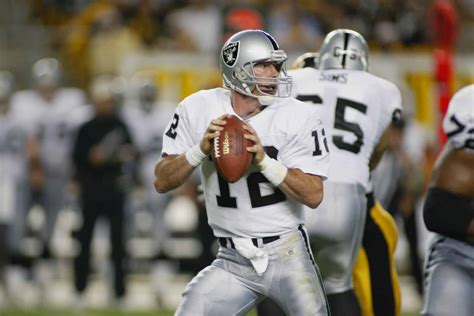
The 2000 season ended at 12-4. Gannon threw for 3,430 yards, 28 touchdowns, and was named a First-Team All-Pro. The Raiders won the division. In 2001 they went 10-6, made the postseason again, and Gannon won the Pro Bowl MVP award – the first of two consecutive times he’d win it, something no other player in NFL history had done back-to-back.
Those two seasons established a case that was already unusual: a quarterback playing the best football of his career at 34 and 35 years old. His completion percentage stayed above 60 percent both years. His interception numbers were clean. The offense moved.
Then came the 2001 AFC Divisional playoff against the New England Patriots in Foxboro, January 19, 2002. With 1:43 left and the Raiders leading 13-10, Patriots quarterback Tom Brady fumbled – or appeared to – after a hit by cornerback Charles Woodson. Officials ruled it an incomplete pass under the tuck rule, a rarely enforced and frankly bizarre interpretation of the rulebook. New England kept the ball, kicked a field goal to tie, and won in overtime 16-13.
The Tuck Rule Game remains one of the most debated calls in playoff history. The Raiders lost a game most people at Qualcomm Stadium – and most watching at home – thought they had won. What happened the following season was, depending on how you look at it, either a response to that loss or simply what was already inevitable.
2002: The MVP Season
Gruden was gone. He’d been traded to Tampa Bay in February 2002 for two first-round picks, two second-round picks, and $8 million. Bill Callahan took over as head coach. Gannon turned 37 in December.
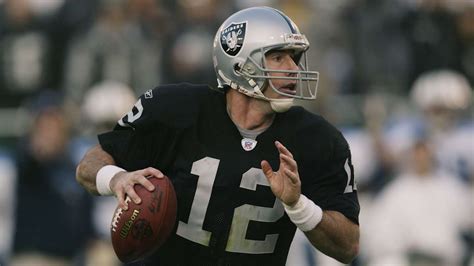
He threw for 4,689 yards – leading the league. He completed 418 passes on 618 attempts, leading the league in both. His 26 touchdowns against 10 interceptions produced a 97.2 passer rating, a career high. He set an NFL record at the time with 10 games of 300 or more passing yards in a single season. The MVP was unanimous.
What’s worth sitting with is the age. Thirty-seven. Peyton Manning won his first MVP at 27. Brett Favre at 26. Gannon did it after 15 years in the league, on a team now coached by someone other than the man who built the offense with him. That’s not a small thing. The 2002 season doesn’t make sense on paper, and yet every week the numbers were real.
The Raiders finished 11-5, won the AFC West for the third straight year, and beat the Tennessee Titans 41-24 in the AFC Championship. Gannon accounted for four total touchdowns in that game. The Super Bowl opponent: Tampa Bay. Coached by Jon Gruden.
Super Bowl XXXVII
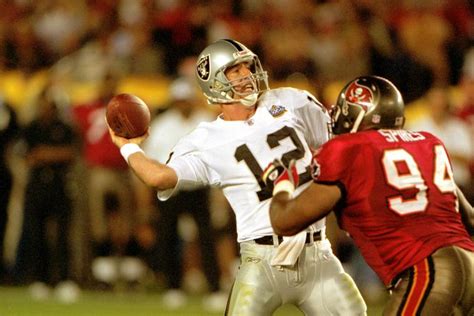
Qualcomm Stadium, San Diego, January 26, 2003. The Raiders were favored by 3.5 points. What happened over the next three hours is still uncomfortable to watch.
Gruden had spent two months preparing the Bucs using his own institutional knowledge of the Raiders offense – and, according to multiple reports, actually impersonating Gannon in Tampa Bay’s practices. He mimicked Gannon’s footwork, his pump-fake mechanics, specifically the habit of patting the ball before redirecting. Bucs defensive backs had studied those movements for weeks.
Gannon threw five interceptions. Three were returned for touchdowns. He was sacked five times. The final score was 48-21, the most lopsided Super Bowl result in 17 years at that point.
It’s tempting to put that entirely on Gannon, and a lot of people did. But the Tampa Bay defense that year allowed 12.3 points per game during the regular season, second-best in the NFL, and their secondary had intercepted 31 passes. Derrick Brooks was playing the best football of his Hall of Fame career. Ronde Barber’s pick-six in the third quarter – a 92-yard return – essentially ended any hope of a comeback.
Still: five interceptions, three returned for touchdowns. It happened. You can’t fully separate the loss from Gannon’s performance, even accounting for everything working against him. The number that bothers me is not the five picks – it’s that the Raiders scored 21 points, which suggests the offense wasn’t completely broken. They just couldn’t stop the bleeding.
The Last Two Seasons and What They Cost Him
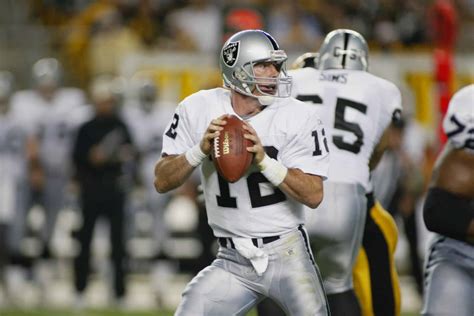
In Week 11 of the 2003 season, Gannon took a hit against the New York Jets and fractured his shoulder. He was 37. He tried to come back later that year. The Raiders went 4-12.
He played 11 games in 2004, the franchise’s final season in Oakland before the move to Las Vegas was eventually finalized years later. His passer rating that year was 69.2. He retired before the 2005 season. The neck and shoulder injuries had caught up with what his mind could still do.
In his six seasons in Oakland, Gannon completed 1,533 of 2,448 pass attempts for 17,585 yards, 114 touchdowns, and 50 interceptions. He is third on the Raiders all-time passing list. His 45-29 regular season record as a starter in Silver and Black is the best winning percentage of any Raiders quarterback with more than 20 starts.
Where He Fits in Raiders History
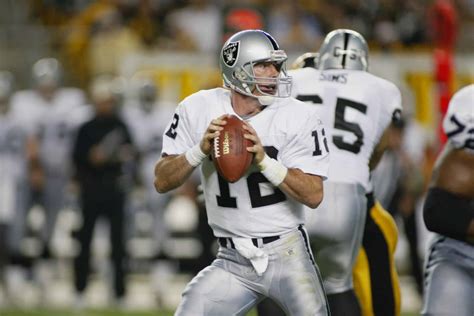
The Raiders have had four quarterbacks start a Super Bowl: Daryle Lamonica in Super Bowl II, Ken Stabler in Super Bowl XI, Jim Plunkett in Super Bowls XV and XVIII, and Gannon in Super Bowl XXXVII. Stabler and Plunkett are in the Hall of Fame. Lamonica never made it. Gannon hasn’t either.
The Hall of Fame case for Gannon is real and it’s been largely ignored. He won an NFL MVP. He made four consecutive Pro Bowls. He led the league in passing yards in 2002 and set a single-season record for 300-yard games that stood for years. His career numbers – 28,743 yards, 180 touchdowns, a 60.2 completion percentage across 17 seasons – hold up well against quarterbacks who are enshrined.
The counterargument is that his peak was short: four elite seasons out of 17, with little postseason success before Oakland and a catastrophic Super Bowl performance at the end of it. Hall of Fame voters have generally not rewarded late-career peaks in the same way they do sustained excellence. That’s a coherent position. It also means the voters are applying a standard retroactively that wasn’t articulated clearly when he played.
Among Raiders fans the debate has a different texture. The franchise moved to Las Vegas. The Oakland era is now history, sealed off. Gannon’s four-year run from 1999 to 2002 was the last time the Raiders were consistently competitive, the last time they made the Super Bowl. For a lot of people who watched those teams, he’s not an afterthought. He was the whole thing.
After Football
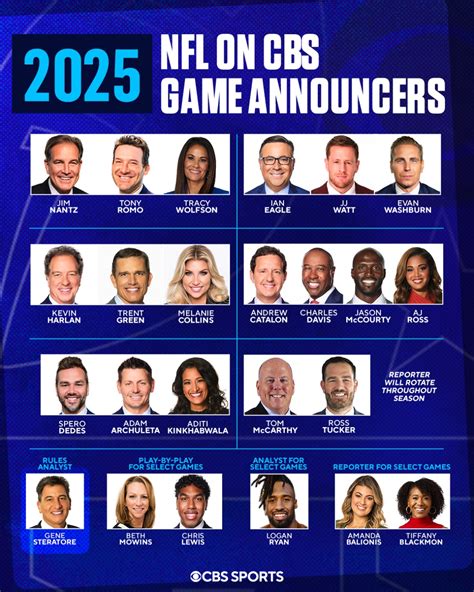
Gannon joined CBS Sports as an NFL analyst in 2005 and stayed for 16 seasons. He was part of the network’s lead NFL coverage team for much of that run, working alongside Jim Nantz and Phil Simms before the booth configuration changed.
In January 2018, when Jon Gruden returned to coach the Raiders, Gannon attended the introductory press conference and was offered a role as quarterbacks coach. He turned it down. He said on 95.7 The Game in Oakland that he’d come to the decision somewhere on the flight up and realized he couldn’t give it what it would require. “To work alongside Jon Gruden it takes a special person,” he said. “It takes a person with great energy, passion and commitment and, more importantly, time.”
He has stayed connected to the Raiders organization in a looser capacity – appearing on team broadcasts, doing interviews for Raiders media, commenting on the franchise’s ongoing quarterback decisions. As recently as early 2026 he was on the SiriusXM NFL radio set at Super Bowl LX discussing Kirk Cousins and the team’s current QB situation.
He was inducted into the University of Delaware Athletics Hall of Fame in 2005 and the Philadelphia Sports Hall of Fame in 2015. He set eight Raiders franchise records during his time in Oakland. His career was a long argument for patience – his own, mostly, and the Raiders’ in 1999 when they signed a 33-year-old free agent most teams had already given up on.
Comments