
John Abraham and the Stories Behind the Star – Films, Relationships, Fitness, and What Most Profiles Miss
A Mumbai Kid With Two Religions and One Name That Confused Everyone
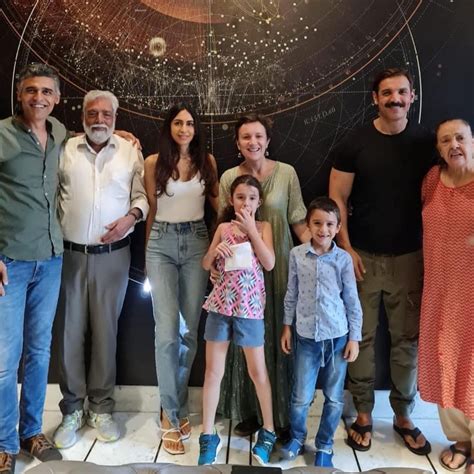
His father is Abraham John – a Malayali Syrian Christian architect from Aluva, Kerala. His mother, Firoza Irani, comes from Mumbai’s Zoroastrian Parsi community. The way Nasrani naming works, a son takes his father’s first name as his last name. So the boy became John Abraham. His Parsi family gave him a second name – Farhan – that almost nobody knows.
He grew up in Mahim, went to Bombay Scottish School, captained the football team at Jai Hind College, ran the 100m and 200m in track, trained in Taekwondo under a coach named Javed Khan, and then did an MBA at NMIMS Mumbai. That last part tends to get skipped in most writeups. A Bollywood action star with a postgraduate business degree is either an anomaly or a preview of how he’d eventually run a production company and a football club without needing anyone to manage things for him.
After college he took a media planning job at Time and Space Media Entertainment Promotions. Ordinary enough. Then in March 1999 he almost missed the deadline for the Gladrags Manhunt competition – nearly didn’t send in the form – got in anyway, won the whole thing, and finished first runner-up at the Manhunt International contest in the Philippines. Cary Models in Singapore signed him. He worked in Hong Kong, London, New York.
Three years of that, then Jism.
Dhoom Made Him Famous. Vicky Donor Made Him Interesting.
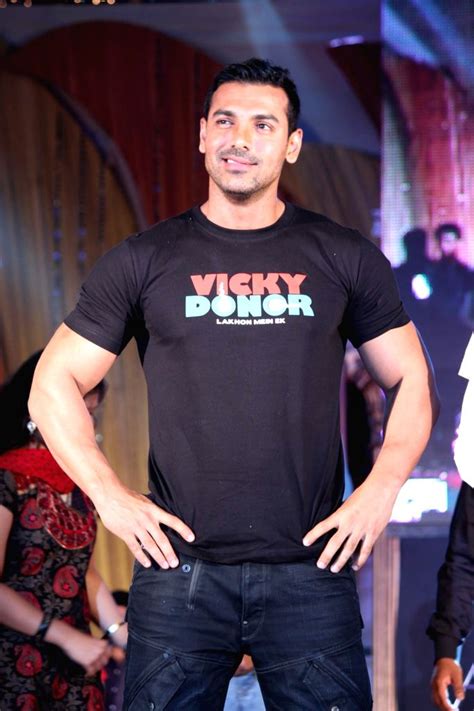
Jism came out in 2003 and got noticed mostly for what it looked like on screen. The film worked. But Dhoom in 2004 was different – he played Kabir, a motorcycle thief being chased by Abhishek Bachchan and Uday Chopra, and the role fit him so well that it’s still what a lot of people think of when they hear his name. The bike. The smirk. The whole thing.
What followed was a string of films that confirmed he could hold the screen in action and comedy both – Garam Masala (2005), Taxi No. 9211 (2006), Dostana with Abhishek Bachchan and Priyanka Chopra in 2008, which became one of the highest-grossing Hindi films that year. He wasn’t doing bad work. But he also wasn’t doing work that surprised anyone.
Vicky Donor changed that calculation. John produced it in 2012, didn’t play the lead – that was Ayushmann Khurrana in his debut – and the film was about sperm donation. Not a subject any mainstream Hindi studio was rushing to greenlight. Shoojit Sircar directed. It made money, won awards, and introduced Ayushmann to the industry. The fact that John took the producing risk on a film he wasn’t starring in says more about his instincts than any interview quote could.
Madras Cafe followed in 2013. Political thriller, Sri Lankan civil war backdrop, genuinely difficult subject for commercial cinema. It earned him a National Film Award for Best Supporting Actor – or more precisely, the film won the award, and John was part of that. Force (2011), Shootout at Wadala (2013), Batla House (2019), Parmanu (2018). He gravitates toward films that at least one studio has already said no to. He’s said as much in interviews.
Then Pathaan in 2023. He played the antagonist opposite Shah Rukh Khan and Deepika Padukone – one of the biggest commercial releases in Bollywood in years, crossing 1,000 crore rupees globally. Playing the villain in a franchise blockbuster after two decades in the industry is not a typical career arc. Most actors that established want the hero slot. John took the other role and the film was better for it.
His production company, JA Entertainment, has been running out of Mumbai since the Vicky Donor era. The company’s logic has been consistent: back stories other producers won’t touch, control the creative process, keep the budgets real. Rocky Handsome (2016), which he also starred in, came through JA. So did Madras Cafe. Tehran (2024) was his most recent acting credit as of writing.
John Abraham and Bipasha Basu – Ten Years, One Film Set, and a Breakup That Still Gets Searched
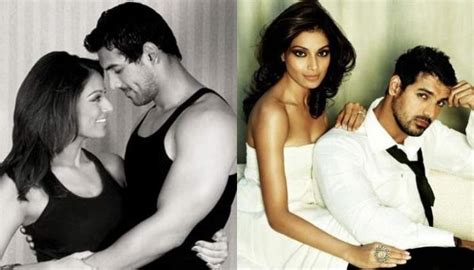
They met during the Jism shoot in 2003. The on-screen chemistry was obvious and it turned out to be real. By the mid-2000s they were one of the most photographed couples in Bollywood – appearing together at premieres, making no effort to hide it, working together again in Aetbaar, Madhoshi, Dhan Dhana Dhan Goal. The assumption, widely shared, was that they’d eventually get married.
They didn’t. The relationship ended in 2011, after roughly eight years. What actually caused it is something neither of them has discussed in full. Rumors circulated – the most persistent one involved Priya Runchal, an investment banker who was supposedly attending the same gym. John denied cheating explicitly and on record. Bipasha did not describe the breakup as friendly. Both of those things can be true without resolving into a clean version of events.
By 2014, John had married Priya and Bipasha married Karan Singh Grover in 2016. They have a daughter named Devi. What strikes me, looking back at how the breakup was covered, is how much of it was presented as solved – as if both moving on erased the original confusion about what happened. It didn’t. The timeline still doesn’t fully line up. But that may just be what a private person who refuses to give publicists access to his life looks like from the outside.
Priya Runchal and a Marriage That Has Almost No Public Record
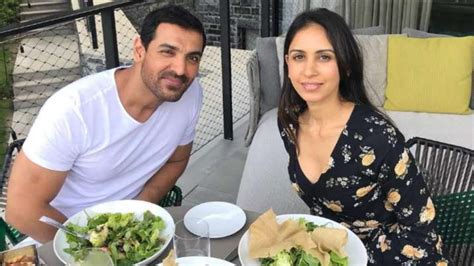
They married in January 2014. Quietly. No photographers at the ceremony, no posed announcement, no press release. The news came out anyway because it always does, but there was no event to cover.
Priya Runchal completed a business school degree in London and had been working in Los Angeles as an investment banker when they met – reportedly through mutual friends around 2010. John has said in interviews that she manages his football team, his startups, and aspects of the production operation. He describes her as bringing “maturity and stability” to his life, which in context sounds less like a compliment and more like an honest self-assessment – he’s acknowledged being a difficult partner, someone who disappears into work, who wakes at 4:30 am, doesn’t drink, doesn’t attend parties, doesn’t keep the kinds of social ties that make celebrity marriages publicly legible.
They don’t have children. John addressed this directly when asked – his position was that parenthood is a serious responsibility and he wasn’t ready to be a hands-on parent while managing a football academy in Shillong, a production company, and an acting career simultaneously. That’s a more honest answer than most actors give to that question.
The marriage has been effectively scandal-free for over a decade, which is unusual for someone at his visibility level. His explanation is structural: no publicist, no agent, no parties to go to where things happen. “Once my films are done, I disappear,” he said to India Today. That’s not a pose. His Instagram goes quiet between projects.
The Fitness Part Is More Specific Than Most Articles Make It Sound

He’s a vegetarian bodybuilder. That framing matters because it pushes back against the assumption, common in Indian fitness culture, that building significant muscle requires meat. John has maintained serious mass for twenty-plus years on a plant-based diet and without steroids – he’s been direct about opposing hormone use, which is not the universal position among Bollywood’s physique-focused actors.
His trainer Kris Gethin worked with him during a documented preparation phase: four sessions per week, each around 45 minutes, structured around two muscle groups per day. Chest and triceps on day one, back and abs on day two, lower body on day three, cardio on the other days. For Force (2011), he gained approximately 10 kilograms of muscle by loading proteins and carbohydrates for the role. For Madras Cafe (2013), he needed a leaner athletic frame and switched to DTP and Y3T training methods to strip back down. Both films required completely different physical states and he hit both.
His diet cuts out maida (refined wheat flour), sweets, and fried food. He wakes between 4 and 4:30 am. These aren’t interesting facts exactly – they’re just the actual details underneath the generic “disciplined fitness icon” framing that fills most celebrity profile pieces. The number that keeps striking me: he’s maintained this for two decades while running businesses, owning a football club, and producing films. Most people can’t do it for two months.
NorthEast United FC and the Football Life That Gets One Paragraph Everywhere
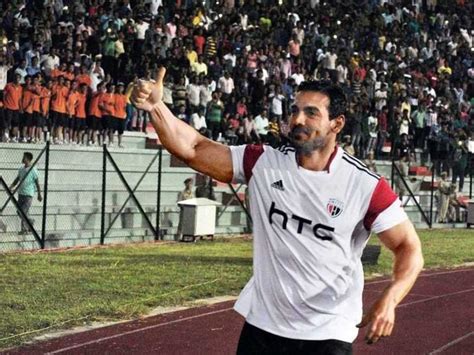
He co-owns NorthEast United FC, one of the founding clubs of the Indian Super League, based in the northeast region of India with their home games in Guwahati. The ISL launched in 2014 with eight franchises, and NorthEast United was among them from the start.
John spends time at the club’s football academy in Shillong. That’s not a typical owner’s relationship with a sports franchise – showing up for photo opportunities, fronting the brand, attending finals if the team gets there. He’s described it as a business he actively manages. Priya Runchal helps run it. Given his MBA background and the fact that he’s been operating JA Entertainment without external management, the football ownership fits a pattern rather than interrupting one.
The club hasn’t won an ISL title as of this writing. They’ve reached the semi-finals. That’s the kind of fact that gets quietly omitted from celebrity-owner profiles, which tend to imply the ownership itself is the achievement.
What the Public Record Shows on Controversies
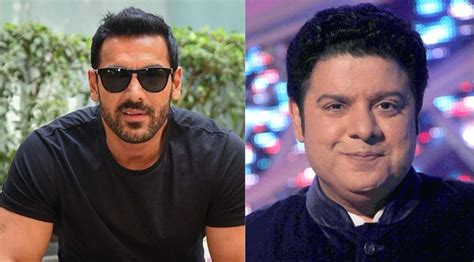
Three documented incidents, reasonably separated in time. In 2006 he was arrested for rash driving after an accident in Mumbai – the case was settled. In 2009 the promotional poster for New York drew accusations of being copied from a foreign film’s artwork – the production disputed it and nothing came of it legally. In 2018 he made comments about the MeToo movement that were widely criticized as inadequate; he didn’t say anything egregious but he also didn’t say anything meaningful, and the criticism was that someone with his platform should have done better.
None of these incidents significantly affected his career. That may say something about how the industry handles these things, or it may say that none of them were severe enough to create lasting damage. Probably both.
The Filmography, Organized by What It Actually Shows
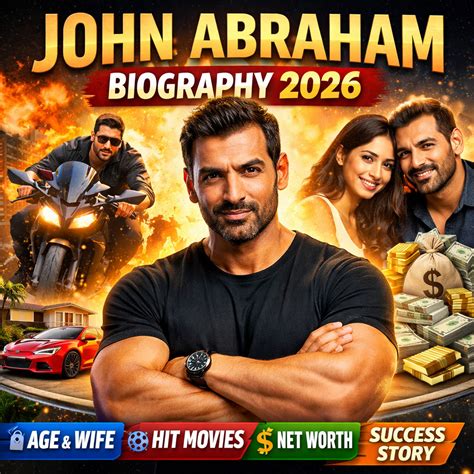
His acting career has three distinct phases that don’t get named as such very often. The first runs from Jism (2003) through Dostana (2008) – he’s building a following, doing action and romantic comedy, still being cast primarily for how he looks. The second phase, roughly 2009 to 2016, is where the producing starts (No Smoking was actually his debut as producer in 2007, though it flopped), and the films get stranger and more specific: New York, Force, Vicky Donor, Madras Cafe, Shootout at Wadala. The third phase, from Parmanu (2018) forward, includes the biggest commercial numbers of his career – Satyameva Jayate made significant money on a modest budget, Pathaan was a franchise event.
He’s appeared on Forbes India’s Celebrity 100 list every year since 2017. His estimated net worth sits around 251 crore rupees across his various interests. He received four Filmfare Award nominations over his career and one National Film Award.
The thing that gets underweighted in most summaries: he has a better record as a producer than as a leading man, commercially speaking. Vicky Donor’s return on investment was exceptional. Madras Cafe earned critical respect the films he starred in that year couldn’t match. He understands story selection better from behind the camera than in front of it – or at least, he’s willing to take different risks there. Whether that’s because he has more control, or because the producer’s chair forces a different kind of thinking, is hard to say from the outside.
Comments