
Jerome Ford, running back: everything from Tampa to Washington
Ford’s career NFL stat line looks ordinary until you understand the roster situation that produced it. A 4.46 forty. A 98.90 athleticism score at PlayerProfiler, 28th out of 64 running backs in his draft class. Five receiving touchdowns in a single season. And yet here he is, entering 2026 as a depth signing on a one-year deal, third on a depth chart he may never fully own. The gap between his physical tools and his opportunity is the whole story.
From Tampa to Tuscaloosa to Cincinnati: how Ford got to the NFL
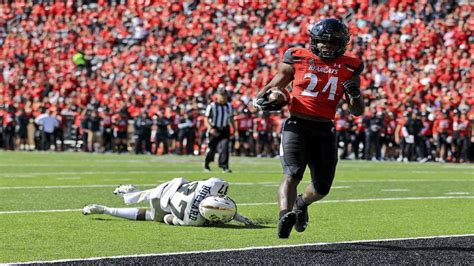
Ford grew up in Seffner, Florida, attending Armwood High School, and came out as a four-star recruit ranked sixth nationally among all-purpose backs in the 2018 class by 247Sports. He had offers from Tennessee, Nebraska, North Carolina, UCF, USF, and Arizona, and chose Alabama over all of them.
That decision nearly ended his prospects. Alabama’s backfield in 2018 and 2019 included Najee Harris, Brian Robinson Jr., and Damien Harris. Ford appeared in eight games across two seasons, totaled 32 carries and 114 yards, and got exactly one start: the 2019 opener against Duke, when Harris and Robinson were suspended for the first half. He led Alabama backs that day with 64 rushing yards on 10 carries. After that game, the depth chart closed back around him.
He transferred to Cincinnati in January 2020. In his first season with the Bearcats he shared time with senior Gerrid Doaks, who led the team with 144 carries. Ford got roughly half that volume but scored 8 touchdowns (to Doaks’ 7) and averaged nearly 2 more yards per carry. When Doaks left for the NFL, Ford took full possession of the backfield in 2021. He carried the ball 215 times that season, 169 more than the next back on the depth chart, and averaged 6.2 yards per carry, sixth-best in that draft class among running backs with 150 or more attempts.
In the Cotton Bowl against Alabama, the school that wouldn’t give him a chance, he ran for 77 yards on 15 carries at 5.1 per attempt. He was named First-Team All-AAC that year and won the AAC Championship Game MVP. His full college totals at Cincinnati: 32 games, 214 carries, 1,319 yards, 19 touchdowns, 21 receptions, 220 receiving yards.
His pre-draft profile reads as genuinely contradictory. The athleticism is undeniable: that 4.46 forty is in the 86th percentile historically at the position, his burst score hits the 84th percentile, and his agility score lands in the 17th (make of that what you will). Scouts flagged limited pass protection experience and a receiving sample they considered thin for a third-down back. The combine numbers said top-three rounds; the film said fifth. The Cleveland Browns took him 156th overall in 2022.
The 2022 rookie year: learning to wait again
Cleveland had Nick Chubb and Kareem Hunt. Ford carried the ball eight times in 13 games, never more than twice in a single contest, and recorded no receiving stats. His actual job was on kick returns, where he generated 723 yards on 30 runbacks, a volume that ranked him among the more productive AFC returners that season. Three stints on injured reserve interrupted things further.
| Year | Team | Games | Carries | Rush Yards | Rush TD | Receptions | Rec Yards | Rec TD | Yards from Scrimmage |
|---|---|---|---|---|---|---|---|---|---|
| 2022 | CLE | 13 | 8 | 12 | 0 | 0 | 0 | 0 | 12 |
| 2023 | CLE | 17 | 204 | 813 | 4 | 44 | 319 | 5 | 1,132 |
| 2024 | CLE | 14 | 104 | 565 | 3 | 37 | 225 | 0 | 790 |
| 2025 | CLE | 13 | 24 | 73 | 0 | 26 | 103 | 0 | 176 |
| Career | 57 | 340 | 1,463 | 7 | 107 | 647 | 5 | 2,110 |
The career table is the clearest way to see what happened: one exceptional season, surrounded by circumstances that explain it.
2023: what Ford did when Chubb went down
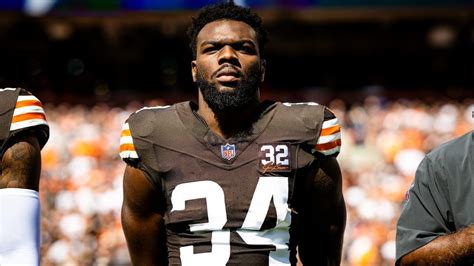
Week 2 at Pittsburgh. Nick Chubb, the same knee as 2015 at Georgia, torn ACL, PCL, and MCL. The Browns’ entire offensive identity left the field on a cart. Ford had 31 carries and 142 yards in two games to that point. He was about to carry the team for the next four months.
What he did: 204 carries, 813 rushing yards, 4 rushing touchdowns across 17 games and 12 starts. And then the receiving line, which almost nobody focuses on. Forty-four receptions. 319 receiving yards. Five touchdown catches. The 1,132 yards from scrimmage and 9 total touchdowns put him in legitimate RB2 territory for the season, not replacement-level filler.
The 4.0 yards per carry has been used to diminish the season, and that reading is lazy. Cleveland’s interior offensive line that year included Joel Bitonio and Wyatt Teller, genuinely elite guards who create running lanes that inflate per-carry averages for any back. Four yards per carry behind that line isn’t a failure. Kareem Hunt also returned midseason and cut into Ford’s volume without meaningfully disrupting his overall totals. The receiving production is what actually separates 2023 from a standard backup season: 44 catches out of the backfield, five touchdown receptions. That’s a real passing-game profile.
One detail that doesn’t quite fit the narrative: Ford averaged 4.0 yards per carry on the season, but he also had some of the most memorable individual runs of any Browns back that year, including a 66-yard burst against Cincinnati in Week 16 and a 39-yard run against Jacksonville. The season average obscures how explosive he could be when he found space. A back with a 98th-percentile athleticism score running 4.0 per carry overall is getting stopped a lot in short-yardage situations, not failing to break big plays.
2024 and 2025: why the numbers fell
Chubb came back for Week 7 of the 2024 season. Before that, Ford had started six straight games and averaged 5.2 yards per carry. The Browns weren’t going to sit a four-time Pro Bowler returning from reconstructive knee surgery in favor of a fifth-round backup, and nobody reasonable expected them to. Ford finished with 104 carries for 565 yards and 3 touchdowns in 14 games, leading the team in rushing for the season. That’s a 4.0-4.5 carry-per-game rate as the clear second back in a functional rotation. Not a regression. Just a context.
2025 is different. He played 13 games, touched the ball 50 times total (24 carries, 26 receptions), and produced 176 yards with zero touchdowns. In December 2025 the Browns placed him on injured reserve with a shoulder injury. The shoulder explains a lot, but the season was already lost by then. Cleveland’s offense that year ranked 31st in total yards per game, and the quarterback situation was a disaster the whole way through. Ford was a backup runner in a system that wasn’t running the ball effectively, and then he got hurt. That’s the 2025 season. Calling it a decline is the wrong word. He was on a broken team, playing hurt, in a contract year.
By February 2026, he was a free agent.
The Washington Commanders signing and what it means
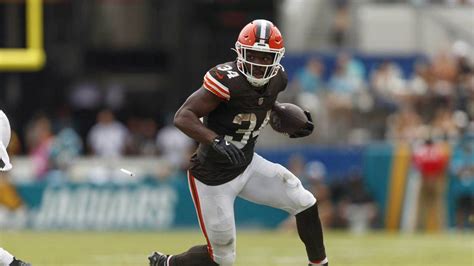
The Commanders announced the signing March 19, 2026. One year, terms undisclosed. Ford enters the NFC East joining a backfield that also includes Jacory Croskey-Merritt, Rachaad White, Jeremy McNichols, and sixth-round 2026 draft pick Kaytron Allen. Pre-training camp depth chart: Croskey-Merritt first, White second, Ford third.
Rachaad White’s efficiency as a rusher has declined quietly. Among the 63 running backs with 250 or more carries since he entered the league, White ranks 54th in yards per rush (4.0) and 54th in success rate (35.4%). What keeps him relevant is pass protection, where PFF graded him 12th among running backs in 2025, and the fact that he has posted at least 40 receptions in each of the last four seasons. He’s the passing-down back. Croskey-Merritt is the early-down runner. McNichols led Washington’s entire backfield in routes run (178), targets (31), and receptions (25) in 2025. It’s a full committee.
Where Ford fits in this is genuinely interesting, and it’s the one angle almost nothing written about this signing has explored. New offensive coordinator David Blough, who came from Ben Johnson’s staff in Detroit, has stated his intention to run a more under-center offense in 2026. That’s a real shift. Per Sports Info Solutions, 96% of Jayden Daniels’ dropbacks in his first two NFL seasons came from shotgun, and 82% of Washington’s designed runs came from the same formation. Blough wants to change that. He specifically mentioned Croskey-Merritt’s cutback ability and the offensive line’s athleticism as fits for the scheme, and said the goal is to “generate explosive plays” through run action and keepers that put Daniels on the perimeter in different ways.
An under-center, run-action offense typically needs a second back who can line up in split-back or I formations and run between the tackles, not just bounce outside. That’s Ford’s profile. It’s not White’s. Washington ranked 16th overall in explosive plays (15-plus yards) in 2024 but 31st when throwing. Blough is trying to generate those explosives through the run game and play-action, which means a premium on backs who can absorb contact, hold their assignments in protection, and occasionally catch a wheel route out of a two-back formation. Ford can do most of that. Whether he gets the snaps to prove it depends on how training camp sorts out.
Jerome Ford’s fantasy football value in 2026
Ford is a late-round handcuff or a waiver-wire name in 10-team and 12-team standard leagues. That’s the honest answer. Rachaad White owns the PPR floor in Washington’s backfield. Croskey-Merritt owns the carries. McNichols, who has been the primary receiving-down back for two seasons running, isn’t going away quietly. And now there’s also a sixth-round rookie in Allen who gives the team another option to develop.
The upside scenario is straightforward: Croskey-Merritt gets hurt. Ford then steps into a feature role for a legitimate offense surrounding Jayden Daniels, and he has done exactly that before. Nine touchdowns in 2023 didn’t come from nowhere. A mobile quarterback who draws extra defenders into the box, as Daniels does, creates the same kind of lanes that Ford exploited when Cleveland put him behind Bitonio and Teller. PlayerProfiler comps him to Ryan Mathews, which is telling: explosive, capable of 100-yard games, but never trusted enough to be the lead back without circumstances forcing the decision.
In PPR formats, watch his training camp pass-protection reps. Blough’s offense, modeled on what Johnson ran in Detroit, demands functional pass blocking from any back who wants third-down snaps. If Ford wins those reps over McNichols, his target share in the passing game becomes real even without a Croskey-Merritt injury. Ford has 107 career receptions. He’s not just a runner.
Career stats and physical profile
Ford was born September 12, 1999, in Tampa, Florida. He attended Armwood High School in Seffner. Listed at 5-foot-10, 210 pounds. His 4.46 forty is in the 86th percentile historically at the running back position. PlayerProfiler’s athleticism score for him is 98.90, which ranked him 28th of 64 running backs in the 2022 draft class.
| Measure | Value | Position Percentile |
|---|---|---|
| 40-yard dash | 4.46 sec | 86th |
| Speed score | 106.1 | 84th |
| Burst score | 111.7 | 17th |
| Agility score | 11.53 | 36th |
| Overall athleticism | 98.90 | 28th of 64 RBs, 2022 class |
Full NFL career through end of 2025: 57 games, 18 starts, 340 carries, 1,463 rushing yards (4.3 average), 7 rushing touchdowns; 107 receptions, 647 receiving yards, 5 receiving touchdowns; 1,405 kick return yards. Drafted 156th overall, fifth round, Cleveland Browns, 2022. Signed by the Washington Commanders, March 2026, one year. Instagram: rome813.
The burst score at the 17th percentile is the one combine number worth flagging. Elite straight-line speed (86th percentile) paired with a mediocre burst score explains the film pattern: Ford looks fast in space, but he doesn’t explode through tight holes the way scouts want a feature back to. He needs the lane to already exist. When Cleveland’s guards opened it, he hit it. When they didn’t, he averaged what you’d expect from a back who can’t create his own burst off the line.
Comments