
Fletcher Cox – Defensive Tackle, Philadelphia Eagles (2012–2023)
From Yazoo City to the First Round
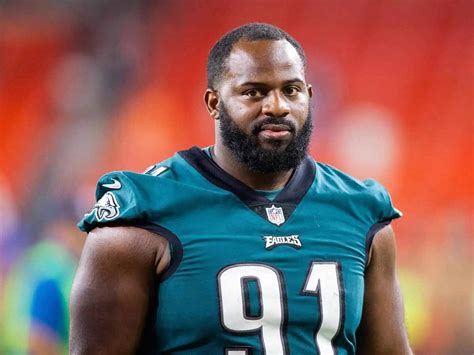
Fletcher Cox was born December 13, 1990, in Yazoo City, Mississippi – a town of about 12,000 people sitting in the Yazoo–Mississippi Delta, roughly 45 minutes north of Jackson. He played basketball and ran track at Yazoo City High School before football became the thing. Not the other way around. His initial instinct was for sports that required quickness and explosiveness in open space, which turned out to matter a great deal when scouts tried to figure out what exactly they were looking at in a 6-foot-4, 310-pound interior lineman who moved like he was half that size.
At Mississippi State he played three seasons, 2009 through 2011. By his junior year he had 103 total tackles, 11 sacks, and two interceptions – one returned for a touchdown. Those are linebacker numbers, roughly. For a defensive tackle they were absurd. First-team All-American, first-team All-SEC. The Bulldogs were quietly becoming what people would later call “D-Line U,” a reputation built substantially on Cox’s time there, and he left after his junior season to enter the 2012 draft.
Jim Washburn, the Eagles’ defensive line coach at the time, flew down to evaluate him in person. The story that came back: Washburn had never seen anyone that large move that way. They went to dinner. Talked Mississippi, guns, football. Washburn came home certain. The Eagles were picking 15th. They traded up to 12th – giving up a third-round pick – specifically because they were afraid someone would take Cox before they got there.
The Rookie Year and Andy Reid’s Unusual Caution
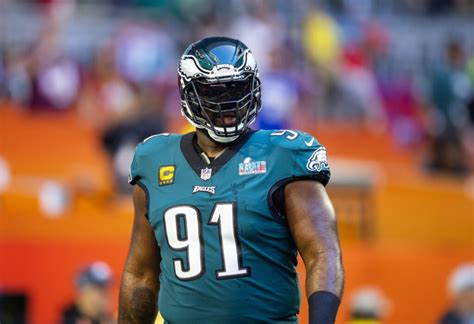
Cox did not start immediately. For the first six games of 2012, he was listed behind Derek Landri on the depth chart. Andy Reid, who had watched two consecutive first-round picks struggle under the weight of early expectations, wanted Cox to observe before he was asked to lead. What changed Reid’s mind wasn’t anything that happened in a game. It was practice. Cox was so consistently dominant against the Eagles’ offensive linemen – occasionally injuring them – that Reid called him into his office. Not to praise him. To ask him to dial it back so the team had functioning linemen to practice against.
He finished the 2012 season with 39 tackles, 5.5 sacks, and an All-Rookie Team selection. Unremarkable on paper by the standard of what came later. But the Eagles already knew what they had.
The Breakout: 2014 and the Making of an Elite Interior Rusher
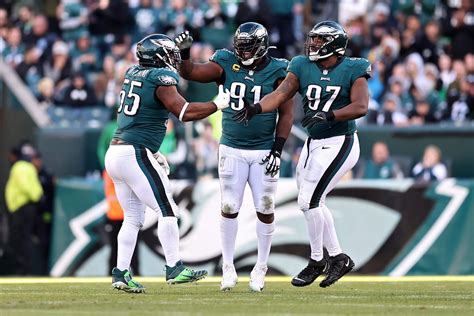
2014 was the year the league understood Cox wasn’t just good – he was a problem. He posted 61 tackles, four sacks, one forced fumble, and three fumble recoveries. In Week 1 against Jacksonville, he returned a fumble 17 yards for a touchdown. In Week 5 against New Orleans, he had three sacks in a single game, forced two fumbles, and recovered one of them. Second-team All-Pro at the end of the season.
What made Cox genuinely difficult to scheme against was the combination. He could line up as a three-technique – the gap between the guard and tackle – and win with pure quickness around the edge of the interior line. But he could also just bull-rush guards backward into the quarterback’s lap. Most elite pass rushers do one or the other. Cox did both, which meant blocking schemes designed to stop one approach tended to open the other.
The 2015 season brought his first Pro Bowl. Then 2016. Then 2017, 2018, 2019, 2020 – six straight, the most consecutive Pro Bowl selections ever by an Eagles defensive tackle. He earned that last one at 29 years old, which is worth noting because interior defensive linemen tend to age faster than almost any other position in the sport.
Super Bowl LII – February 4, 2018

The Eagles went 13-3 in the 2017 regular season, lost Carson Wentz in December to a torn ACL, and then – somehow – won the Super Bowl anyway. Nick Foles started against the New England Patriots in Minneapolis. Final score: 41-33, the highest-scoring Super Bowl at that point in history.
Cox had one tackle and two quarterback hits in the game. Not a dominant individual performance by his standards. But the Eagles’ defensive approach that night was built around forcing the Patriots’ offensive line to account for Cox on every snap, and the constraints that created opened up the rest of the defense. Philadelphia won its first Super Bowl in franchise history. Cox had a ring.
What followed was arguably his best individual season. In 2018, coming off the championship, he posted 10.5 sacks and 34 quarterback hits – both career highs – in 16 games, earning his only First-team All-Pro selection. That’s the peak on the graph: the year after the ring, at 27 years old, still ascending.
The Middle Years: Durability and a Slow Decline
2019 was difficult. Cox entered the season nursing a foot injury and finished with 3.5 acks, one of the lowest outputs of his career. In 2020, he still made the Pro Bowl – his sixth – but the raw production was declining. His snap share dropped each year from 2019 onward as the Eagles managed his workload more deliberately.
What didn’t decline was his presence. Teams still double-teamed him. Offensive coordinators still built game plans around him. His 2022 season, at 31, was genuinely surprising: seven sacks, 43 tackles, a snap share of 64.6 percent – numbers that matched or exceeded what he’d done at 25. The Eagles that year allowed the fewest yards per play in the NFL (4.8), and Cox anchored the middle of that defense.
He re-signed on a one-year, $14 million deal in March 2023 – his fourth contract with the same franchise, which itself says something about how Roseman valued him. His final season: five sacks, 15 games, one playoff appearance. In the Wild Card loss to Tampa Bay, he recorded half a sack. That was it.
Career Numbers
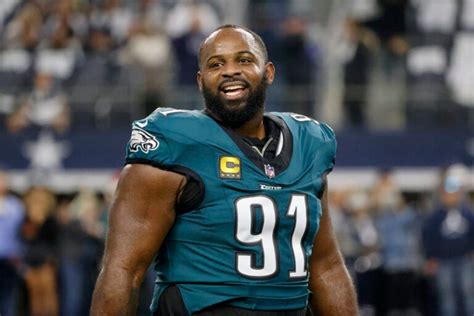
Across 188 regular-season games and 12 postseason starts: 70 sacks, 519 tackles, 88 tackles for loss, 173 quarterback hits, 16 forced fumbles, 14 fumble recoveries, three defensive touchdowns. His 70 career sacks rank fifth in Eagles franchise history overall – and first among defensive tackles in team history, by a significant margin.
For context on where 70 interior sacks sits historically: Aaron Donald finished with 111.5, but Donald is widely considered the best defensive tackle who ever played. Among everyone else at the position, 70 from the inside, over 12 seasons, puts Cox in a very short conversation. The 2010s All-Decade Team included exactly two defensive tackles: Donald and Cox. That selection was voted on by a panel that included coaches, scouts, and former players. They weren’t being sentimental.
Six Pro Bowls – all consecutive, 2015 through 2020. Four All-Pro selections: one first-team (2018), three second-team (2014, 2015, 2017). Six-time team captain. Two Super Bowl appearances, one ring.
The Retirement
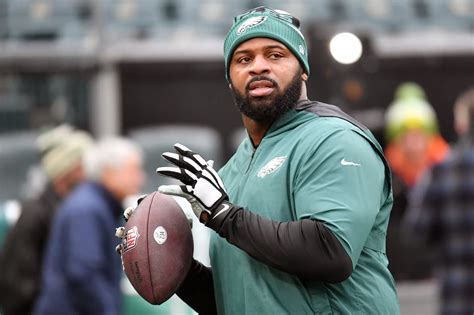
On March 10, 2024 – nine days after Jason Kelce announced his own retirement – Cox posted his statement on Instagram. “I gave everything I had to this team and to this city. I don’t know what’s next for me, but I do know that I’m forever grateful for my time here in Philadelphia and with the Eagles organization.”
He was 33. He’d played in exactly 200 games for the Eagles counting playoffs, started 182 regular-season games and 12 postseason games. Both of those marks are records for defensive tackles in franchise history.
Jeffrey Lurie’s statement called it a “strong case” for the Pro Football Hall of Fame. Howie Roseman, who traded up to draft him in 2012 and kept re-signing him over the next 11 years, didn’t say much publicly beyond the official release. He didn’t need to. The transaction history said it.
The Hall of Fame Question
Cox becomes eligible for Canton in 2029, five years after his retirement. The case in his favor is real: 70 interior sacks is exceptional, the All-Decade Team selection is the kind of peer recognition that carries weight with voters, and he won a championship with the franchise that drafted him. One team, 12 years, no drama. Voters tend to like that.
The complication is Donald. Having played the same position at the same time as the most dominant defensive tackle in NFL history creates a comparison that Cox cannot win statistically, and Hall of Fame voters – whether consciously or not – tend to use the best player at a position as the standard against which contemporaries are measured. Donald had 111.5 career sacks and seven All-Pro selections. Cox had 70 and four. The gap is real.
What gets lost in that comparison: Cox rushed primarily from the inside, which is harder. Donald had the luxury of alignment flexibility and one of the most sophisticated pass-rush arsenals the position has ever seen. Cox worked in a system, within an Eagles defense that needed him to eat blocks as much as create sacks. His 173 career quarterback hits – the disruptions that don’t show in the sack column – point to a player whose full impact doesn’t reduce cleanly to one number.
Washburn, the coach who scouted him in Mississippi and watched him develop, said without qualification: “He’s a Hall of Famer, hands down. There were two or three years there where he was the most dominant defensive player in the league.” That’s a scout talking, not a publicist. Scouts count differently than box scores do. Whether the voters agree, starting in 2029, is an open question – and a fair one.
What Cox Actually Meant to the Eagles
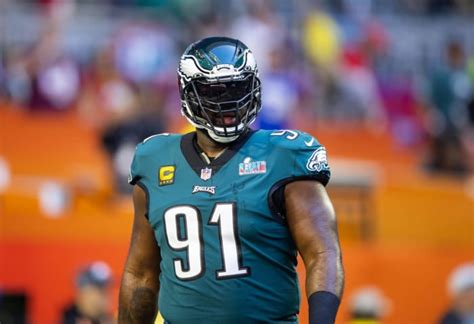
The Eagles drafted Cox in 2012 when the franchise was in transition. Andy Reid was in his final season. Chip Kelly was coming. Then Doug Pederson. Then Nick Sirianni. Four head coaches across 12 years, and Cox was there for all of them – the fixed point in a defense that otherwise kept changing around him. Brandon Graham is the only other player from that era with comparable longevity, and Graham was a second-round pick who had to fight for his career after a torn Achilles in the 2018 Super Bowl. Cox never had a moment where his place on the roster was seriously in question until his early 30s.
He was team captain six times. Not an honorary designation – a vote from his teammates. In a locker room that included Wentz, Kelce, Lane Johnson, and a dozen other strong personalities, Cox held that standing for six seasons. The organizational tribute after his retirement mentioned his role as “big brother and mentor” to younger defensive linemen, which is the kind of thing teams say about everyone who leaves. In Cox’s case the people saying it included Javon Hargrave, Jordan Davis, and Jalen Carter – three high-draft-pick interior linemen who developed alongside or after him and had every reason to watch how he handled himself.
His 2016 contract extension – six years, $103 million – was the largest ever given to a defensive tackle at signing. Roseman said publicly that the Eagles weren’t going to let that kind of player leave. They re-signed him three more times after that, each time at rates that reflected how much they still valued his presence even as his production varied. The last deal, $14 million for one year at age 32, tells you something. Teams don’t pay 32-year-old defensive tackles $14 million because they’re nostalgic.
Comments