
Dallas Cowboys Running Backs: The Current Starter, the Full Depth Chart, and the All-Time Greats
Javonte Williams carried the ball 252 times for 1,201 rushing yards and 11 touchdowns in 2025. Nobody expected that. Not after three injury-shortened seasons in Denver, not after arriving in Dallas on a one-year prove-it deal, and not after the Cowboys’ entire backfield combined for just six rushing touchdowns the year before. Williams didn’t just fill a hole. He became the offense.
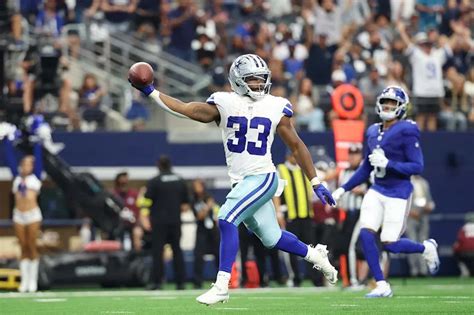
The Cowboys’ Starting RB Entering 2026
Williams crushed expectations to the tune of 1,200 rushing yards and 11 rushing touchdowns in 2025 and is a strong RB2 heading into 2026 with RB1 upside. The Dallas Cowboys and Williams agreed to terms on a three-year, $24 million extension that includes $16 million guaranteed. That contract is the clearest possible signal from the front office: Williams runs this backfield now.
Born April 25, 2000, in Wallace, North Carolina, Williams attended Wallace-Rose Hill High School, where he earned a 4.6 GPA and graduated as class valedictorian. Dak Prescott calls him “Valedictorian-Tae.” It fits. Williams attended the University of North Carolina at Chapel Hill before being drafted by the Denver Broncos.
The Denver years were painful. A promising rookie season in 2021 gave way to a severe knee injury in Week 4 of 2022, and he never fully recaptured his form before leaving for Dallas. The Dallas Cowboys signed RB Javonte Williams on March 10, 2025, after the Denver Broncos released him. At the time, most observers figured he’d be a rotational back behind a more established option. Instead he started Week 1, scored twice against Philadelphia, and never looked back.
2025 Season Stats: What the Numbers Actually Show
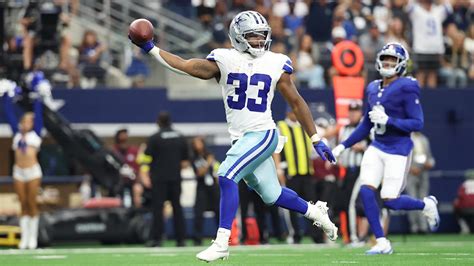
Williams finished seventh in the NFL in rushing attempts (252), sixth in rushing yards (1,201), and tied for seventh in rushing touchdowns (11), averaging 4.8 yards per carry (16th in the league). Standard stats tell one story. The advanced numbers tell a better one.
His PFF rushing grade of 81.7 ranked 15th among 55 qualified running backs. He forced 54 missed tackles as a runner, averaging 3.6 yards after contact per attempt. That yards-after-contact figure is where Williams separates himself from a volume back. He’s not running behind great blocking and falling forward for 4.5 yards. He’s taking contact and generating extra yards on his own.
In Weeks 1-8, his yards after contact per attempt was 3.52, a mark analysts described as “otherworldly.” In Weeks 8-17, he posted a 5.5 percent explosive run rate with a 13 percent missed tackle rate. He also secured 35 of 51 targets for 137 yards and two scores in the passing game. That receiving volume matters for full PPR fantasy formats, though it’s still not elite. His best weeks came when Dallas led and the Cowboys stayed on the ground. His worst came when they fell behind early and Dak Prescott threw 45 times.
For perspective: Christian McCaffrey needed 311 attempts to rush for 1,202 yards in 2025, only one more rushing yard than Williams, with one fewer rushing TD and three fewer explosive runs overall. That comparison is imperfect and Williams would be the first to say so. But it’s not nothing.
Dallas Cowboys RB Depth Chart for 2026
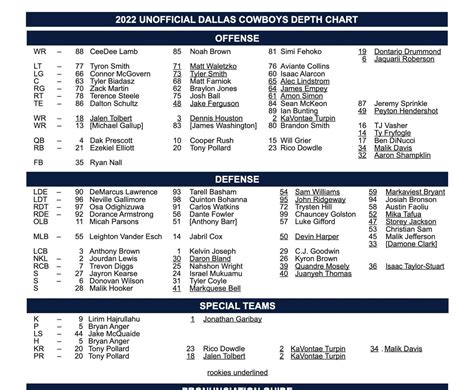
The current depth chart has Javonte Williams at RB1, with Miles Sanders second, and Jaydon Blue third. In practice, the Cowboys did not add to the running back position in the 2026 NFL Draft, leaving Williams positioned to reprise a bell-cow role. Sanders is a veteran presence but not a serious threat to Williams’ carries.
The more interesting question is who plays behind Williams if he goes down or gets a breather. Jaydon Blue was drafted out of Texas in the fifth round of the 2025 NFL draft. He only saw action in five games during a healthy rookie season, but in Week 18 against the Giants, he rushed 16 times for 64 yards and a touchdown. The sample is tiny. What it showed, though, was exactly what scouts said before the draft: this kid can carry a full workload when given one.
Blue’s ability to generate explosive plays on the ground or as a receiver was never in question. His ability to pass protect and take care of the football seemed to be. Year two is the test. The Cowboys did not sign a veteran running back in free agency and did not spend a draft pick on the position in the 2026 NFL draft. That’s either a vote of confidence in Blue, or a willingness to live with whatever he gives them. Possibly both.
Phil Mafah is another option who impressed in limited 2025 looks, while Malik Davis remains available as a special teams contributor who can handle small offensive packages in a pinch.
Fantasy Football: How to Value the Cowboys Backfield in 2026
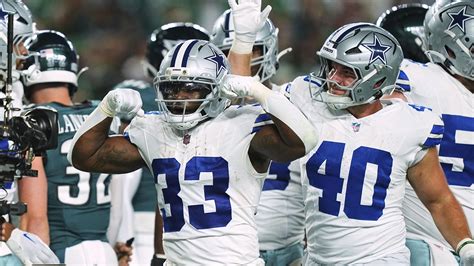
Williams finished as the RB11 or RB12 in fantasy points per game in 2025. He was the No. 12 PPR running back at 15.2 points per game, and analysts suggest drafting him as early as Round 5 in 2026. That feels about right. Maybe a touch conservative.
The ceiling is real. Williams averaged 75.1 rushing yards per game last year, seventh-most among all running backs and a career best. His 2.5 yards after contact per attempt ranked as the best of his career. He’s locked into the starting role on a team that, under Brian Schottenheimer, wants to run. That’s the whole pitch.
The floor is murkier. In the second half of 2025, he averaged just 11.8 PPR points over his final eight games. Some of that is game script (Dallas fell behind often late in the year), some is fatigue, and some is harder to explain. Standard and half-PPR formats project him as a strong RB2 with top-12 weeks when game script cooperates. Playing him any given week introduces some layer of risk for a dud due to the Cowboys’ aerial capabilities.
The handcuff is Jaydon Blue. He has the receiving skills to keep value even in a Williams-heavy week, and if Williams misses time, Blue has shown he can handle a 16-carry game without falling apart. In dynasty leagues especially, Blue at a cheap price alongside Williams is a reasonable pairing.
The Greatest Dallas Cowboys Running Backs of All Time
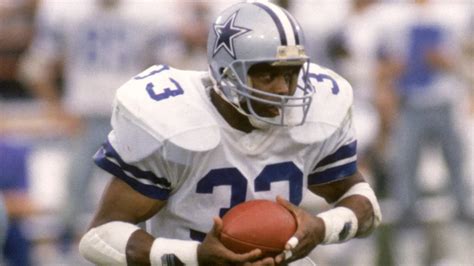
No franchise has produced more legendary running backs across more distinct eras. The Cowboys have had their share of draft busts and schemes that didn’t fit, but the backfield has also been where some of the most transformative players in NFL history did their best work. Here’s how the all-time list actually looks.
Emmitt Smith: The Case Is Closed
Emmitt Smith is the NFL’s all-time leading rusher with 18,355 yards. He won three Super Bowls with Dallas and is the only player in NFL history to win a Super Bowl championship, the NFL MVP award, the NFL rushing crown, and the Super Bowl MVP all in the same season (1993). His 165 rushing touchdowns with the Cowboys are the most in franchise history. In 1993, playing through a separated shoulder to clinch the NFC East, he carried 32 times for 168 yards and a score against the Giants. It remains one of the most celebrated individual performances in team history.
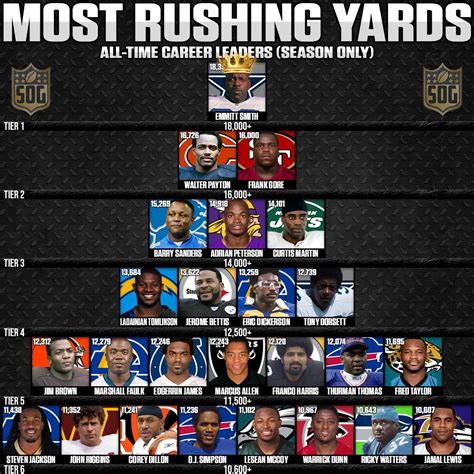
His 18,355 career yards exceed Tony Dorsett’s total by more than 5,000 and his career mark is 1,629 more than second-place Walter Payton. The gap to number two, in other words, is a full season of elite production. With 1,021 rushing yards in 2001, Smith became the first player in NFL history with 11 consecutive 1,000-yard seasons. Some people will tell you he benefited from great blocking. He did, sometimes. What they undercount is what he was doing from 1990 to 1997, when the Cowboys’ line was the best in football. Smith was the reason defenders couldn’t pin their scheme against them. He wasn’t just along for the ride.
Tony Dorsett and the Ring of Honor Backs
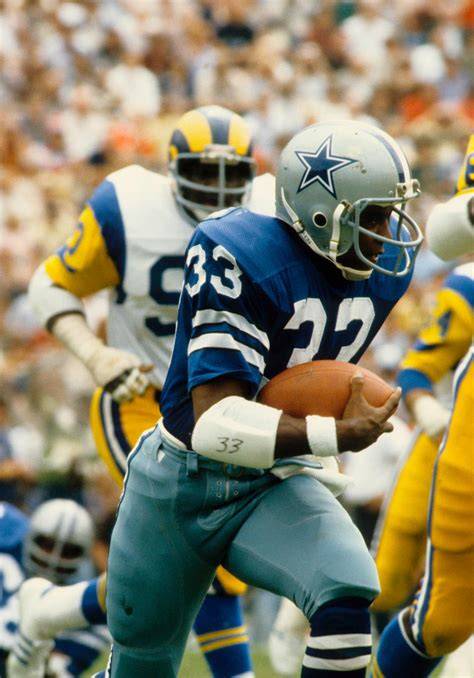
Drafted as the second overall pick in 1977, Tony Dorsett is second in franchise history in rushing yards, with over 12,000, plus 72 touchdowns. He was a key figure in the Cowboys’ Super Bowl-winning season in 1977, and he scampered for a 99-yard touchdown, which remains tied for the longest rush in NFL history. That run happened on January 3, 1983, against the Vikings in a game Dallas was losing, late in the first half, starting from their own one-yard line with one blocker and a lineman who missed his assignment. Dorsett saw daylight on the right side and did the rest. The play still circulates on highlight reels more than four decades later.
Dorsett was the first Dallas Cowboys RB to rush for over 1,000 yards in his first season. He had eight 1,000-yard seasons, 72 rushing touchdowns, and averaged over 100 yards from scrimmage with 10 TDs in 17 career playoff games. That postseason average is the detail most fans miss. He was better when the games mattered most.
Don Perkins was a different kind of back for a different era. He played eight seasons for the Cowboys, leading the team in rushing all eight years, earning six Pro Bowls and finishing third in franchise history with 6,217 rushing yards. The game was different then, running lanes were tighter, run-blocking schemes were simpler, and Perkins still averaged over 4 yards a carry for most of his career. He’s in the Ring of Honor alongside Smith.
Ezekiel Elliott’s Peak and DeMarco Murray’s One Perfect Year
Throughout his seven seasons with the Cowboys, Ezekiel Elliott accumulated 8,262 rushing yards, making him third all-time in franchise history. His 68 rushing touchdowns rank him third in Cowboys history. His 2016 season, 1,631 yards as a rookie, is the standard by which every Cowboys back since has been measured.
Elliott’s peak from 2016 to 2018 was as dominant as anything in the modern run game. Ezekiel Elliott’s peak performance and modern workhorse style made him the best running back in football during his brief prime. The brief part matters. Injuries, contract disputes, and an offense that increasingly asked him to be a satellite receiver rather than a downhill runner dulled him considerably from 2021 onward.
DeMarco Murray had three Pro Bowl nods, one All-Pro nomination, and an Offensive Player of the Year award. He had the speed to run away from defenders and enjoyed getting physical as well. His 2014 season, 1,845 rushing yards on 392 carries, was the best single-season rushing performance in Cowboys history outside of Smith’s peak years. Murray left for Philadelphia the following offseason, was miserable there in a different scheme, and the Cowboys replaced him with Elliott. That transition aged better than it seemed at the time.
How Williams Fits Into the Cowboys’ Rushing History
Williams is not Emmitt Smith or Tony Dorsett. Nobody is asking him to be. The comparison that makes sense is whether he’s the best Cowboys back since Elliott’s dominant 2016-2018 run, and the honest answer is: yes, probably.
In 2024, the Cowboys’ entire backfield combined for just six rushing touchdowns. Williams alone had 11 in 2025. The year before Williams arrived, Rico Dowdle was productive in a limited role but never a true starter in the full sense. The Cowboys had been living season to season at running back since Elliott’s contract became untenable.
What Williams gives them that they haven’t had in a while is reliability. Not star power, not highlight-reel elusiveness, but a back who shows up in Week 12 looking the same as he did in Week 1, who takes the third-and-1 sneak and the screen pass and the zone-read with equal seriousness, and who the offensive line trusts enough to run behind consistently. Williams finally blossomed into the productive and efficient back he was drafted to be. His 2.5 yards after contact per attempt ranked as the best of his career. Whether that holds through a full second season, on a heavier workload, pushing 27, is the only question that matters going into 2026. The talent and the fit are settled.
Comments